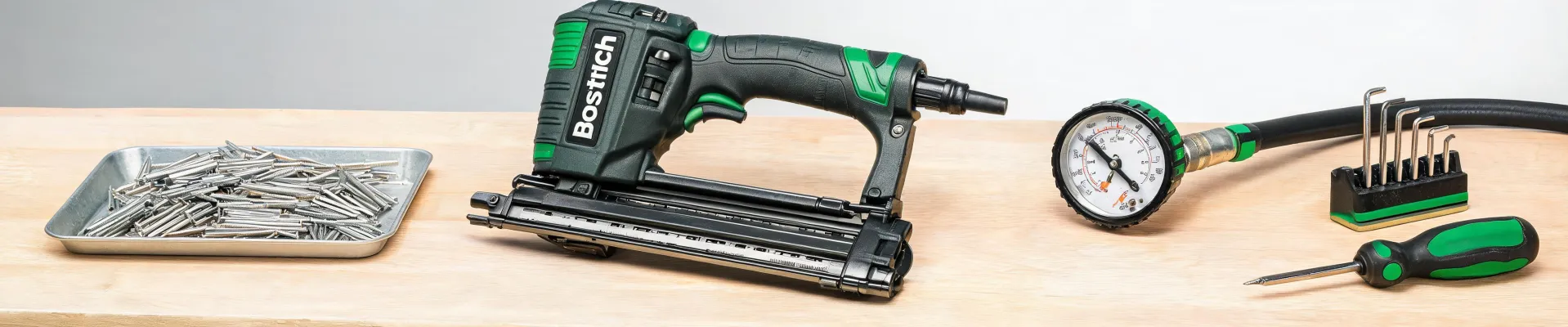
Last March I was standing in our receiving bay with a pair of digital calipers in one hand and a printout from the Freud tools website in the other. We'd just taken delivery of tooling for a custom white oak millwork job: 48 solid carbide flush trim router bits, 10 bolt cutters for cutting the steel banding on our lumber bundles, and a rotary drill hammer we needed for anchor holes in the new finishing room floor.
On paper, the job was routine. Trim the face frames flush, prep the floor, move on. We've done that kind of work hundreds of times. So when the freight showed up on a Tuesday morning, I wasn't expecting to spend the next three hours on the phone.
The bits were the first thing I checked. Not because I'm paranoid—because the packaging looked different from the last batch we'd ordered. The sleeve was shorter, the label font was smaller, and the part number had an extra suffix I didn't recognize. I pulled one bit out, measured the bearing with the calipers, and wrote the number down.
Then I opened the Freud product page for that exact SKU and compared.
The number that didn't sit right
My caliper read 0.494" on the bearing OD. The label on the box said 0.500" ±0.010". The website said 0.500" ±0.005". Three numbers, none of them quite agreeing.
Here's where I almost moved on. The bit was probably fine. A 0.006" gap on a bearing isn't going to ruin a face frame. But the label was wrong, and the website was tighter than the label, and I couldn't tell which one actually applied to the tool in my hand. So I called the distributor instead of signing the sheet.
Long story short: they'd repackaged a mixed lot. The bits themselves were within Freud's factory tolerance—tighter than the website spec, actually—but the labels on our boxes had been printed from an old spec sheet. The documentation attached to our order was essentially fiction.
That's the part that bothered me. Not the measurement. The paperwork.
Never expected the problem to be the label rather than the tool. Turns out the bit was fine and the box was lying.
The 10 bolt cutters and the drill hammer
While I had the receiving bay set up, I went through the rest of the order. The drill hammer checked out—impact energy matched what we needed for our anchor pull tests, though I had to dig through three different pages on the manufacturer's site to find the number I wanted. (Should mention: that spec isn't on the box. You have to look it up.)
The 10 bolt cutters were a different story. Two of them had burrs on the cutting edges. Not enough to fail immediately, but enough that they'd chew through the steel banding instead of cutting it clean. I flagged those for return. The other eight are still in service.
One of the younger guys on the floor asked me, half-joking, when the first cordless drill came out. I want to say 1961, Black & Decker, though I might be misremembering. He laughed and said the drill we'd just unboxed looked like it came from a different century. Fair point. The standard moves. What passed inspection in 1961 wouldn't pass today, and what passes today won't pass in another decade.
That's why I stopped trusting the box. The box reflects whatever spec sheet was current the day the label got printed. The tool in your hand doesn't care about the label.
What the flush trim bit check actually taught me
If you're specifying a freud solid carbide flush trim router bit for a job and you only look at the SKU and the price, you're leaving the two specs that actually matter—bearing OD and runout—to whoever packed the box. Ask for both. Put them on the PO. It's a five-minute email that saves a week of rework.
For the drill hammer, the spec I needed wasn't in the manual. It was buried in a support PDF on the manufacturer's site. If you're buying one for anchor work, pull the impact energy number before the tool shows up, not after.
For the bolt cutters, the check is simple: run a thumbnail along the cutting edge. If it catches, flag it. Burrs don't show up in a photo and they don't show up in a spec sheet. They show up on the first cut.
What I do differently now
We rejected the two bolt cutters and sent the router bits back for relabeling. The distributor ate the freight. Our production schedule slipped four days—not catastrophic, but not free either.
I don't have hard data on how often this happens across the industry. What I can say is that in our shop, roughly one in five first deliveries has some kind of documentation or spec mismatch. Most are minor. Some aren't. I wish I'd tracked the exact rate from the start, but the anecdotal pattern has been consistent enough that we built a process around it.
Before this, our receiving process was basically: does it look right, and does it count right. That's it. Now we've got a one-page checklist:
- Caliper check on the first and last unit of every cutting-tool batch.
- Website spec pull for any SKU we haven't ordered in six months.
- Any label discrepancy—no matter how small—gets a phone call before the box is opened on the floor.
I'd rather spend twenty minutes on a receiving check than four days explaining to a customer why their cabinets are late.
The bits were fine. The bolt cutters weren't. The label told me nothing useful either way.
That's the lesson: verify the tool, not the box.

Leave a Reply