The Short Answer
If you're building out a tool box for professional work, the first decision isn't "which brand"—it's "which battery platform and air system." Everything else follows from that. Pick a platform with broad accessory and replacement-part availability, then let total cost of ownership—not sticker price—decide the rest.
I've watched crews piece together mixed-brand kits to save a few hundred bucks upfront. Six months later they're carrying three chargers to the job site and paying overnight shipping on a discontinued battery. That's not saving money. That's renting convenience at a terrible rate.
Why I Care About This More Than I Should
In my role coordinating tool and equipment procurement for a mid-size contracting outfit, I've handled over 200 tool purchases and replacements in the past six years. Some were planned upgrades. Plenty were emergency replacements because a cheaper tool failed mid-job.
The pattern is consistent enough that we now calculate TCO before any tool purchase over $150. It's not glamorous work. But the spreadsheet doesn't lie.
The Core System: What Actually Earns Its Place
Every professional tool box needs a cordless drill, an impact driver, a circular saw, and a reciprocating saw. If you're doing finish work or remodeling, add a Porter-Cable cordless jigsaw to that core list earlier than you think.
Here's why: a jigsaw is the tool you reach for when nothing else fits—cutting a pipe access hole in an installed cabinet, trimming door casings in place, notching deck boards around a post. The cut quality matters because you're usually working on something visible. A wobbling base plate or a blade that drifts off-line turns a 10-minute task into a 45-minute patch job.
I've tested enough budget jigsaws to know the difference isn't in the spec sheet. It's in the base plate rigidity and the blade guidance. Porter-Cable's cordless jigsaw holds a line better than most sub-$100 units I've used because the shoe doesn't flex under pressure. That's a small engineering detail with outsized consequences on finish work.
Hammer Drills: The Honest Take
Whether you're looking at a platform like the 18V ONE+ 1/2" hammer drill P214 or Porter-Cable's 20V hammer drill options, the decision framework is the same: match the tool to the actual masonry work you do, not the worst-case scenario you imagine.
If you drill into brick or block once a month, a hammer drill on a cordless platform is fine. If you're anchoring into poured concrete weekly, you need a rotary hammer. No hammer drill—regardless of brand or voltage—will perform like a dedicated rotary hammer on 4,000+ PSI concrete. I've watched people burn through two hammer drills trying to avoid buying a rotary hammer. That's a $400 mistake on a $300 problem.
The Pneumatic Side: Where People Get Burned
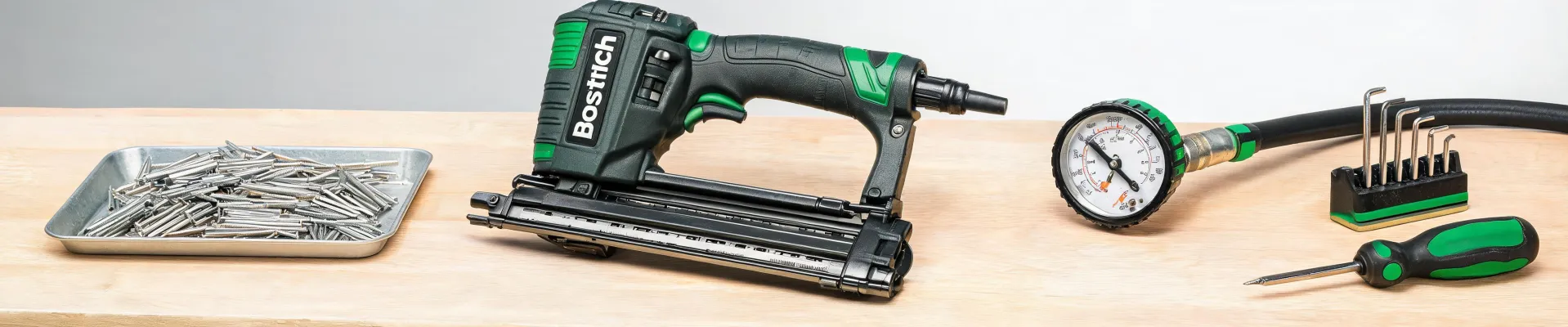
A Porter-Cable pneumatic staple gun is a genuinely useful tool for upholstery, insulation, housewrap, and light trim work. But the stapler is only half the system. The compressor and the maintenance schedule are where TCO lives.
Cheap compressors lose pressure during sustained nailing or stapling. When pressure drops, staples set at inconsistent depths. On insulation or housewrap, that means rework. On furniture, it means visible surface damage. We tracked this one quarter: crews using undersized compressors reported roughly 3x more rework incidents than crews with properly sized units.
And here's the part nobody mentions in the product listing: pneumatic tools need seal maintenance. O-rings and seals wear out quietly. The tool still fires, but performance degrades. It's the same principle as knowing how to check wear ring clearance in a centrifugal pump—you inspect the wear components on a schedule because failure is silent until it's catastrophic. For pneumatic staplers and nailers, that means checking O-rings every 200-300 hours of use, not waiting for a misfire that ruins a finished surface.
The Part That Surprised Me
I used to think buying the most capable tool in each category was the safe move. Then I looked at our actual usage data across 200+ purchases. Specialty tools—rotary hammers, high-capacity compressors, oscillating multi-tools—sat unused for weeks at a time. Meanwhile, the mid-range drill and impact driver got hammered daily.
What I mean is: spending $300 on a drill you use every day makes more sense than spending $300 on a specialty tool you use twice a quarter. The expensive tool that sits in the truck is not an investment. It's a subscription you're paying for in depreciation.
Our purchasing policy now caps specialty tool spend at 20% of any single toolbox build. That number isn't sacred—it's just what worked for our mix of work.
Where This Advice Breaks Down
If you're outfitting a crew of five or more, the economics shift. Shared tools get used more frequently, which changes the TCO math in favor of higher-tier equipment. Buying the premium model makes sense when it's running eight hours a day, five days a week. It doesn't when it's sitting on a shelf.
Also, if you're on a fixed-price contract with a tight margin, sometimes the budget tool genuinely is the right call—as long as you price in the replacement cost and downtime. The mistake isn't buying cheap. It's buying cheap and pretending it won't cost you later.
One more caveat: I work primarily in remodeling and light commercial. If your work is industrial or heavy civil, my experience with these tool categories may not map cleanly onto yours. Check with someone who runs your specific mix of jobs.

Leave a Reply