The slip check valve started leaking at 2 a.m. on a Tuesday in January.
Slow drip at first. Then, over about a week, it went from 90 psi to 40 psi overnight. Our maintenance lead—27 years on the floor—summed it up in one text: "Compressor's down. Want me to look at another brand?"
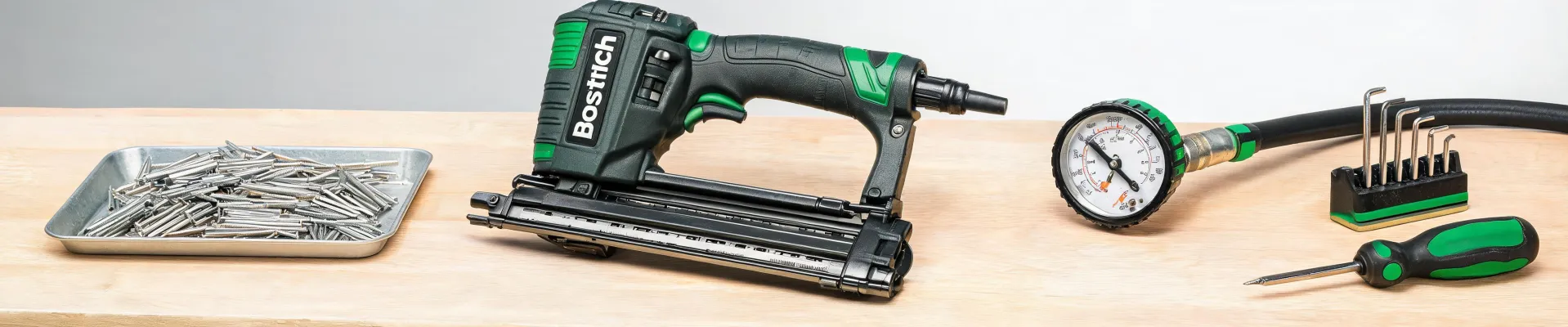
The compressor was three months old. A Bostitch 2 HP air compressor. Part of an $8,400 order that also included a Bostitch cordless framing nailer, a 163cc pressure washer, and a handful of odds and ends that cost less than the shipping label on the compressor.
I signed off on that order. I'm the quality and brand compliance manager—I review roughly 200+ items a quarter before they reach our sites. By Q1 2024, I'd rejected about 15% of first deliveries on various grounds: spec drift, wrong labeling, non-compliant packaging. This is basically what I do.
So when the pressure started dropping, I went looking for someone to blame. I just didn't expect it to be us.
What actually happened
Here's the context. Back in October 2023, our maintenance team submitted a tool request. Three sites, 14 technicians. Their old nailers were jamming. Their compressors were wheezing. They needed new gear.
I reviewed the request. Prices were reasonable. The spec sheet checked out. I approved it.
Six weeks later, three things in that order went sideways:
- The 30-0021 2" slip check valve on the Bostitch 2 HP air compressor started leaking
- The 163cc pressure washer began acting up in ways I'll get to in a minute
- Nobody in our warehouse knew what size hex key fits a faucet handle—our technicians said they'd been guessing every time
Three different problems. Two different vendors. One common thread.
The valve wasn't the problem
I pulled the installation records. Talked to every technician who'd touched the compressor. Eventually got the story from a subcontractor's foreman.
The piping job was rushed. The 30-0021 slip check valve on that compressor had been installed upstream of the moisture trap. Condensate was backing into the valve seat. It had been holding hydrostatic pressure it was never designed to take.
Not a valve defect. An installation sequence issue. We re-piped it properly—two days of labor, about $180 in parts—and it never leaked again.
And here's the thing that sticks with me: the Bostitch system itself was fine. The cordless framing nailer ran smooth, day in, day out. That 2 HP compressor we nearly replaced held pressure through peak season without a hiccup. We almost blamed the tools for something we got wrong on our end.
Then there was the pressure washer
The 163cc pressure washer came from a different supplier. I won't name them because the problem wasn't the brand—it was the category.
They sold it as an "all-in-one" machine. Pressure washing, light sanding, and what the spec sheet called "general pump duty." I should have caught that phrasing. "General" is doing a lot of work in that sentence.
Three months in, the pressure was inconsistent. The spray gun wobbled. Startup took over 20 seconds. One of our technicians tried it on a Ford Transit and stopped after two minutes. His exact words: "I'd get this cleaner with a garden hose."
That machine is now sitting on a shelf in our warehouse, unoiled and unmissed.
Meanwhile, the Bostitch 2 HP air compressor is still running. The cordless framing nailer is still driving nails. And the hex key for faucet handles—turns out a standard 5/32" fits most faucet handles with set screws. Our maintenance lead laughed when we figured that out. "Three years I've been guessing," he said.
What I changed
Honestly, I don't have hard data on whether specialist tools always outperform generalist ones. I wish I did. What I can tell you is that after that $8,400 order, I changed how I review tool requests.
Now, when a request comes in, I ask one question: what is this tool specifically for?
If the answer is three or more jobs, I get skeptical. Not because multi-purpose tools are always bad—but because "does everything" usually translates to "optimized for nothing."
Last year we re-evaluated our equipment purchases with that lens. We cut three multi-purpose tools and replaced them with specialists. And—this is the part that surprised me—the total didn't go up. It actually went down a little.
One more change: every fluid equipment contract now specifies installation sequence. Every single one. I'm not letting another team blame a valve for a piping problem.
The vendor who says "that's not our strength—here's who does it better" earns my trust for everything else. That's not a weakness. That's a signal.
My first instinct was to blame the brand. The maintenance team wanted to blame procurement. Turns out none of us was right. We were just cutting a corner and calling it efficiency.
So, when someone hands me a spec sheet for a tool that claims to do five jobs, I've learned to trust it less, not more.
That's what the $8,400 taught me.
Leave a Reply