When a maintenance line is down and the restart deadline is 36 hours away, the cheapest quote is usually the most expensive decision. In emergency tooling and industrial supply, you're not buying speed. You're buying certainty—confirmed stock, compatible parts, and a delivery window that actually holds. That distinction matters more than most procurement teams admit.
I'm a maintenance dispatch lead at an industrial contractor. I've handled 300+ rush orders in 12 years, including same-day turnarounds for plant shutdown and packaging line clients. I've made the cheap call. I've also paid the rush fee. The second option has cost us less.
Certainty Is the Product, Not the Freight
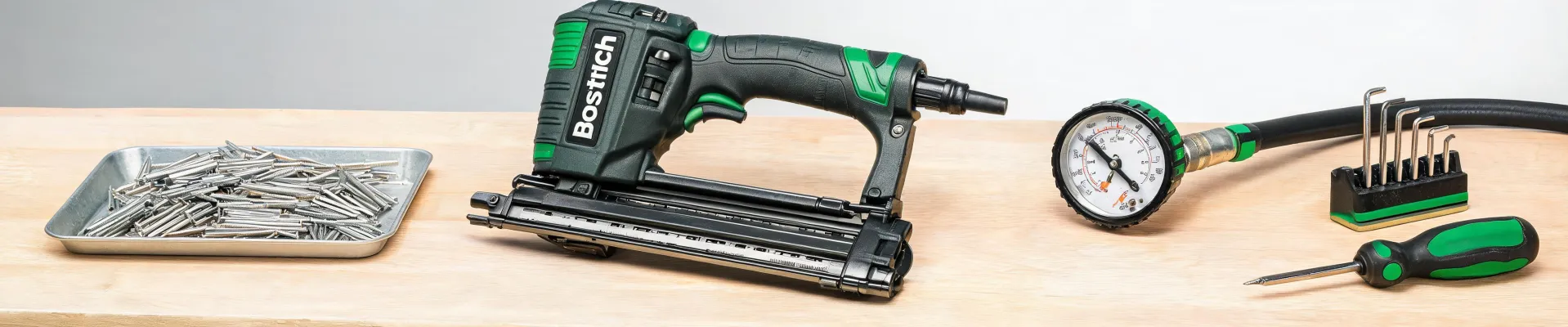
In March 2024, a packaging client called on a Tuesday at 6:40 a.m. Their line was down, and they needed a restart by Wednesday evening. Normal turnaround for the parts and tools they wanted was three to five days. We had 36 hours. The order included a Bostitch industrial stapler for carton assembly, a Bostitch 6 gallon air compressor for pneumatic tools, a cordless impact wrench for changeover bolts, a 247 piece mechanics tool set for the maintenance techs, and a wafer type butterfly valve to isolate a compressed air branch.
We first tried a discount supplier. They promised everything by Wednesday noon. Not ideal, but workable. Then the details fell apart. The compressor had a slow recovery time for the nailers. The stapler arrived without the right fastener sample. The valve was the wrong flange thickness. We ended up paying $400 extra in rush fees on top of a $3,800 base order to source from a local industrial distributor that had confirmed stock. We delivered by 4:15 p.m. Wednesday. The client avoided a $15,000 penalty clause and kept a $42,000 production run on schedule.
When I compared the two orders side by side—same spec sheet, different supply chain—I finally understood why certainty is a line item. It's not glamorous. It's the difference between a controlled restart and a scramble.
The Math I Run Before I Pay a Rush Fee
I don't approve rush fees because I like the drama. I approve them when the math says the alternative is worse. On that March job, the client's line downtime was costing them roughly $8,000 per hour. A four-hour delay would have cost $32,000. The rush fee was $400. Even if we'd paid $1,200, the math still favors the confirmed delivery. That's the point. You're not paying for speed alone. You're paying to remove the most expensive variable: uncertainty.
People think rush orders cost more because vendors gouge. Actually, rush orders cost more because they disrupt planned workflows and require reserved inventory. The cheap option often shifts risk to you. That's the causation reversal most buyers miss. You save $200 on the invoice and lose $2,000 in labor waiting for a truck that never had the item.
The Hidden Cost of Cheap Emergency Tools
Take a Bostitch 6 gallon air compressor review. In a normal buying cycle, you might scan tank size, price, and noise. In an emergency, I care about CFM at 90 psi, recovery time, duty cycle, and whether it can run the nailers and staplers on site. A Bostitch industrial stapler isn't a commodity when a line is down. It's uptime. A cordless impact wrench isn't just torque numbers. It's battery platform, socket retention, and whether the tech can use it one-handed on a ladder. A 247 piece mechanics tool set isn't about having 247 pieces. It's about not losing an hour because the 10 mm socket is missing at 2 a.m.
FTC advertising guidelines require claims to be truthful and substantiated (ftc.gov). That's why I ignore any compressor review that doesn't list CFM at 90 psi, duty cycle, and recovery time. I also ignore tool set listings that show a photo of 247 pieces but don't list the drive sizes, ratchet count, or warranty terms. In emergency work, vague specs are a delay waiting to happen.
Valves, Air Systems, and the Part Nobody Wants to Talk About
What is wafer type butterfly valve? In plain terms, it's a compact valve that fits between two pipe flanges. The valve body is thin, like a wafer, and the flange bolts pass through or around it. A disc rotates on a shaft to stop or regulate flow. You'll see it in compressed air, water, and process lines because it's lighter and takes less space than a full lug-style or flanged butterfly valve. But it needs the correct flange standard, gasket, and alignment. In an emergency air system repair, the wrong valve means a leak, a delay, or a safety risk.
If you're isolating a compressor line to swap a Bostitch 6 gallon air compressor or repair a pneumatic stapler, the wafer valve isn't glamorous. It's the difference between a controlled shutdown and a scramble. OSHA notes that compressed air used for cleaning must be reduced to less than 30 psi (osha.gov). That's the kind of detail that separates a safe repair from a costly incident. Verify current regulations and local codes before working on compressed air systems.
What I'd Do Differently—and What I Still Won't Do
You might be thinking: rush fees are just a panic tax. Fair. If the job can wait, let it wait. I'm not saying every order deserves overnight freight. I'm saying emergencies are the wrong time to optimize for the lowest invoice. The most frustrating part of emergency procurement is that the same issues recur despite clear communication. You'd think written specs would prevent misunderstandings, but interpretation varies wildly. After the third late delivery from the same discount vendor, I was ready to stop using them entirely. What finally helped was building a 48-hour buffer into shutdown plans and pre-verifying alternates for critical parts.
Never expected the budget vendor to outperform a premium one on planned orders. Turns out they sometimes did. The surprise wasn't price. It was how much hidden value came with confirmed stock and compatibility checks on emergency orders—support, will-call pickup, and a human who answers the phone. That's what you're paying for when you pay the premium.
Our policy now: for any shutdown-critical order, we verify stock, flange standard, air demand, battery platform, and delivery window before payment. If the vendor can't confirm all five, we don't book it. That's it. A lesson learned the hard way.
Pay for the Window, Not the Panic
In emergency tooling, time certainty is worth a premium. Not because rush is fun. Because missing a deadline costs more. Buy the confirmed part. Pay for the window. Keep the line moving. If that means a Bostitch industrial stapler, a Bostitch 6 gallon air compressor, a cordless impact wrench, a 247 piece mechanics tool set, and a wafer type butterfly valve all arrive from one verified source, that isn't overpaying. That's risk control.
Rush fees and base costs here are from our March 2024 job; verify current rates. Product availability, compatibility, and regulations change. Check official sources before you buy for a live job.

Leave a Reply