-
The question sounds simple. That's the problem.
-
The number on the box that's selling you, and the number that actually works
-
The part of the purchase nobody researches
-
The bundle trap, and what a Costco lopper and pruner set taught me about nail guns
-
What getting it wrong actually costs
-
A 20-minute filter before you buy anything
The question sounds simple. That's the problem.
Every spring I get the same text from someone on a crew: what nail gun do I need for framing? It usually shows up late at night after a supply run, or at 5:40 in the morning when the truck's loaded and someone realizes the framing nailer is in the other truck.
I've been running punch lists and repair crews for a general contractor for 11 years. A big part of my job is triage. I show up, figure out what's actually broken or missing, and get the job closed out before the client does their walkthrough. That means I've made tool decisions under time pressure more times than I'd like to count, including a few I'd take back.
When I first started buying my own tools instead of pulling from the shop, I assumed this question was a spec-matching exercise. Right angle, right gauge, right head type. Buy it, move on. I did exactly that in 2019 for a deck rebuild and it worked out fine, which is the worst thing that can happen to a bad buying habit. It took three more years and one very bad sheathing day before I understood what I'd actually been getting wrong.
The number on the box that's selling you, and the number that actually works
Look at any air compressor listing. The biggest number is PSI. A 6-gallon, 150 PSI pancake unit catches your eye because 150 sounds like a lot, and next to a 120 PSI model it looks stronger.
PSI is tank pressure. It tells you how hard the compressor can push, not how fast it can refill. What actually drives a nailer is CFM at 90 PSI (cubic feet per minute of air the compressor can deliver while you're pulling the trigger), and that number lives in the spec sheet in much smaller type.
For context, and check the label on the machine in front of you because these vary by model: a 6-gallon, 150 PSI pancake compressor usually lands somewhere around 2.5 to 2.7 SCFM at 90 PSI. A framing nailer run at any real production pace is going to want more air than that, roughly 2 to 5 CFM depending on the model. So the compressor can absolutely fire a framing nailer. What it can't do is keep up with you if you're bump-firing sheathing all afternoon.
You find that out in the worst possible way. The compressor runs constantly, recovery time between shots stretches out, and you end up standing there holding a nailer against a stud waiting for a tank to catch up. I watched a guy lose almost an hour on a two-hour wall because of this, and he blamed the nailer the entire time.
So here's the first deep layer: you're not choosing a nail gun. You're choosing an air system. Nailer, compressor, hose diameter, fittings, and how long your run is all decide whether the tool works. Buying them separately, which is how nearly everyone buys them, means you're picking pieces of a system without knowing what the system needs.
The part of the purchase nobody researches
The nailer shows up. Now what?
Fasteners, mostly. And this is where the framing question gets real. Framing nailers are built around a collation angle (21-degree or 30-34 degree, roughly) and whether they take full round head or clipped head nails. Some inspectors and some jurisdictions won't accept clipped head nails in certain structural applications, so before you buy anything, find out what your local code actually says. That's not my area. I'm not a code official, so I'd call your inspector and ask instead of trusting a forum thread.
Then there's availability. If the only yard within 40 minutes of your job stocks one collation style and your nailer takes the other one, you've built a tool that works everywhere except where you work.
Collation material matters too. Paper-tape strips fall apart in humid weather. Plastic strips hold up better in the rain but leave debris behind. If you're doing exterior work in a wet climate, that's a real factor, not a footnote.
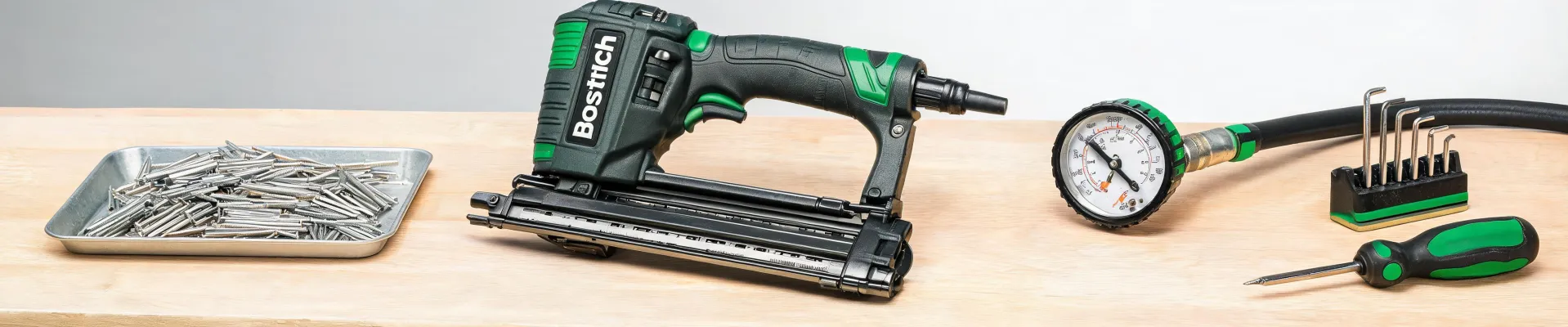
Then there's the small stuff nobody puts in a review. Depth adjustment. Jam clearing. If your nailer jams 18 feet up on a ladder, the difference between a frustrating five minutes and a forty-minute round trip down and back up is whether you've got a stubby screwdriver in your pouch. That's the whole thing. A stubby screwdriver set (the kind that shows up as a Bostitch 85071 in my bag, and honestly any compact set does the job) is the least glamorous tool I buy and the first one I'd replace if it walked off a site.
Which brings up the other half of the cost conversation.
I don't have hard data on repair rates across brands, so I won't pretend to. What I can tell you from running the same tools for years is that the ones that stay in the truck are the ones I can get parts for. O-rings, bumpers, triggers, a rebuild kit. Bostitch has kept parts and service support for their pneumatic line in a way that matters to me, including their staplers. I keep a Bostitch pneumatic stapler on the truck for insulation and underlayment, and the reason is less about the stapler and more about the fact that I can fix it instead of replacing it.
A $199 tool you can repair for $12 is cheaper over five years than a $99 tool you throw away every spring. That's not a slogan. It's arithmetic.
The bundle trap, and what a Costco lopper and pruner set taught me about nail guns
Walk through the tool aisle at Costco in April and you'll see a lopper and pruner set. Three pieces, nice display, a price that makes the per-piece math look like a no-brainer. A lot of people buy it.
They use one piece. Maybe two. The third one lives in the garage for six years. The bundle didn't lower the price, it lowered the price per piece while raising the price per piece-you-actually-use. That trick works on all of us.
Tool combos run the same play. A nail gun combo with three nailers sounds like a system. But if you frame once a year and trim every week, that combo is mostly storage space. The right question isn't how many tools you get. It's how many of them you'll actually pull out of the case in the next 18 months.
I've bought combos I didn't need. Twice. The second one was a deal good enough that I genuinely thought the math worked. It didn't. I would have been better off with the single tool I needed and $120 in fasteners.
What getting it wrong actually costs
Here's the part that never makes it into a review. The cost of a bad tool decision isn't the return shipping. It's the day.
In 2023 we were sheathing a garage addition on a compressed schedule. The compressor on site was too small for the nailer we were running. Nothing catastrophically failed. The compressor just couldn't recover fast enough, so the whole crew ran at maybe 60% of what the day should have produced. We lost most of a day on a job where the day was already the deliverable. Nobody got hurt. We just didn't finish.
Our shop rule since then, written on the inside of the trailer door: if a tool can't be back in service within 48 hours, it doesn't earn a spot in the truck.
Add it up sometime. The unit price is the visible number. The invisible ones are air supply, fasteners, downtime, rework from a poor drive or a bad angle, and the replacement cost when a tool with no parts support dies on you. The lowest quote from the cheapest source can easily be the most expensive system you own.
People call this total cost of ownership, which sounds like a finance term. It's not. It's a truck idea. The $40 compressor that costs you half a day of production is a $400 compressor.
A 20-minute filter before you buy anything
When I'm triaging a rush tool purchase, this is the sequence, and the order matters:
- Start with the job, not the tool. Write down what you'll actually be doing over the next 18 months, in hours per week. Framing 4 hours a week and trim 12 is a different system than the reverse.
- Check CFM at 90 PSI, not PSI. Match it to the air demand of the nailer at your real pace, then leave headroom. If you're right at the edge of the spec, you're already behind.
- Confirm fastener availability locally. Angle, head type, collation. Call the yard instead of assuming.
- Ask what parts cost and how fast they arrive. If the answer is "you'd send it in," that's a red flag for anything you touch daily.
- Price the first year of consumables. Fasteners, oil, fittings, a rebuild kit. That's your real ballpark number.
- Then look at the unit price. Last, not first.
Does that take longer? Maybe 20 minutes. Twenty minutes beats finding out on a Tuesday morning, 18 feet up a ladder, that the air can't keep up.
Bottom line: the framing nailer you need isn't a product. It's the air system around it and the supply chain behind it. Buy the system, budget for the parts, and count the small accessories that keep you from climbing down. The tool still in your truck in five years is almost never the one that looked best on the spec sheet.

Leave a Reply