-
What should I check before buying Stanley Bostitch air compressor parts?
-
Is the Bostitch MIIIFS pneumatic floor stapler worth it for a small crew?
-
What’s actually useful in a 280 piece tool set—and what’s filler?
-
Metric wrench set: which sizes do techs actually use?
-
How do you program a Z-Wave door lock?
-
Where do hidden costs show up in tool and compressor purchases?
-
Should we standardize on Bostitch for fastening and compressors?
-
What’s the one question people forget to ask?
I’m a procurement manager at a 42-person specialty contracting company. I’ve managed our tool and consumables budget—about $310,000 annually—for seven years, negotiated with 60+ vendors, and logged every order in our cost tracking system. This isn’t a catalog. It’s the stuff I wish someone had told me before I approved the PO. Here are the questions that come up most.
What should I check before buying Stanley Bostitch air compressor parts?
First, stop shopping by model name alone. Pull the plate off the compressor and write down the model number, serial number, and tank size. Then get the exploded parts diagram. Bostitch diagrams usually give you an item number and a part number; those aren’t always the same thing. I’ve watched a well-meaning tech order a Bostitch unloader valve from a photo and get the wrong thread size—$180 part, $1,400 in crew downtime while we waited on the right one.
Second, check the air side, not just the part. If you’re replacing a regulator, filter, or drain valve, verify CFM, pressure rating, and fitting type. Don’t assume cross-brand compatibility. I can only speak to our shop’s mix of Bostitch and other compressors, but every fitting we’ve had to return was because someone skipped that step.
"Compressed air shall not be used for cleaning purposes except where reduced to less than 30 p.s.i." — OSHA 29 CFR 1910.242(b)
Bottom line: the part is cheap; the wrong part is expensive.
Is the Bostitch MIIIFS pneumatic floor stapler worth it for a small crew?
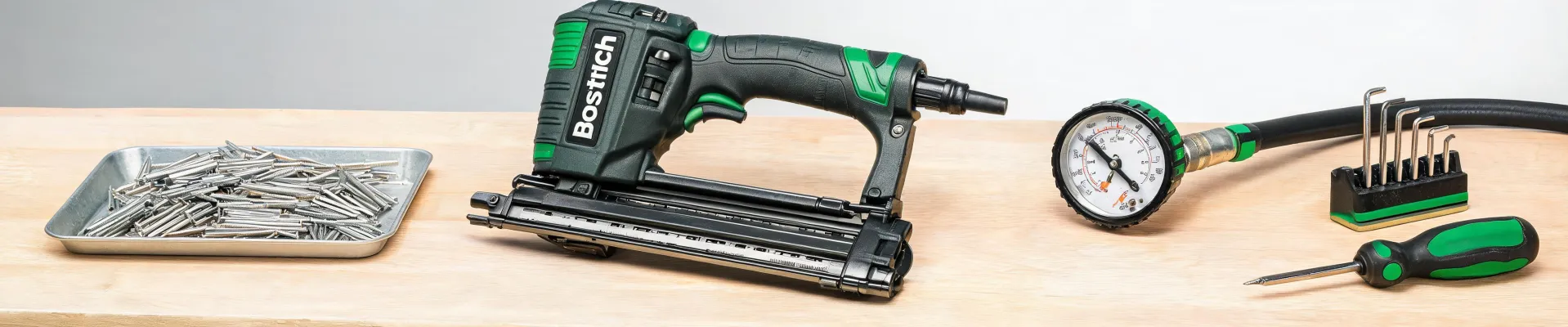
Depends on volume. The Bostitch MIIIFS pneumatic floor stapler is a specialized tool for hardwood flooring, so it’s a no-brainer if you’re installing floors most weeks. If you do one small job a quarter, rent. We ran the math after renting one 11 times in 2022. Once we hit about 1,800 square feet a month—maybe 1,700, I’d have to check—buying made sense, even after factoring maintenance, staples, and air supply.
Check your compressor first. A floor stapler can demand more CFM than a trim nailer, and a small pancake compressor won’t keep up. That’s not a tool problem—that’s an air supply problem. We had to upgrade a hose and add a dedicated regulator because the pressure dropped at the end of a long run.
This worked for us, but our situation was steady residential work with a two-person flooring crew. Your mileage may vary if you’re doing occasional repair jobs or working in tight occupied spaces.
What’s actually useful in a 280 piece tool set—and what’s filler?
It’s tempting to think “280 pieces” means 280 tools. But a 280 piece tool set usually counts every socket, bit, hex key, and adapter as a piece. The real question is whether the set covers the sizes your techs reach for daily. I look for a solid ratchet, common metric and SAE sockets, extensions, and a case that doesn’t dump everything when you open it.
The “more pieces is better” advice ignores duplicates and skipped sizes. A 280-piece set can still be missing the one 10mm socket that walks off every month. We buy a decent set for the truck, then supplement with individual sockets and a separate metric wrench set for the shop.
Honestly, the case matters more than people admit. If it’s disorganized, techs don’t use it. If they don’t use it, you bought drawer filler.
Metric wrench set: which sizes do techs actually use?
For general maintenance, start with 8, 10, 12, 13, 14, 15, 17, and 19 mm. You’ll use 10, 13, and 15 constantly. Sizes like 16 and 18 show up on some equipment, but I wouldn’t buy a 20-piece metric wrench set just to get them if the quality is bad. A tight-fitting 13 mm combo wrench beats a loose “complete” set every time.
Look for a standard that tells you something about the tool. ASME B107.100 covers combination wrenches, so it’s a useful filter when comparing specs. Also check whether the set is stubby, flex-head, or long-pattern—those are different jobs, not just different prices.
We keep a shop metric wrench set with a foam organizer and a smaller travel set in each service van. The part I hate: replacing a single 10 mm wrench costs almost as much as a cheap set. That’s why we standardize on one or two brands for the shop.
How do you program a Z-Wave door lock?
Short answer: put your Z-Wave hub into inclusion mode, then trigger the lock’s pairing button or enter its programming sequence. If the lock supports SmartStart, scan the DSK QR code instead. If it was previously paired to another hub, run an exclusion first—otherwise inclusion will fail and you’ll blame the lock.
- Install fresh batteries and bring the hub within range.
- Open your hub app and choose “Add device” or “Include.”
- On the lock, press the pairing button or enter the manufacturer’s inclusion code.
- Rename the lock and test lock/unlock from the app.
Important: the keypad programming code for user PINs is separate from Z-Wave pairing. Z-Wave Alliance documentation calls this inclusion/exclusion; your lock manual may call it “learn mode.” Same idea.
Why this belongs in a tool FAQ? Because a Z-Wave lock on the tool crib door is an efficiency play. It gives you audit trails for who opened the cage, and it beats chasing a lost key. Just budget for batteries and a reliable hub—those are the hidden costs.
Where do hidden costs show up in tool and compressor purchases?
In the stuff that doesn’t make the quote: fittings, filters, hoses, staples, nails, batteries, chargers, repair parts, and downtime. I built a cost calculator after getting burned on hidden fees twice. The sticker price is ballpark; the TCO is the real number.
In 2023, I compared two compressor packages for a service truck. One quoted lower. Then I added the correct regulator, dryer, oil, and spare drain valve—about $420 more. The other package included them. That’s a 14% difference hiding in accessories.
I have mixed feelings about cheap tools. On one hand, a low-cost backup can get you through a rush. On the other, if it fails mid-job, the redo costs more than the tool. We now track “cost per completed job,” not just purchase price.
Should we standardize on Bostitch for fastening and compressors?
Standardize for the right reasons, not brand loyalty. Bostitch makes sense if you already run Bostitch nailers and compressors, because shared fittings, parts diagrams, and service knowledge reduce friction. But don’t force it. A cordless platform decision, for example, should be based on battery compatibility, tool lineup, and what your techs already own.
Our policy now requires quotes from three vendors minimum for anything over $2,500. That’s not because one brand wins everything. It’s because the evaluation process surfaces hidden differences: lead times, warranty turnaround, parts availability, and training.
Efficiency is the competitive edge here. Fewer SKUs, fewer adapters, fewer “who ordered this?” moments. That said, I can only speak to our mix of commercial maintenance and light residential work. If you’re in heavy industrial or marine environments, the calculus might be different.
What’s the one question people forget to ask?
Who owns the repair loop? Everyone asks about price and specs. Almost nobody asks who will find the Stanley Bostitch air compressor parts, who keeps the Bostitch MIIIFS pneumatic floor stapler maintained, and who reorders the 10 mm sockets and metric wrench set before a job stalls.
That’s the hidden efficiency tax. If the answer is “whoever notices first,” you’ll pay for it in downtime. We assigned a tool crib owner and a simple min/max spreadsheet. It’s not fancy, but it cut “we need it today” orders by 31% in our shop.
There’s something satisfying about a job that starts with every part and tool already staged. After years of emergency purchases, finally having a system feels like a raise. Not a cash raise—a sanity raise.

Leave a Reply