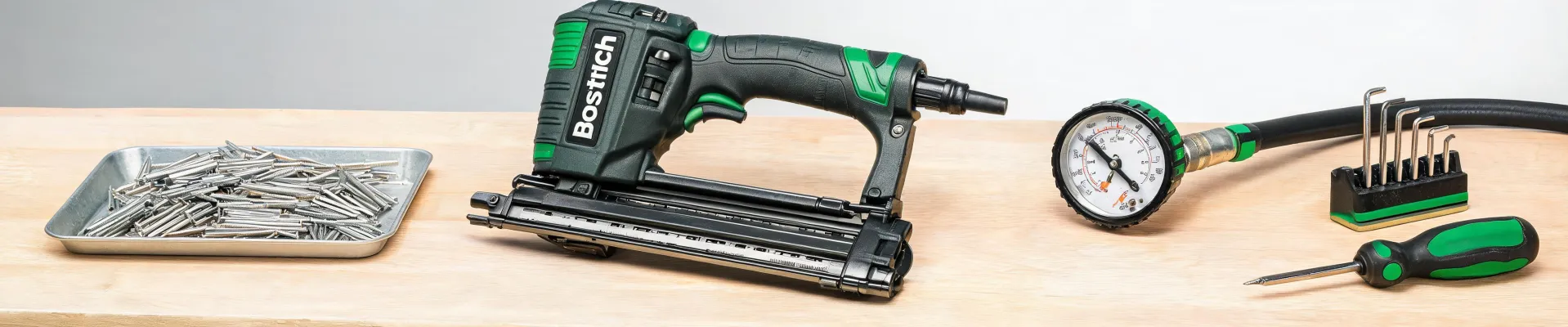
The short answer: it’s usually not the nailer
If you’re asking why won't my nail gun shoot nails, check the air or battery, the fasteners, the magazine, the driver blade/bumper, the trigger/contact trip, and the air line before you send it to repair. In the tool orders I manage, that’s fixed more no-fire complaints than actual broken nailers. A Bostitch F28WW or any other pro-grade nailer can be perfectly fine and still refuse to fire because someone grabbed the wrong collation, the compressor is set wrong, or the contact trip is stuck.
I’m an office administrator for a 180-person construction services company. I manage MRO and tool purchasing—roughly $420,000 annually across 14 vendors—and I report to both operations and finance. I don’t swing a framing nailer every day, but I do own the process when a crew says, “This thing won’t shoot.” That process starts with a five-minute check, not a purchase order.
Why you can trust this checklist
When I took over purchasing in 2020, my default move was to replace anything that looked worn. That got expensive fast. In 2023, a foreman told me his Bostitch F28WW wouldn’t fire. I almost ordered a replacement. Our repair tech asked one question first: “What nails are in it?” The crew had loaded the wrong angle/collation for that model. We cleared the magazine, checked the manual, switched fasteners, and it ran. That one call saved a $680 repair/replacement line item—and made me look like I knew what I was doing (which was mostly luck).
Looking back, I should have built a no-fire checklist the first month I managed tools. At the time, I assumed “nailer won’t shoot” meant “nailer is broken.” The conventional wisdom is that a pro-grade tool either works or it doesn’t. My experience with 300+ tool orders suggests the boring stuff—specs, fasteners, air, batteries—causes more downtime than catastrophic failure.
The 6 checks that solve most no-fire problems
1. Air pressure or battery first
For pneumatic Bostitch nailers, confirm the compressor is running and the regulator is set to the manual’s range for your model and fastener length. Too low and the piston won’t drive; too high can damage the tool and fasteners. For cordless, charge a known-good battery and check the contacts. Don’t assume the battery is fine because the LED blinks (I’ve been fooled by that one).
2. Fasteners: angle, collation, length, and gauge
This is where I see the most avoidable failures. A Bostitch nail gun F28WW, for example, takes a specific fastener type and angle. If someone loads a different collation, the magazine may accept it just enough to jam the feed. Check the manual or the tool’s data plate. If you’re not sure, compare the old nail strip to the new box—not the box label, the actual strip.
3. Magazine and jam clearance
Open the magazine, remove all fasteners, and look for a bent nail, a piece of collation, or debris. A partial jam can feel like a dead trigger. Clear it with the tool disconnected from air or battery. Never point the discharge at yourself or anyone else while clearing.
4. Driver blade and bumper
A worn or chipped driver blade can fail to strike the nail head. A collapsed bumper can shorten the stroke. If you see metal burrs, cracks, or the blade doesn’t retract, stop. That’s a repair part issue, not a field fix—unless you’re trained and have the right parts diagram.
5. Trigger, contact trip, and safety mechanism
Many nailers have a trigger and a contact trip (the nose safety). If the contact trip is stuck, bent, or taped down, the tool may not cycle.
OSHA 1910.243 covers portable powered tools and requires guards and safety devices to remain operational. On a nailer, that includes the trigger and contact trip.Don’t disable them. Fix the mechanism or tag the tool out.
6. Air line, moisture, and lubrication
Water in the line, a kinked hose, or a quick-connect that’s half seated can starve the tool. Drain the compressor tank, check the filter/regulator, and try a different hose if you have one. For lubrication, follow the manual—some Bostitch tools want a few drops of air-tool oil; some sealed units don’t.
Where this fits into MRO buying
The same spec discipline applies beyond nailers. I order chainsaw accessories and gate valve repair parts for our facilities and field crews. A chain that’s close isn’t right. A gate valve repair kit that’s “probably compatible” isn’t right. The cheapest way to avoid a return—or a safety problem—is to verify the model number before you click buy.
It’s tempting to think you can just compare unit prices. But identical-looking parts from different vendors can have different tolerances, materials, or thread pitches. The “always get three quotes” advice ignores the transaction cost of vendor evaluation and the value of a supplier who answers the phone when a crew is down.
What I’d do differently next time
If I could redo my first year managing tool repairs, I’d create a one-page no-fire checklist and tape it inside the tool crib. I’d also keep a small binder with model-specific manuals for the tools we run most—Bostitch F28WW, our framing nailers, and the Bostitch Antivibe hammer kits we issue for punch-list work. The Antivibe hammer isn’t part of the nailer system, but it’s a good example of why model-level details matter: the right tool for the task beats a generic substitute every time.
Five minutes of verification beats five days of correction. That’s not a slogan; it’s the cheapest insurance I’ve found for a purchasing department that gets judged when crews are standing around.
When to stop and send it in
If you’ve checked air/battery, fasteners, magazine, driver blade, trigger/contact trip, and air line—and it still won’t fire—stop. Don’t keep cycling it. You may have a cracked piston, failed seal, damaged cylinder, or an electrical fault in a cordless unit. Those are authorized-service or trained-repair issues. Also, don’t assume every compressor/nailer combo is interchangeable; check the manual for your exact model and fastener. And if your tool is under warranty, opening the sealed housing can void it.
Finally, be honest about the exception: some “no-fire” problems are actually feed problems that only show up at full speed. A magazine spring can be weak enough to fail under recoil but pass a hand-feed test. If you’ve replaced the obvious consumables and the symptom returns, document the model, fastener lot, pressure, and battery, then hand it to a repair tech. Guessing gets expensive.

Leave a Reply