-
Step 1: Separate 'repair part' from 'new tool'
-
Step 2: Capture the exact model and type number
-
Step 3: Verify charger and battery compatibility before ordering
-
Step 4: Confirm whether 'hammer drill' means drill, hammer drill, or rotary hammer
-
Step 5: For roofing nail gun parts, build a 'kill list' of wear items
-
Step 6: Apply the same checklist to non-Bostitch items
-
Step 7: Get the invoice and warranty terms in writing
-
Step 8: Choose certainty for deadline-critical orders
-
Common Mistakes (and How I Avoid Them)
-
Final Note
I’m the office administrator for a 180-person facilities and construction services company. I manage roughly $420,000 in tool, parts, and service orders annually across 11 vendors. I report to both operations and finance.
If your ticket says something like 'Bostitch roofing nail gun parts, Bostitch hammer drill, nail gun battery charger, 2500 PSI pressure washer, and—while you’re at it—who makes the best pruning shears?' you’re in the right place. This is the 8-step checklist I use when a crew needs tools or repair parts fast. It won’t make the brand debate go away. It will keep you from ordering the wrong part twice.
Three things: model number, serial/date code, and a photo of the old part. In that order. Most delays come from skipping one of those.
Step 1: Separate 'repair part' from 'new tool'
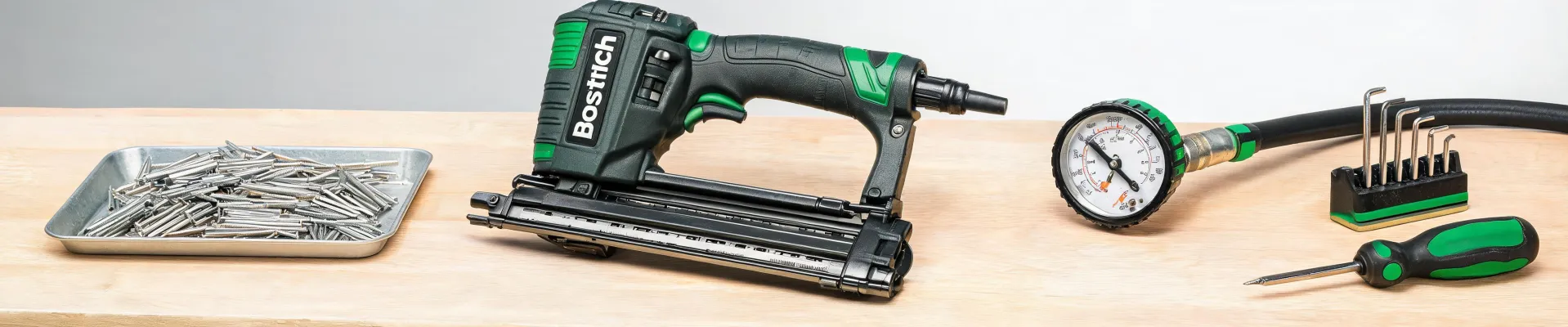
Look, a repair request and a new tool purchase are different workflows. A Bostitch roofing nail gun part—say a driver blade, bumper, O-ring kit, or magazine assembly—must match the exact nailer model and often the type code. A new Bostitch hammer drill or 2500 PSI pressure washer is a capital-ish purchase with different approval rules.
From the outside, it looks like one purchase order. The reality is finance may code them differently, and warranty terms are not the same. Ask: Are we fixing an asset, or replacing it?
Step 2: Capture the exact model and type number
For Bostitch tools, the model number is usually on the tool body or label. Roofing nailers often have a type code too. According to Bostitch’s official parts lookup (bostitch.com; accessed April 2026), parts diagrams are organized by model and type. If you give a vendor only 'Bostitch roofing nail gun,' you’re asking for a guess.
Take a photo of the label. Include the serial/date code. If the label is worn, use the manual or the original invoice. This one step prevents most wrong-part returns.
Step 3: Verify charger and battery compatibility before ordering
The nail gun battery charger is where I see the most expensive 'small' mistake. A charger may look similar and cost less, but compatibility is platform-specific. Check voltage, connector shape, and whether it charges the exact battery model. Don’t trust marketplace titles alone; verify against the manufacturer’s current compatibility chart.
Never expected the cheapest charger to be the one that caused downtime. Turns out charge time and battery compatibility mattered more than unit price. A $49 charger that takes 90 minutes and overheats is not cheaper than a $79 charger that keeps a crew running.
Step 4: Confirm whether 'hammer drill' means drill, hammer drill, or rotary hammer
If someone asks for a Bostitch hammer drill, pause. The search term can pull up cordless drills, hammer drills, and SDS rotary hammers. They are not interchangeable for concrete, masonry, or cabinet work. Check the chuck type, battery platform, and required drilling capacity.
Also decide bare tool vs. kit. If you already have batteries and a charger, a bare tool may be fine. If not, price the kit. In my opinion, the kit is usually the better buy for a crew that shares batteries—unless you’re already standardized on a different platform.
Step 5: For roofing nail gun parts, build a 'kill list' of wear items
Roofing nailers take a beating. Common wear parts include O-rings, bumper, driver blade, feed pawls, magazine springs, and trigger valve components. When a nailer goes down, order the wear kit if available—not just the one broken piece. The next part will fail soon.
Use the parts diagram to confirm item numbers. If your vendor’s site shows a superseded part, verify it replaces the old number. A superseded part is not automatically compatible with every type code.
Step 6: Apply the same checklist to non-Bostitch items
A 2500 PSI pressure washer and pruning shears may show up on the same requisition. That’s fine. The checklist still works. For the pressure washer, confirm PSI, GPM, pump type, nozzle set, hose length, and whether it needs a GFCI cord. For 'who makes the best pruning shears,' don’t turn it into a brand war. Focus on blade steel, replaceable parts, handle geometry, and whether the landscaping crew prefers bypass or anvil style.
To be fair, brand reputation matters. But for procurement, serviceability and parts availability matter more. If the best pruning shears have no replacement blades, they’re not the best for a commercial crew.
Step 7: Get the invoice and warranty terms in writing
We didn’t have a formal approval chain for rush orders. Cost us when an unauthorized rush fee showed up on the invoice. Now I verify invoicing capability before placing any order.
Ask for an itemized quote: part number, description, quantity, unit price, shipping, tax, and lead time. For warranty, confirm whether the part is OEM (original equipment manufacturer), aftermarket, or refurbished. Get the return window in writing.
If the vendor can’t provide a proper invoice, walk away. Cheap parts are not cheap if finance rejects the expense.
Step 8: Choose certainty for deadline-critical orders
In March 2024, we paid $400 extra for rush delivery. The alternative was missing a $15,000 event. That was an easy call.
I have mixed feelings about rush shipping. On one hand, it feels like paying to fix our own planning. On the other, I’ve seen a $90 expedite fee save a $4,000 crew day. In an emergency, 'probably on time' is the biggest risk. Pay for tracking, guaranteed delivery, and a backup source.
'The uncertain cheap option is often more expensive than the certain expensive one.' That’s not a slogan. It’s what happens when a nailer part arrives two days late and a crew sits idle.
Common Mistakes (and How I Avoid Them)
- Ordering by description instead of model/type. 'Bostitch roofing nail gun parts' is a category, not a SKU.
- Assuming charger compatibility. Verify voltage, connector, and battery model.
- Buying the cheapest pressure washer. Check GPM and pump serviceability, not just 2500 PSI.
- Letting the pruning shears question derail the order. Standardize specs and buy replaceable parts.
- No backup vendor. The third time a part was backordered, I finally created a primary + backup list. Should have done it after the first time.
Final Note
Price data and availability change. Verify current parts lists at bostitch.com and confirm charger/battery compatibility with the manufacturer before ordering. For pressure washers and pruning shears, check the specific manufacturer’s manual and warranty. No checklist replaces a two-minute call to the crew that will use the tool.

Leave a Reply