I’m not a tradesperson. I’m the office administrator for a 120-person facilities and construction services company. I manage all tool and MRO ordering—roughly $85,000 annually across 11 vendors—and I report to both operations and finance. When I took over purchasing in 2020, I assumed the cheapest kit was always the smartest buy. I was wrong. Here are the questions I actually get from our maintenance team, our vendors, and my own finance department.
What should an office administrator check before ordering Bostitch tools?
When I first started buying tools, I assumed a nail gun was a nail gun. Three jammed fasteners and one very patient maintenance tech later, I learned that model-specific consumables matter. For Bostitch purchases, I check three things: the exact model number, whether it uses fasteners we already stock, and whether replacement parts are available. Bostitch’s repair and parts support is one reason we keep looking at their platform. In my opinion, quality shows up in the first five minutes of a jobsite visit. If a tech is fighting a tool, the customer notices. Better to pay for the right tool than to explain a sloppy finish later.
What is a pneumatic staple gun Bostitch used for in facilities work?
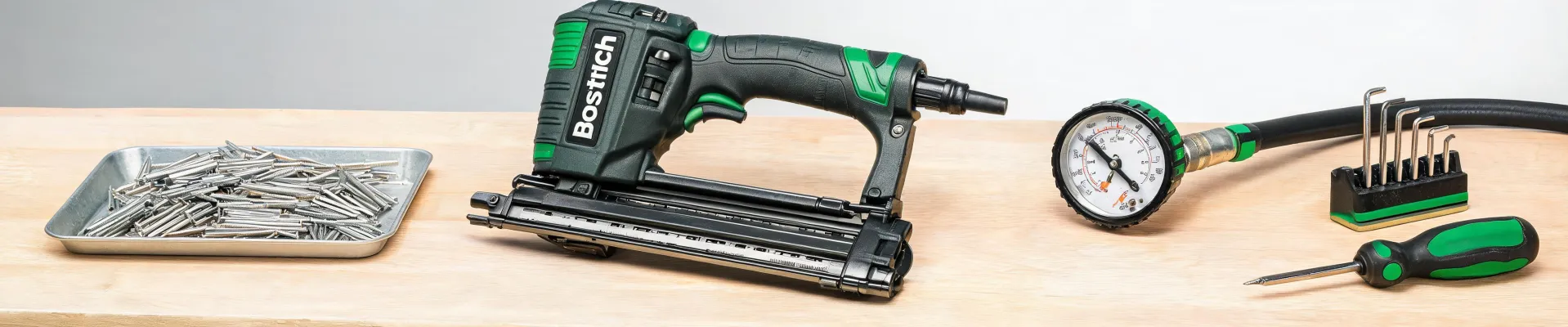
A pneumatic staple gun Bostitch is usually an air-powered tool for high-volume stapling—think insulation, underlayment, upholstery panels, crating, and some packaging work. It is not the same as a manual desk stapler, and it is not automatically compatible with every compressor. I ask our techs for the required PSI and CFM, then match that to the compressor we already own. Per FTC advertising guidance (ftc.gov), performance and compatibility claims should be truthful and substantiated, so I don’t take "it should work" as an answer. I get the manual or spec sheet. Honestly, if the numbers line up, fine. If not, we either rent a compressor or buy the right one.
Where can I find a Bostitch nail gun parts diagram before ordering replacement parts?
Start with the model and serial number on the tool, then look for the official Bostitch parts diagram for that exact model. I keep a PDF in our shared drive because our maintenance techs never have the manual when they need it. The diagram matters because "fits Bostitch nailer" can mean five different generations. Once I have the part number, I verify availability, lead time, and return policy. I also confirm the vendor can send a proper invoice with the PO number. I learned that lesson the hard way: a supplier once gave us a handwritten receipt, finance rejected the expense, and I ate $2,400 from the department budget. Not ideal. Now I verify invoicing before I click order.
Is a 20V MAX impact driver kit worth adding to our tool crib?
For us, yes—if it fits a platform we already support. A 20V MAX impact driver kit is usually a cordless driver, batteries, charger, and case. The spreadsheet might show a cheaper kit, but my gut asks different questions: Do we already have batteries for that platform? Can the team share chargers? Are replacement batteries and triggers available? We once bought a low-cost kit that saved $180 up front. The batteries ran out faster than the crew liked, and downtime ate the savings. To be fair, not every crew needs premium. But if your techs use an impact driver daily, the kit that keeps them moving is usually the better buy.
What size hole saw do I need for #10 x socket hex-drive sheet metal screws?
Short answer: a hole saw is probably the wrong tool for #10 x socket hex-drive sheet metal screws. Those screws need a pilot hole, not a large hole saw cut. For light-gauge sheet metal, many techs start with a 9/64 inch to 5/32 inch pilot bit for a #10 self-tapping screw, then test on scrap because metal thickness changes everything. Don’t hold me to those numbers for every material. If you actually need a hole saw—say for a conduit knockout, pipe, or grommet—choose the saw diameter based on the outside diameter of what you’re installing, not the screw size. The screw is the fastener. The hole saw is for the opening. Mixing them up leads to oversized holes and ugly repairs.
Should we standardize on Bostitch for fastening tools and parts?
I have mixed feelings about standardizing on one brand for everything. On one hand, keeping Bostitch nailers and staplers means fewer fastener SKUs, easier parts diagrams, and techs who know the tools. On the other hand, not every tool needs to match. We standardize on fastening tools and accessories where compatibility matters, then allow other brands for generic hand tools. If you ask me, the real goal is fewer surprises. A standard platform means the customer sees a crew that looks organized and prepared. A mismatched pile of mystery batteries and orphan parts says the opposite. Details like that affect how clients judge our professional image.
How do I avoid invoice and receiving problems when ordering tools and parts?
Three things: confirm the part number, confirm the invoice format, and confirm the return window. In that order. I put the PO number on every order and tell the vendor it must appear on the invoice. For Bostitch nail gun parts, I also ask for the model number in the line description. That sounds basic, but it prevents the "we ordered a piston for the old nailer and got one for the new one" problem. To be fair, vendors are juggling a lot. But if they can’t handle clean documentation, they’re not a good fit for us. Our accounting team saves hours when invoices match POs on the first pass.
What is one thing you wish you had known about tool procurement?
Looking back, I should have built a small spec library before we bought anything. At the time, I was chasing line-item savings and treating every tool request like a one-off. Now I keep model numbers, parts diagrams, battery platforms, and compatible fastener lists in one shared folder. That single change cut our back-and-forth with vendors and reduced wrong orders. If I could redo one decision, I’d spend less time comparing sticker prices and more time asking, "Will this still be supported in three years?" A tool that looks good on the invoice but stalls a crew on site is not a bargain. The client remembers the finished job, not what we saved on the kit.

Leave a Reply