The question I kept getting wrong
In March 2024, one of our foremen sent me a two-line email: "Where can I buy a variable speed angle grinder? Need it Thursday."
I did what any procurement person does under a deadline. Pulled three quotes, picked the cheapest one that could hit Thursday, sent the PO, moved on.
Eighteen months later I went back through our purchasing history looking for a different problem entirely, and found that grinder — and roughly forty decisions like it — sitting at the top of a $61,000 hole. Not the grinder itself. That thing was $113. The hole was everything I never asked before I bought it.
If you're the person who signs off on tool spend, that's the part worth reading. The number eating your budget probably isn't the unit price you're comparing. It's the layer underneath it.
What I thought the problem was
For my first three years running our tool and consumables budget, I ran it like a commodity buyer. Same tool, three vendors, lowest landed cost wins. Straightforward. Defensible. I had a spreadsheet and everything.
In my first year, I made the classic spec error: I assumed "angle grinder" meant the same thing to every vendor on my quote list. It doesn't.
I bought twelve grinders at 22% below what the incumbent quoted us, felt pretty good about it, then spent the next four months trying to figure out why our abrasives spend had jumped and why the fab shop kept sending tools back.
Fixed speed. No dial. Fine for cutting rebar. Bad for stainless, where you're generating heat you don't need and burning through wheels at a rate nobody flagged until the quarterly consumables report came out and my controller asked me a question I couldn't answer.
That was a $600 lesson, plus about three weeks of shop-floor grumbling I still can't put a number on.
Here's the part that took me longer to see: I wasn't buying bad tools. I was buying good tools for the wrong question.
The real problem: a tool is not a SKU, it's a system
This is what changed how I buy. A tool is the visible part. The system around it is where the money actually lives, and I've come to think of it as three layers.
Layer one: the accessory interface
It's tempting to think the tool is the purchase and everything else is a rounding error. But the accessory layer decides whether the tool ever earns its keep.
Take a diamond core drill bit. Same nominal diameter, three different products on the shelf. One is rated for wet cutting only. One is dry-rated but expects intermittent use with cool-down. One is built for a specific RPM window and a specific arbor thread. Put the wrong one on the wrong drill at the wrong speed and you don't get a slow cut — you get a glazed bit, a cooked motor, or both. The bit was the cheap part. The drill wasn't.
Same pattern with a hammer ratchet. The head is what you notice; the torque rating and the handle geometry are what decide whether the operator reaches for it again or leaves it in the truck and grabs a breaker bar. A $40 ratchet that gets used is cheaper than a $22 ratchet that doesn't. That took me an embarrassingly long time to accept, because it isn't a math problem, it's a behavior problem.
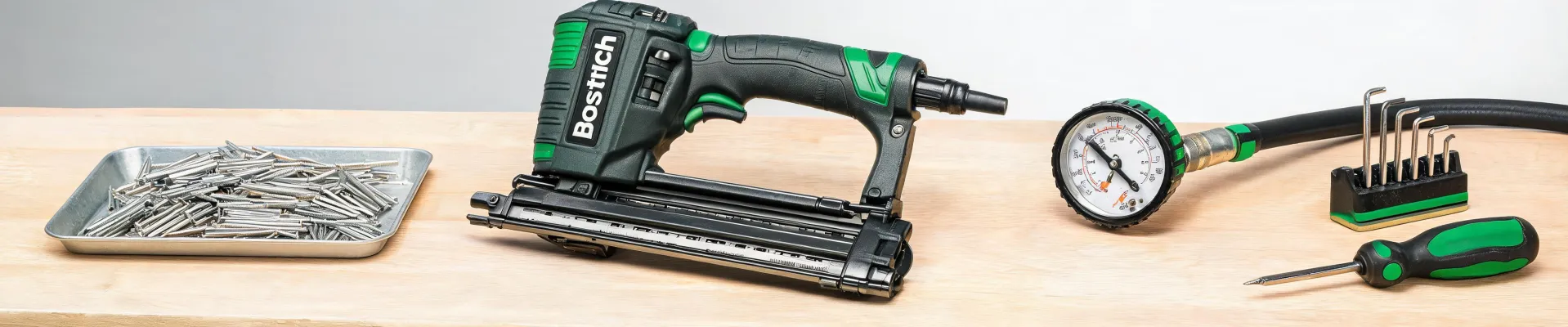
And with nailers it gets sharper. A Bostitch nail gun is not a standalone object. It sits inside a chain: fastener collation, magazine capacity, air supply or battery platform. A Stanley Bostitch cordless framing nailer solves a different problem than a pneumatic framing nailer, and the right answer depends on whether your crews have compressors on site or are working off generators. If you buy the tool before you've mapped that chain, you've bought a paperweight with a warranty card attached.
Layer two: spec words that don't mean what you think
"Variable speed" is the cleanest example I have. To a buyer it sounds like a checkbox. To the person holding the tool, it's two numbers — a low-end RPM that determines whether the thing is usable for finishing work, and a high end that determines whether it has any cutting power at all.
A grinder that runs 2,000 to 11,000 RPM and one that runs 3,000 to 10,000 RPM both say "variable speed" on the box. They are not the same tool, and they don't cost the same, and the price difference was never the point.
This is where the causality gets flipped on people. The assumption is that expensive tools deliver better quality. The reality runs closer to the reverse: tools that perform reliably in a specific application earn the right to cost more, because the cost of the alternative shows up somewhere else in the ledger. Cheap isn't the cause of rework. Unspecified requirements are the cause of rework, and cheap tools are just how that failure gets transmitted to your shop floor.
Layer three: the support tail
The last layer is what happens in month fourteen. Parts availability. Whether a parts diagram actually exists. Whether a replacement trigger assembly is a two-day order or a two-month order that quietly kills a job.
I weight this at roughly 15% of my decision now. That number felt arbitrary when I made it up, and it's been uncomfortably accurate since. If a vendor can't tell me where the parts come from, that's a red flag regardless of what the quote says.
What it actually costs
The most frustrating part of running tool spend: the same failure shows up in four different budget lines and nobody connects them. You see tool purchases, consumables, downtime, and rework as separate problems. It's one problem.
Rough numbers from our own tracking system, for a 60-person mechanical shop:
- Downtime. A crew idle for four hours because the only grinder on site had the wrong guard for the job — that's not a $113 problem, that's a payroll problem.
- Duplicate purchases. We had 38 active tool SKUs at one point — no, 41, I'm looking at the wrong tab — and about a fifth of them were duplicates we bought because the first one was "wrong" in a way nobody wrote down.
- Warranty exposure. Run an abrasive wheel past its rated RPM and you've handed the manufacturer a clean reason to say no. We ate two of those before I changed the process.
- Safety. OSHA's hand and portable powered tool requirements sit in 29 CFR 1910 Subpart P, and the responsibility for proper guards, correctly rated wheels, and correct use lands on the employer. ANSI B7.1 covers the use, care, and protection of abrasive wheels specifically. Ten minutes with both is worth it if you're the one authorizing grinder purchases — a wheel that comes apart isn't a budget line.
Add it up honestly and our tool line was about 40% larger than it needed to be. I want to say it was more, but I haven't finished reconciling last year, so I'll leave it at 40%.
What I changed (short version)
I'm not going to hand you a nine-step framework. Three things did most of the work.
One: no PO without a spec sheet. Not a product page — a spec sheet with the numbers that matter for the actual job. RPM range, arbor size, torque rating, air consumption at rated pressure, battery platform, consumable part numbers. If the requester can't fill it in, the conversation isn't finished.
Two: consumables go in the same comparison. When I compare two nailers or two grinders now, I model the first year of wheels, bits, or fasteners alongside the tool. That one change moved our "cheapest" vendor from first place to third on more than one decision. Not always — sometimes cheap is genuinely the right call. But now it's a conclusion instead of an assumption.
Three: buy platforms, not one-offs. This is where a brand like Bostitch earns its place in the conversation — not because any single tool is magic, but because shared parts, shared accessories, and an actual parts channel across a line tends to beat saving $30 on one unit you'll be chasing spares for next year. Verify compatibility against the manufacturer's own documentation before you commit. Not a forum post. Not a supplier rep. Not me.
Bottom line: "always get three quotes" isn't wrong, it's just incomplete. It ignores the cost of not knowing what you're quoting.
What I'd tell the version of me who asked where to buy
The question isn't where. It's which one, for what, and what does it take to keep running.
Get that part right and the buying gets easy. There's something satisfying about it, honestly. The first time a foreman asked me for a tool and I sent back a spec question instead of a link, he was annoyed for about a day. Then he stopped having to send tools back.
That's the whole trade. Ten minutes of specification versus three weeks of returns.
If you're building a tool procurement process from nothing, start with the spec sheet. Everything else is downstream of it.

Leave a Reply