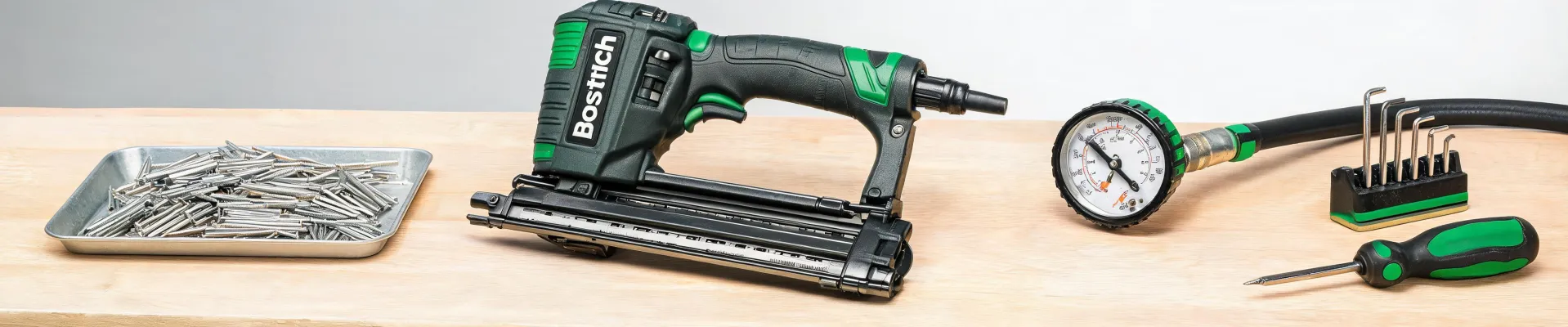
The short answer: no, nail gun nails are not universal
Nail gun nails are not universal, and assuming they were cost my team $2,400 in ruined trim, two days of downtime, and one very uncomfortable client call. The fix is not complicated: match the nail to the exact tool model, not the brand on the side of the gun. A Stanley Bostitch nail gun does not automatically take every Bostitch nail. A Bostitch 6 gallon 150 PSI air compressor manual does not automatically tell you the right pressure for every nailer. And a 6-gallon tank at 150 PSI can still fail to run a framing nailer if the CFM is wrong.
I have been handling tool crib and pneumatic fastening orders for commercial contractors for 11 years. I have personally made and documented 19 significant mistakes, totaling roughly $8,700 in wasted budget. Now I maintain our team's pre-job checklist so nobody else repeats them.
Why you should trust this checklist
In 2017, my first year on the tool crib desk, I made the classic same-brand mistake. A foreman asked for nails for a Stanley Bostitch nail gun. I saw 'Bostitch' on the gun and ordered 30 boxes of Bostitch-branded finish nails. I checked the box, not the model number. The collation angle was wrong for that specific magazine. The gun jammed on the first test fire. We had three trim crews standing around. That error cost about $890 in redo material plus a one-week delay. That was the first time I learned that nail guns are not like AA batteries.
The bigger disaster happened in September 2022. We were behind on a 14-unit trim package. A crew grabbed 18-gauge brads for a 16-gauge finish nailer because the boxes looked similar. Nobody verified the model number. The nails fed sideways, bent, and scratched the prefinished casing. The mistake affected a $3,200 order. We caught it when the client's site super sent photos of the damaged trim. We wasted $450 in nails and material, plus a three-day production delay. That is when I created our nail compatibility pre-check.
What actually determines whether a nail fits
The brand name is the least useful piece of information. The model number and the manual are the authority. For any Bostitch or Stanley Bostitch nail gun, check these before you order:
- Gauge: 18-gauge brads, 16-gauge finish nails, 15-gauge angled finish nails, and framing nails are not interchangeable.
- Collation angle: Angled magazines often need a specific angle. A 20-degree nail will not run in a 25-degree magazine.
- Head type: Full round head, clipped head, offset head, and brad head are different.
- Length and shank: Smooth, ring, screw, and helical shanks behave differently in hardwood and engineered lumber.
- Coating: Galvanized, stainless, and plain steel matter for exterior work and treated lumber.
If you are asking 'are nail gun nails universal?' the honest answer is usually no. Some nails cross over between models if every spec matches. But 'probably' is not good enough when a jammed gun can damage a $4,000 door.
How I verify a nail in under two minutes
First, I read the model number off the gun, not the box. Second, I pull the nail chart from the current manual. If I cannot find the manual, I search for the exact model plus 'nail chart' and confirm the source is the manufacturer, not a forum. Third, I check the compressor tag against the required CFM. Fourth, I put one strip of nails in the gun and test fire into a scrap piece of the actual material. That last step has caught more problems than any spec sheet.
I once assumed 'same specifications' meant identical results across two Bostitch nailers. Didn't verify. Turned out each magazine had a slightly different angle. Learned never to assume the same brand means the same fastener after that.
The compressor side: PSI is not CFM
Here is the counterintuitive part. A Bostitch 6 gallon 150 PSI air compressor manual can list 150 PSI max pressure, but that does not mean the compressor will run every Bostitch nailer. Nailers care about CFM at the required pressure, duty cycle, and recovery time. A 6-gallon pancake compressor may run an 18-gauge brad nailer all day. It will likely struggle with a framing nailer or two finish nailers running at the same time. The tank size and PSI look impressive. The CFM number is what keeps the gun from slowing down mid-shot.
For the Bostitch 6 gallon 150 PSI air compressor manual, I keep a printed copy in the crib and a digital copy on the tablet. As of the 2024 revision I downloaded, the manual lists max pressure, tank size, and CFM at 90 PSI. That CFM number is the one that matters for nailers. If a Stanley Bostitch nail gun needs 2.0 CFM at 90 PSI and your compressor delivers 1.2 CFM at 90 PSI, the gun will run for a few shots and then lag. That lag bends nails. Bending nails costs money.
I learned that in Q1 2024 after the third rejection on a punch-list job. We had the right nails, but the compressor could not keep up with two crews. The guns lost pressure, nails sat proud, and we spent a day pulling and resetting trim. That was not a nail problem. That was a compressor spec problem. Now we write the required CFM and pressure on the tool crib tag, right next to the nail chart.
The checklist that actually reduced our errors
We did not solve this with a bigger binder. We solved it by making the manual and nail chart digital and unavoidable. Every Bostitch nailer gets a QR code on the case. It opens the model-specific nail chart and the Bostitch 6 gallon 150 PSI air compressor manual page for the tools it runs. The foreman scans it before signing out nails. That sounds like overkill until you price a three-day delay.
Switching to a digital nail chart and QR-coded manual pages cut our turnaround from 5 days to 2 days on trim packages. Not because the tools got faster, but because we stopped waiting for the right nails or a replacement gun after a jam. The automated process eliminated the data entry errors we used to have. Efficiency is not about rushing. It is about removing the stupid delays. A 30-second check is cheaper than a two-day delay.
Our tool crib is not a tech company, but this one change cut our nail-related rework from seven incidents in 2022 to one in 2024. We have caught 47 potential errors using this checklist in the past 18 months. Efficiency here is not about being fancy. It is about stopping a $12 box of nails from turning into a $2,400 mistake.
If I remember correctly, the exact savings were around $6,800 in avoided rework last year, though I might be misremembering the split between material and labor. The point is not the exact number. The point is that checking the model takes 30 seconds.
Where this advice stops
This worked for us, but our situation was a mid-size commercial trim shop with predictable orders and a central tool crib. If you are a one-person remodeler grabbing nails at a supply house, the process will look different. You may not have QR codes, but you still need the model number.
I can only speak to pneumatic fastening, not every tool on the truck. If you are dealing with pressure washer problems, that is a different system. A pressure washer has a pump, unloader, and nozzle issues that have nothing to do with nail gun nails or compressor CFM. If you are troubleshooting a dual sump pump, that is also a different world. Those are wet-system problems. Do not use air tool logic on a pressure washer, and do not use compressor logic on a dual sump pump. I would be guessing outside my lane.
Also, not every aftermarket nail is bad. Some independent fasteners work fine if they match the gauge, angle, collation, head, length, shank, and coating. The manual is the authority, not the brand name on the box. Check the current manual revision for your exact model, because specs can change. Verify the compressor's CFM at the required pressure, not just the max PSI. And if you are comparing a Stanley Bostitch nail gun to another brand, read both manuals before assuming anything is universal.
That is the boundary. If your nailer is jamming, start with the model number and the manual. If your compressor is slowing down, start with CFM, not PSI. If your problem is a pressure washer or dual sump pump, start somewhere else.

Leave a Reply