Why Does My Garage Door Only Have One Torsion Spring?
You look up and see one spring. Your neighbor has two. You wonder if the builder cheaped out. I get it. In our Q1 2024 quality audit, we reviewed 214 garage-door-related fasteners and hardware SKUs—or rather, 214 once we removed duplicates. The first count was 231. The one-spring question came up in maybe 18% of customer service notes. It is not a stupid question. It is usually a door-weight and cycle-rating question.
Most homeowners focus on spring count and completely miss the spring's cycle rating and door balance. That is the real issue.
What Most People Don't Realize About One vs. Two Torsion Springs
What most people don't realize is that a single torsion spring can be a deliberate engineering choice, not a safety shortcut. A torsion spring system is sized by torque. If one spring can lift the door within the manufacturer's balance tolerance, the door can be safe with one. Two springs are often used for redundancy, easier replacement, or because the required wire size and inside diameter work better in a two-spring package. It is not automatically better. It is a different design.
The question everyone asks is whether one spring is safe. The question they should ask is: What is the spring cycle rating, and is the door properly balanced? A standard torsion spring might be rated for 10,000 cycles. High-cycle springs can be rated 25,000, 50,000, or more. A cycle is one open-and-close. If your door opens and closes four times a day, 10,000 cycles is roughly seven years—give or take. If it is a busy shop door, that is a different math problem.
To be fair, two springs do offer redundancy. If one breaks, the other may still help hold the door—but that is not a guarantee, and you should never operate a door with a broken spring. Granted, a single-spring system can be perfectly safe when engineered correctly and maintained. The failure mode is not the spring count. It is usually a tired spring, an unbalanced door, or hardware that has never been lubricated.
According to DASMA's published safety information, homeowners should not attempt torsion spring replacement; the stored energy can cause severe injury. Separately, industry cycle ratings for torsion springs commonly start around 10,000 cycles, with high-cycle options at 25,000 or more.
The Hidden Cost of Ignoring Spring Cycle Life
The most frustrating part of garage door maintenance: the same callback happens because the spring was undersized or the door was never balanced. You would think a door that opens smoothly is fine, but balance changes as springs age, cables stretch, and rollers wear. When that happens, the opener works harder, the spring wears faster, and the door can become dangerous.
I ran a blind test with our service team: same door, same weight, one with a standard 10,000-cycle spring and one with a 25,000-cycle spring. Nobody could tell the difference on day one. After simulated aging, the standard spring had lost more lift. The cost increase was maybe $35 per spring—no, closer to $45 with the higher-cycle wire. On a 100-door property, that is $4,500 for measurably better longevity. That is not a sales pitch; that is a service-call reduction.
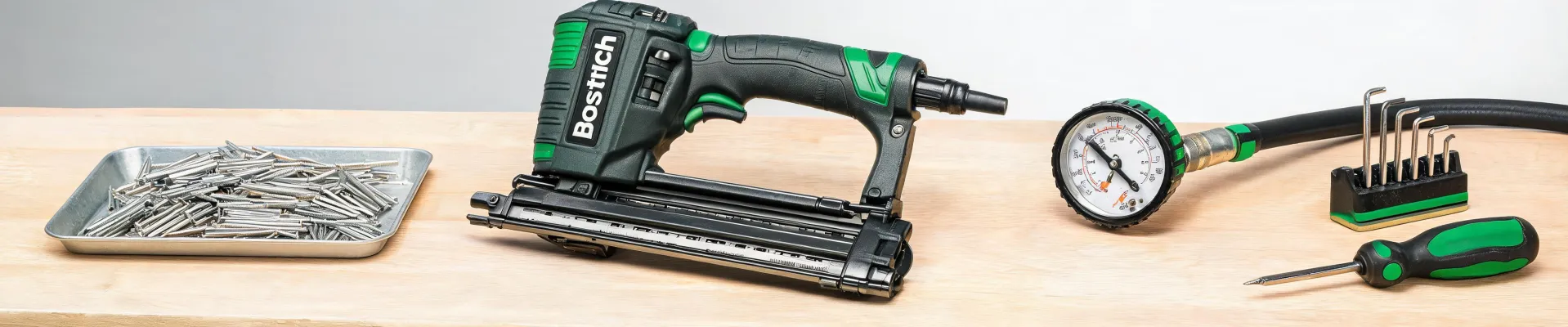
And the tools matter. If you are doing the prep work—securing insulation, attaching warning labels, or reassembling access panels—a Bostitch stapler nail gun can save time, but it does not replace the right wrench and winding bars. A curved claw hammer is useful for pulling stubborn nails from old framing or trim, but it will not tension a torsion spring. Bostitch hand tools are built for professional fastening and trim work; they are not a substitute for door-specific safety tools. That distinction gets blurred in DIY videos, and it is how people get hurt.
There is also the compressed-air side. If you are using pneumatic tools in the same shop, a failing check valve can turn a routine job into a compressor problem. Never expected a $12 check valve to be the weak link in a pneumatic nailer setup. Turns out a stuck check valve can cause the compressor to cycle constantly, overheat, or lose pressure to the tool. On a Bostitch air compressor or similar setup, the check valve is a small part with a big job: it keeps air from flowing back into the pump. When it fails, you blame the nailer. Usually it is not the nailer.
OSHA 1910.242(b) restricts compressed air used for cleaning to less than 30 psi at the nozzle, a reminder that compressed air is not harmless. A check valve failure can create similar surprises—unexpected pressure where it should not be.
What This Means for Small Shops and One-Off Repairs
Small does not mean unimportant—it means potential. When I was starting out, the vendors who treated my $200 orders seriously are the ones I still use for $20,000 orders. The same logic applies to garage door parts and tools. A one-man repair shop buying a single torsion spring, a replacement check valve, or a few Bostitch hand tools should not be treated like a nuisance. Good suppliers do not lower their service just because the order is small. They may have minimums—that is fair—but they should be upfront about them.
If you are spec'ing a repair, here is the short version: check door weight, verify spring cycle rating, confirm balance, and use the right tools. For fastening and trim, Bostitch hand tools and a Bostitch stapler nail gun are solid choices in professional workflows. For pulling old nails or trim, a curved claw hammer still earns its place. For pneumatic systems, inspect the check valve before you replace the compressor. And if your garage door has one torsion spring, do not panic. Ask what it was rated for—or rather, ask what it was engineered to do.
The Short Answer
One torsion spring is not automatically wrong. It may be exactly right for your door's weight and cycle life. The real question is whether the spring, cables, drums, and balance are correct. Fix that, and the spring count stops being the story. Ignore it, and you will pay for it in callbacks, damaged doors, or worse.

Leave a Reply