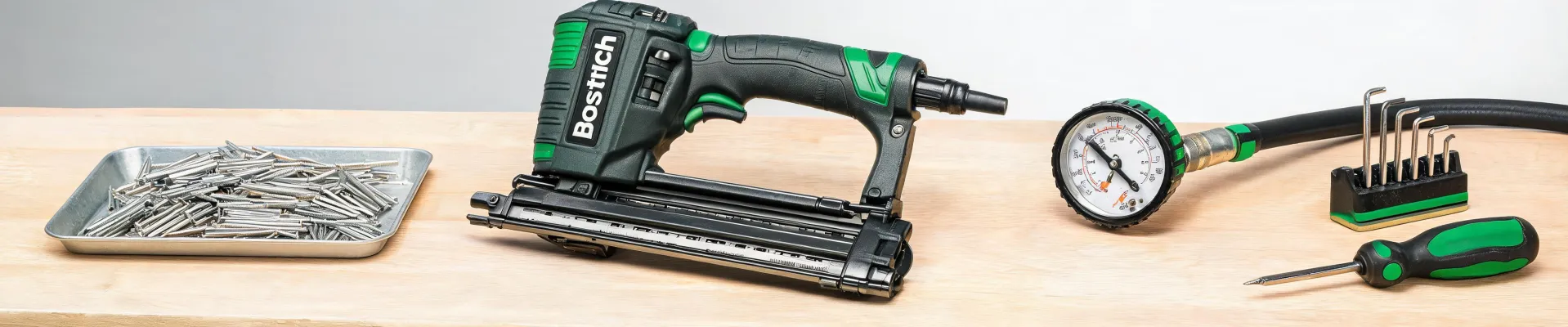
When the framing gun goes quiet 36 hours before inspection
In March 2024, a contractor called at 4:12 p.m. on a Friday. He had a crew on a deck project, a Stanley Bostitch framing nail gun in one hand, and a Bostitch air compressor nail gun combo that had just stopped keeping up. Inspection was 36 hours away. Normal turnaround for a service call like that is 2–3 business days. We had hours, not days.
His first assumption was the nail gun. He had already swapped in a backup Stanley Bostitch framing nail gun, same result: weak drive, then no drive. That is when he called me. In my role coordinating emergency tool repairs for contractors, I hear the nailer is bad a lot. Sometimes it is. But when a second gun acts the same way, the air supply is usually the real problem.
I will be honest: when I first started diagnosing compressors, I assumed any pressure drop meant a bad check valve. Ten years later, I know that is too simple. The check valve is one suspect. It is not the only one.
On the phone, I asked three questions: What does the tank gauge say after shutdown? Do you hear a hiss from the unloader valve? Does the compressor restart easily? He said the gauge fell from 90 psi to 50 psi in about four minutes, the unloader hissed after the motor stopped, and the compressor tripped the breaker twice. That combination pointed toward bleed-back through the check valve, but it still did not prove the check valve was the root cause.
The symptoms that pointed to the check valve
When I got to the site, the compressor—a small Bostitch shop unit—was running, but it sounded strained. The tank gauge climbed to about 90 psi, then stalled. The unloader valve hissed after shutdown. Then the pressure bled down fast. Not slow-leak fast. More like losing 40 psi while we stood there talking fast.
Here is the customer-education part, because this is where most people start guessing. How to know if a check valve is bad usually comes down to a few repeatable signs:
- The compressor runs but will not build full pressure, or builds very slowly.
- After shutdown, air escapes back through the unloader valve or pump head.
- The compressor struggles to restart because tank pressure is pushing back into the pump.
- The pump head gets unusually hot, even after a short run.
- You hear a continuous hiss from the unloader valve after the motor stops.
But—and this is the oversimplification I see all the time—a bad unloader valve, a leaking tank drain, or a failed pressure switch can mimic those symptoms. The replace-the-check-valve advice ignores how the whole system works together. So I do not just throw parts at it. I isolate.
I have seen this on everything from a small portable Bostitch unit to a 60-gallon shop compressor. The brand does not matter as much as the sequence. Air goes from pump to check valve to tank to regulator to hose to nailer. If the check valve fails, the nailer gets less air than it needs, but the nailer is not the part that failed. That is why I ask customers to describe the compressor behavior, not just the tool behavior.
Isolating the check valve without guessing
First, safety. I killed power, locked out the disconnect, and drained the tank to zero. I never trust a gauge by itself. I also reminded the crew about compressed air safety: according to OSHA 1910.242(b), compressed air used for cleaning must be reduced to less than 30 psi. That is not a suggestion; it is a line you do not cross.
Then I disconnected the line between the pump and the check valve. The check valve sits between the pump discharge and the tank. Its job is simple: let air into the tank, then stop it from flowing back into the pump when the motor stops. According to the Bostitch compressor manual for that unit, a failed check valve can cause hard starting, pressure bleed-back, and reduced nailer performance.
When I opened the fitting, I found carbon debris and a worn spring seat. The valve was not sealing. But here is the surprise: the check valve was not the root cause. The pump had been running hot because the oil was low and the intake filter was clogged. The check valve failed because it was working overtime against a struggling pump. Never expected that. Turns out the bad check valve was a symptom as much as a cause.
I pulled a socket set and screws from the truck. (Should mention: the check valve body used two small socket set screws—not the hex bolts I expected. That added ten minutes.) I cleaned the mating surface, replaced the check valve kit, changed the oil, and blew out the intake filter—at low pressure, away from the crew.
When I opened the check valve, the spring was weak and the seat had carbon buildup. The pump oil was dark and low. The intake filter looked like it had not been changed in two years. I asked the foreman when he last drained the tank. He said, maybe last summer. I said, that is part of the problem. Moisture and debris do not stay in the tank forever. They move.
The fix, the test, and the lesson
We have handled maybe 200 emergency compressor calls. Maybe 180, I would have to check the system. This one was typical in the sense that the obvious part was only part of the story. The replacement check valve kit ran about $32 including tax. As of April 2026, small-shop compressor check valve kits generally run $18–$45 from online parts suppliers; verify current pricing. We also spent $14 on oil and $9 on a filter. The client’s alternative was renting a towable compressor for the weekend—roughly $180–$250 per day, plus fuel and delivery.
After reassembly, we ran the compressor to 120 psi, shut it off, and watched the gauge. It held for 30 minutes while the crew loaded tools. The Bostitch air compressor nail gun setup drove 3-1/4-inch framing nails without hesitation. The deck framing passed inspection 34 hours later. Not 36—they finished early. (Surprise, surprise.)
We ran the system for 20 minutes under load, then shut it off and watched. The tank held 120 psi. The unloader gave a short clean hiss. The Bostitch air compressor nail gun combo drove nails without skipping. I had the foreman repeat the shutdown test himself. He heard the difference. That matters more than me telling him.
I also noticed shop deals on chainsaw that weekend at a local hardware store. One of the guys asked if he should grab one. I told him: finish the deck first. A chainsaw will not help you pass a framing inspection.
The real lesson was not carry a spare check valve. It was that customer education saves time. I would rather spend 10 minutes explaining how a check valve works than deal with a crew that replaces three parts and still has a dead nailer. An informed customer asks better questions and makes faster decisions. That Friday, the foreman learned how to check for bleed-back, how to listen to the unloader, and when to stop and call for help.
A quick field checklist
- Compressor runs but will not build past 80–90 psi: suspect check valve, unloader, or worn pump.
- Pressure bleeds back after shutdown: isolate check valve and tank drain.
- Hard restart or tripped breaker: check valve may be holding tank pressure against the pump.
- Hot pump head and dark oil: service the pump before replacing more parts.
- Weak nailer with a second gun: focus on air supply, not the nailer.
If you are trying to figure out how to know if a check valve is bad, start with the symptoms, isolate the system, and verify the root cause. Do not just swap the part. Look at the pump oil, the intake filter, the unloader, and the tank drain. A Bostitch compressor is a system, not a single component. Treat it that way, and you will spend less time guessing—and more time nailing.
Safety note: Compressed air and pneumatic tools can cause serious injury. Follow the manufacturer’s manual, lock out/tag out before service, and verify current regulations at osha.gov. Pricing is for general reference only; actual prices vary by vendor, specs, and time of order.

Leave a Reply