-
The Short Answer
-
Why You Should Trust This
- The Bostitch Ecosystem: What Breaks and Why
-
Air Compressor Repair: When to Fix and When to Replace
-
Circular Saw Parts: The Stuff That Actually Needs Replacing
-
Parallel Jaw Pliers: Small Tool, Big Impact
-
Chain Hoist Applications: More Than Just Lifting
-
What This Doesn't Cover
The Short Answer
If you're here because something broke mid-job, here's what you need to know: the tools that keep a crew productive aren't the ones with the best specs — they're the ones you can diagnose, repair, and re-deploy within hours, not days.
That means understanding three things: your fastening system (Bostitch nailers, staplers, and their air supply), your cutting and gripping tools (circular saw parts, parallel jaw pliers), and your lifting equipment (chain hoists). Get those right and you eliminate 80% of the downtime I see on commercial jobsites.
I've spent the last nine years coordinating tool and equipment logistics for a general contractor that runs 30-40 active residential and light commercial sites at any given time. When a framing crew calls at 6:40 AM saying their Bostitch framing nailer won't fire and the compressor's cycling every 90 seconds, I'm the one figuring out whether to send a replacement, a repair kit, or a whole different tool.
Why You Should Trust This
I'm a tool and equipment coordinator at a mid-size general contracting firm. I've handled 600+ equipment repair and replacement requests over nine years, including same-day turnarounds for commercial framing crews and emergency service calls for maintenance teams running production lines.
In March 2024, a client called at 5:15 AM — their Bostitch pneumatic stapler line had gone down the night before, and they had a 40-square roofing job starting at 7. Normal turnaround on a compressor repair is 3-5 business days. We found a local pneumatic service shop that diagnosed a failed pressure switch, paid $180 extra for the emergency slot (on top of the $95 base repair), and had the unit back on site by 10:30 AM. The client's alternative was renting a replacement compressor for $340/week while theirs sat in a queue.
That's when I started documenting every failure pattern I saw. Not because I'm obsessive (okay, maybe a little), but because after the third time a crew called about the same Bostitch nailer issue, I realized we were solving the same problems over and over instead of preventing them.
The Bostitch Ecosystem: What Breaks and Why
Nailers and Staplers
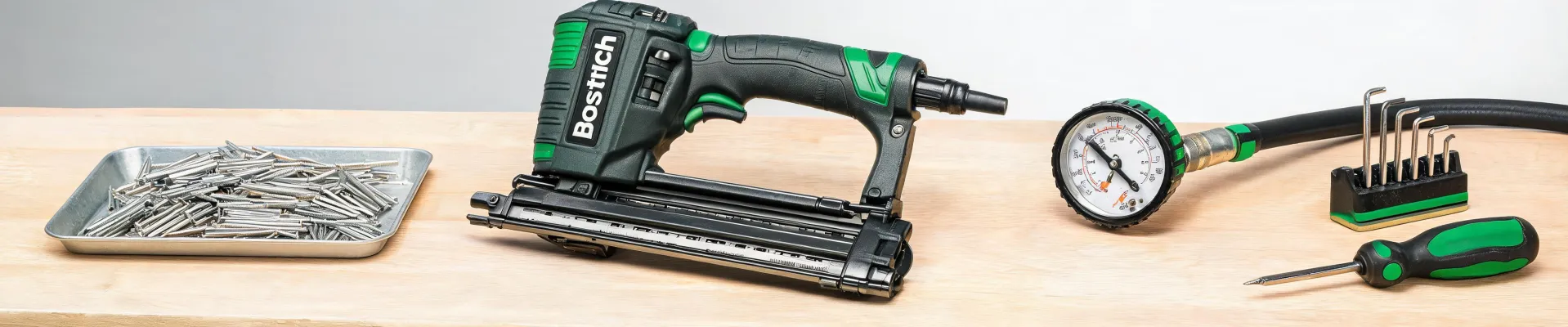
Bostitch pneumatic and cordless nailers are the backbone of most framing and finish crews I work with. The brand's strength is system compatibility — a Bostitch nailer paired with a Bostitch compressor tends to have fewer pressure and fitting mismatches than mixing brands.
The failures I see most often:
- O-ring degradation in the piston driver — usually after 200,000+ cycles or when crews run tools above 120 PSI consistently. If your nailer starts double-firing or leaving nails proud, this is your first suspect.
- Trigger valve sticking — typically from moisture in the air line. If you're not running a dryer or at least draining your tank daily, this will happen. Not might. Will.
- Magazine spring fatigue — shows up as intermittent feeding, especially with longer fasteners.
The Bostitch Stapling Hammer ST127
The ST127 gets used for a lot of things it wasn't designed for. I've seen crews try to use it as a framing hammer, a demolition tool, and once — I wish I was kidding — as a pry bar. It's a stapling hammer. Treat it like one and it'll last years.
Where the ST127 actually shines: roofing underlayment, house wrap, and insulation. The weight distribution is designed for overhead and vertical work, which is why roofers like it. The most common failure point is the driver blade — it'll chip or mushroom if you're driving into concrete or heavily knoted lumber. Replacement blades are cheap. Keep two in your kit.
One thing I learned the hard way: I assumed any Bostitch stapler could run the same fasteners as the ST127. Didn't verify. Turned out the ST127 takes specific crown widths that don't interchange with their finish staplers. We had a crew on a multi-family project run out of fasteners mid-day because someone grabbed the wrong box from the trailer.
Air Compressor Repair: When to Fix and When to Replace
Bostitch air compressor repair is one of those decisions where the math isn't always obvious. Here's the framework I use:
Repair if: the motor runs but pressure won't hold (usually a check valve or gasket), the unit is under 7 years old, and the repair quote is under 40% of replacement cost.
Replace if: the motor itself has failed, you're seeing oil blow-by on an oil-lubricated unit, or the tank shows corrosion (that's a safety issue, not a performance one).
Parts availability matters more than people think. Bostitch keeps a solid inventory of common wear parts — pressure switches, regulators, drain valves, check valves — but if you're running an older or discontinued model, you might be waiting weeks. Before you commit to a repair, call the parts supplier and confirm availability. Not the parts diagram. The actual parts supplier.
The most frustrating part of compressor repair: the same failure showing up three months after a fix because the root cause wasn't addressed. You'd think a replaced pressure switch would solve the cycling problem, but if the tank's full of moisture and the lines are undersized, you're just buying time.
Circular Saw Parts: The Stuff That Actually Needs Replacing
Circular saw parts fail in a predictable order. Here's what I stock:
- Blades — obvious, but the mistake is running a dull blade too long. A dull blade puts strain on the motor and arbor, which leads to bigger repairs. Replace when you're pushing harder than normal through the same material.
- Carbon brushes — if your saw is sparking heavily or losing power intermittently, check the brushes before you assume the motor's dying. Cheap fix, 10-minute job.
- Arbor bearings — excessive blade wobble or noise when the blade spins down. Not a field repair, but worth knowing before you diagnose it as a motor failure.
- Base plate — gets bent, throws off your bevel cuts. Usually from dropping the saw or using it as a step stool (yes, really).
One thing people overlook: the power cord. If your saw cuts out when you move the cord a certain way, that's not a motor issue. It's a $12 cord replacement that takes 15 minutes.
Parallel Jaw Pliers: Small Tool, Big Impact
Parallel jaw pliers are the tool that people don't realize they need until they use a pair. Unlike standard pliers that grip at an angle, parallel jaw pliers maintain full contact across the jaws through the entire range of motion. If you're doing any kind of precision bending, straightening, or holding — electrical work, wire forming, even pulling stubborn cotter pins — the difference is immediate.
What to look for: forged construction (not stamped), a return spring that's replaceable, and jaw teeth that are machined rather than cast. The cheap ones wear out in months. A good pair lasts years.
Part of me wants to tell you to just buy the cheapest pair and see if you use them enough to justify upgrading. Another part knows that a cheap pair will slip on the first serious job, round off a bolt head, and then sit in the bottom of your bag forever. I compromise: buy mid-range, upgrade if you find yourself reaching for them daily.
Chain Hoist Applications: More Than Just Lifting
What are the applications of a chain hoist? Most people think of them purely as vertical lifting tools — engine pulls, beam placement, equipment positioning. That's accurate but incomplete.
Where I see chain hoists used effectively beyond basic lifting:
- Tensioning and pulling — a chain hoist can apply controlled horizontal force for pulling structural members into alignment before bolting.
- Load holding — keeping a load suspended in position while other work happens. This is where the hoist's mechanical brake matters more than its lifting capacity.
- Precision positioning — HVAC units, generators, and heavy equipment that need to be lowered into exact positions where a crane is overkill.
- Recovery operations — pulling vehicles or equipment out of mud, trenches, or awkward positions where a come-along doesn't have enough capacity.
The mistake I see most: using a chain hoist rated for 1 ton to lift something that "feels like" 800 pounds, without accounting for shock loading or angle factors. That 1-ton rating is for a straight vertical pull. Introduce an angle, add any dynamic movement, and your effective capacity drops fast.
What This Doesn't Cover
A few honest limitations:
This is written from the perspective of residential and light commercial construction. If you're running heavy industrial or mining operations, the failure modes and repair economics are different — you're dealing with much larger equipment, different safety standards, and maintenance teams that are typically staffed in-house.
Also, this reflects my experience as of early 2026. Bostitch updates their product line and parts availability periodically. The repair-vs-replace math changes with pricing. Verify current parts availability and pricing before making decisions based on this.
And one more thing: I'm not a certified repair technician. I coordinate repairs and replacements. If you're diagnosing a compressor issue, have a qualified technician confirm the diagnosis before you buy parts. The money you save on a wrong guess is rarely worth the time you lose.
If you're dealing with a specific failure right now and need to decide fast: call the manufacturer's parts line first, confirm the part's in stock, then decide whether the repair timeline works for your job. That single phone call has saved me more time than any amount of internet research.

Leave a Reply