-
Argument 1: Brand Names Don't Replace Spec Sheets
-
Argument 2: The Small Tools Are Where Jobs Stall
-
Argument 3: Cabinet Hardware Is a Compatibility Problem, Not a Popularity Contest
-
But Isn't This Just Extra Work?
-
What I'd Check Before the First Nail, Cut, or Hinge
-
Prevention Isn't Caution. It's Throughput.
I'm a quality and brand compliance manager at a hardware and tools distributor. I review every SKU, kit, and replacement part before it reaches contractors—roughly 250 items a quarter. In 2024, I rejected 18% of first deliveries because the spec sheet, tolerance, or documentation didn't match. That's not because suppliers are lazy. It's because the gap between close enough and job-ready is where money leaks.
Here's my position: the question what are the best brands for cabinet hardware—or for nailers, compressors, pliers, or saw tools—is usually the wrong first question. Prevention beats brand shopping. A five-minute preflight will save you more than a logo ever will.
When I first started managing tool and hardware categories, I assumed brand name was the shortcut. If it said Bostitch or another known name, I figured it was compatible, durable, and ready. Three returns later, I learned that brand gets you into the conversation. Specs get you through the job.
Argument 1: Brand Names Don't Replace Spec Sheets
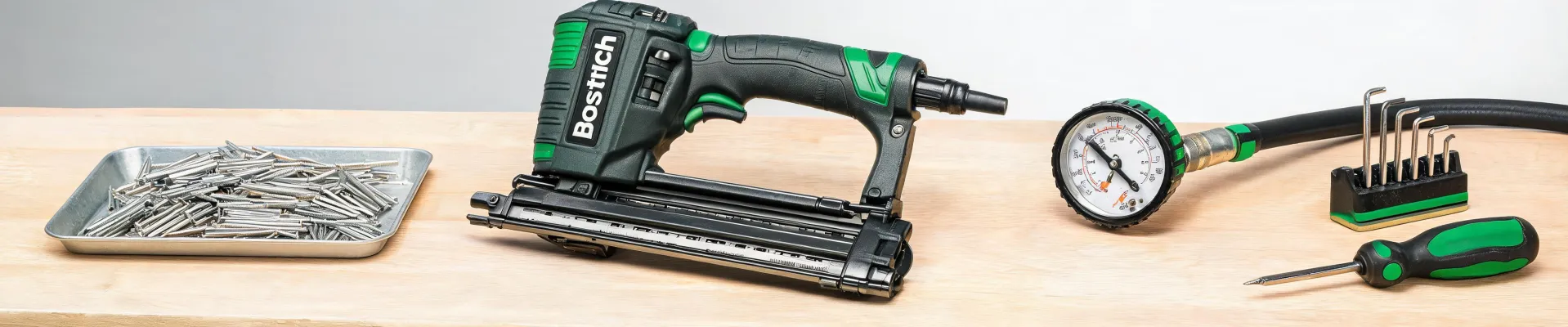
Take a roof Bostitch nail gun. It's a proven roofing tool. But a roof Bostitch nail gun still needs the right nail angle, coil or wire collation, shank type, and air supply. I've seen crews buy the nailer and then grab whatever fasteners were on the truck. That's not a brand problem. That's a preflight problem.
The same goes for a Bostitch 1.5 HP air compressor. It can be a great compact unit for trim, stapling, and light framing. But if you pair it with a high-demand roofing nailer without checking CFM at 90 psi, tank size, duty cycle, and hose diameter, you'll get short-cycling, pressure drop, and half-driven nails. The compressor isn't bad. The match is bad. I should add that horsepower alone tells you almost nothing; the CFM rating at the pressure you actually run is the number that matters.
In our Q1 2024 audit, we pulled 40 nailer-and-compressor kits and ran them against the published requirements. About a quarter failed the first check because the compressor's recovery time couldn't keep up with the tool's demand in a production setting. We didn't reject the brands. We rejected the pairing. That distinction saved us from writing off good tools for the wrong reason.
Argument 2: The Small Tools Are Where Jobs Stall
Nobody puts a pair of XS Cobra pliers on a jobsite poster. But small tools are where a lot of downtime starts. If the jaws don't seat on a fitting, if the adjustment is stiff, or if the spring is missing, someone will improvise. Improvising on a gas line, a cabinet hinge, or a chainsaw cover is how a five-minute task becomes a two-hour repair.
I used to think a chainsaw brake reset tool was a nice-to-have. Then I watched a crew fight a tripped brake with a screwdriver and a lot of frustration. The brake did its job. The crew didn't have the right reset tool within reach. The cover got cracked, the saw was down, and the job waited. That's a $12 tool creating a $300 delay. I keep one in every saw kit now. The conventional wisdom is that the big tools drive productivity. My experience with 200+ tool kits suggests the little tools decide whether the big tools stay running.
Argument 3: Cabinet Hardware Is a Compatibility Problem, Not a Popularity Contest
When someone asks what are the best brands for cabinet hardware, I usually ask three questions back: What's the hinge boring pattern? What overlay do you need? And will the replacement parts still exist in three years? The best brand in the abstract is meaningless if the cup diameter, screw length, or finish doesn't match the door and the cabinet line.
We ran a blind test with our install team: same cabinet door, two hinge options. One was a premium name, one was a mid-tier brand that matched the boring pattern exactly. The installers rated the mid-tier door as more professional because it closed flush without shimming. The premium hinge was better hardware. It just wasn't the better match for that door. On a 500-door run, a 1 mm overlay error becomes 500 callbacks.
So no, I don't start with brand rankings for cabinet hardware. I start with a compatibility grid: hinge type, overlay, bore spacing, door thickness, screw spec, finish, and replacement availability. Brand comes after the specs pass. That's not anti-brand. It's pro-prevention.
But Isn't This Just Extra Work?
Fair question. I've heard it from sales teams and crews alike. The upside of skipping the check is speed. The risk is a stalled job, a return, or a callback. I kept asking myself: is saving 10 minutes worth potentially losing a day? The math usually says no.
We weighed one case carefully. A cheaper compressor option would have saved about $1,200 across a small fleet. The worst case was a roofing crew standing around while the compressor recovered, plus a rental unit and a delayed close. Best case was the savings. Expected value looked close on paper. The downside felt catastrophic in the field. We paid for the right CFM rating instead. That decision didn't feel heroic. It just kept the schedule boring, which is what I want.
According to OSHA's compressed-air rule, 29 CFR 1910.242(b), compressed air used for cleaning must be reduced to less than 30 psi when the nozzle is dead-ended. That's not just a shop-safety detail. It's a reminder that air tools and compressors are systems, and systems need specs, not assumptions.
What I'd Check Before the First Nail, Cut, or Hinge
Here's the one-page preflight I wish I'd started years ago. It's not fancy. It's just cheap insurance.
- Tool and fastener match: angle, gauge, collation, shank, and head type—especially on any roof Bostitch nail gun setup.
- Air supply: CFM at 90 psi, tank size, recovery time, hose ID, and regulator setting. Don't trust horsepower stickers alone on a Bostitch 1.5 HP air compressor or any other unit.
- Small-tool readiness: XS Cobra pliers, chainsaw brake reset tool, spare springs, adjustment pins, and the manual in the case.
- Cabinet hardware compatibility: hinge boring pattern, overlay, bore spacing, door thickness, screw length, finish, and replacement part availability.
- Documentation: spec sheet, parts diagram, warranty terms, and a photo of the delivered label or batch code.
I know that looks like a lot. It's really about five minutes. We cut first-pass rejections from 22% to 9%—maybe 9%, I'd have to pull the Q1 report—after adding this kind of preflight. The best part isn't the rejection rate. It's that crews stopped discovering problems at the worst possible moment.
Prevention Isn't Caution. It's Throughput.
I'm not saying brand doesn't matter. Bostitch and other professional brands earn their reputations for a reason. But a brand is a starting point, not a guarantee. The best tool on the shelf can still fail the job if the compressor can't feed it, the fastener doesn't fit, the pliers don't seat, the brake tool is missing, or the cabinet hinge doesn't match the door.
So before you ask what are the best brands for cabinet hardware, or which nailer to buy, or whether a Bostitch 1.5 HP air compressor will run your roof Bostitch nail gun, run the preflight. Check the spec. Match the system. Keep the small tools where you can reach them. That's not extra work. That's the work that keeps the real work moving.

Leave a Reply