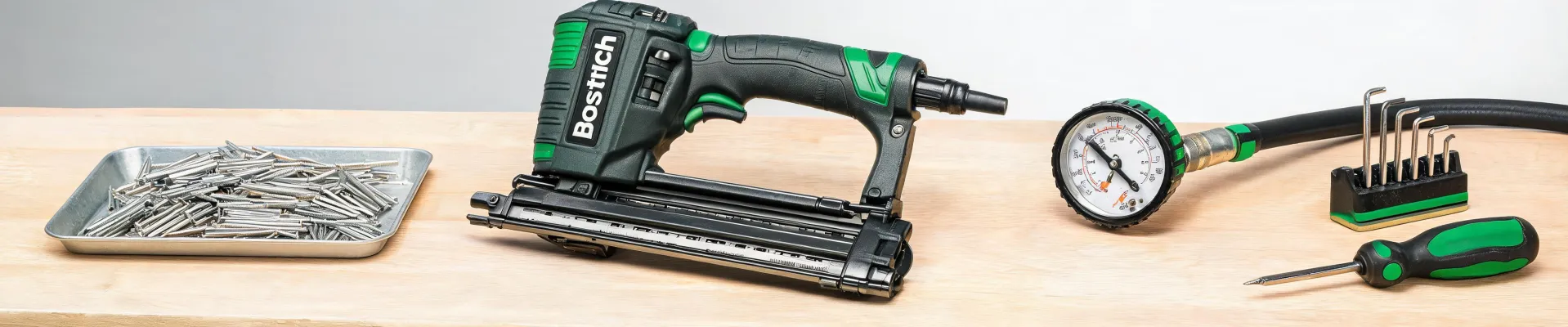
There is no single right Bostitch air compressor setup. The one that fits a trim crew will fall short on a roof, and a 60 gallon air compressor that powers a shop is a liability in a stairwell. The question isn't which is best. It's which matches the work.
I review roughly 200 unique items a month at a distribution company that supplies Bostitch fastening systems. In Q1 2024, I rejected 7% of first deliveries because of missing regulator parts, damaged pressure gauges, or corrosion in the tank drain. That colors every recommendation below.
The three scenarios
There is no universal best Bostitch setup. There are three common scenarios. Once you know which one you're in, the spec choices start to sort themselves out.
Scenario A: Trim and finish work
If your day is baseboards, door casing, cabinets, and crown, the compressor has to be quiet enough to work near clients and light enough to carry up stairs. You don't need a big tank. For trim work, the standard is simple: quiet, portable, serviceable. Period.
When I look up a Bostitch trim air compressor parts list for a small unit like the BTFP02012, the usual failure points are the regulator, the quick coupler, the unloader valve, and the tank check valve. In our Q1 2024 quality audit, a leaking regulator was the number one warranty issue on small Bostitch compressors. The fix is often a $15 part, not a new tank. That's why I tell customers to keep the parts diagram and verify the part number before ordering.
Five years ago, a regulator failure on an inexpensive compressor usually meant replacing the whole unit. Now the part is available and the schematic is online. The fundamentals of compressed air haven't changed, but the execution has.
Scenario B: Roofing and exterior work
Roofing is a different animal. A trim nailer won't drive coil roofing nails, and a small trim compressor won't keep up with a roofing Bostitch nail gun during a production deck.
A roofing crew we supplied last spring tried to use a 4-gallon trim compressor for a tear-off and re-shingle. It ran for about forty minutes before the thermal overload switch killed it. Looking back, we should have pushed them to rent a larger tank from the start. At the time, portability seemed more important than air volume. It wasn't.
For continuous roofing work, look at CFM at 90 PSI, not just tank size. A 60 gallon air compressor gives you the reserve so the motor doesn't cycle after every few rows. And the gun needs to match the nail. For coil roofing nails, that means a coil roofing Bostitch nail gun with a clean, well-lubricated magazine. A dirty magazine spring is a common cause of misfeeds, and it's usually a maintenance issue, not a gun defect.
Scenario C: Shop, facility, and maintenance work
Scenario C is less about a single trade and more about one compressor doing duty for multiple tools. A stationary 60 gallon air compressor earns its floor space if you're running impact wrenches, die grinders, and nailers in the same bay.
The trade-off is maintenance. In our repair log, the most common cause of premature compressor failure is not a bad pump; it's a tank full of water because nobody drained it. I don't have hard data on how many teams lose track of PM schedules, but I wish I had tracked it, because the anecdotal evidence from our repair log says it's a lot.
How to create a new tool chest in Bluebeam
Digital tracking helps, even for physical tool maintenance. Bluebeam Revu has a Tool Chest panel for storing custom markups. You can use it to standardize the way your team annotates compressor parts diagrams and as-builts.
Here's how to create a new tool chest in Bluebeam:
- Open the Tool Chest panel. In Revu, go to Window > Panels and select Tool Chest.
- Click the menu button in the Tool Chest panel and choose Add Tool Chest.
- Name it something like Bostitch PM and click OK.
- Drag saved markups, such as callouts and stamps, into the new chest so you can quickly add the same annotation to any parts PDF.
This doesn't replace a physical inventory system, but it does give a team a repeatable way to mark the same issues on equipment sheets.
What I would check before putting a Bostitch setup into service
When I receive a new compressor or nail gun, I don't plug it in and trust the box. I run a few checks first:
- Inspect the regulator gauge for zero offset before applying air.
- Oil the nail gun if the operator manual calls for it. Most Bostitch finish nailers are fine with a couple drops, but a roofing nailer needs more attention after a day of decking.
- Drain the compressor tank and check for moisture on the first run.
- Confirm the quick coupler matches the hose connector. It sounds basic, but we receive returns with the wrong coupler installed.
- Save the parts diagram in a Bluebeam tool chest before you need it. That way the PM notation is already set up.
None of these are hard, but they catch the majority of failures before they become jobsite problems.
The left handed hammer test
Every so often, someone asks about a left handed hammer. Usually it's a joke. Sometimes it's a serious search. A hammer doesn't care which hand you swing it with, and neither does an air compressor. What matters for a left-handed operator is where the hose connects, how the drain valve is positioned, and whether the nail gun trigger feels reachable. Don't get stuck on a category label when the real question is ergonomics.
How to decide which scenario you're in
Run your situation like a quality inspection:
- Where is the work? If it's inside a finished home or office, choose quiet and portable. If it's on a roof, choose CFM and tank reserve.
- Who owns the maintenance? If nobody owns the PM schedule, a 60 gallon air compressor is just a bigger failure point waiting to happen.
- Can the compressor stay in one place? If yes, a stationary 60 gallon tank might make sense. If it has to ride in a truck, buy based on weight and handle design.
- Can you replace a small part without replacing the whole unit? That's where Bostitch trim air compressor parts availability matters.
One more thing: verify current shipping rules before you send parts back under warranty. As of January 2025, USPS lists First-Class Mail large envelopes at $1.50 for up to 1 ounce, with a maximum size of 12 x 15 x 0.75 inches (usps.com/stamps). Most small regulator and check-valve kits fit in that size. Rates change, so confirm the current price on the USPS site.
Per FTC business guidance, advertising claims have to be truthful and substantiated. If a seller labels a replacement part as OEM or genuine, ask for the part number and packaging that verifies it. This matters more now because replacement parts are easy to find online, and not all of them meet the original spec.
There isn't a universal Bostitch setup. There's the setup that matches your work, your maintenance capacity, and the space you actually have. Pick the scenario that sounds like your week, and start there.

Leave a Reply