-
Bottom line first
-
Why I trust this take
-
What most buyers miss about Bostitch repair kits
-
Bostitch 6 gallon air compressor review: the cost-controller version
-
15 hp rotary screw air compressor: do not compare it to a 6-gallon
-
Tools wrench set and angle grinder discs: the cheap stuff that stops a job
-
What I got wrong
-
Boundaries: when this advice does not apply
Bottom line first
After managing a $180,000 annual tool and compressed-air budget for six years, my bottom line is simple: buy the system you can repair, not just the tool that looks cheapest on the quote. For Bostitch, that means checking the repair kit, parts diagram, and compressor compatibility before you buy. A Bostitch 6 gallon air compressor review might sell you on portability, but the real cost shows up in duty cycle, fittings, and whether a $35 repair kit keeps a $200 nailer alive.
If you are pricing a 15 hp rotary screw air compressor, you are in a different budget category altogether. And if you are wondering what angle grinder discs are made of, the answer affects both cut speed and safety: abrasive grain, resin bond, and fiberglass reinforcement. A tools wrench set is the boring purchase that either keeps the repair moving or stops it cold.
Why I trust this take
I am a procurement manager at a 45-person mechanical contractor. I have managed our tool and compressed-air budget, around $180,000 annually, for six years, negotiated with 20+ vendors, and logged every order in our cost tracking system. In Q2 2024, I audited our 2021 to 2023 tool spend. The pattern was ugly: we were replacing small pneumatic tools way more often than we were repairing them. Not because the tools were junk. Because we did not stock the right repair kits.
What most buyers miss about Bostitch repair kits
Most buyers focus on the tool purchase price and completely miss the parts diagram. The question everyone asks is how much is the nailer. The question they should ask is what is in the Bostitch repair kit, and how long does it take to get.
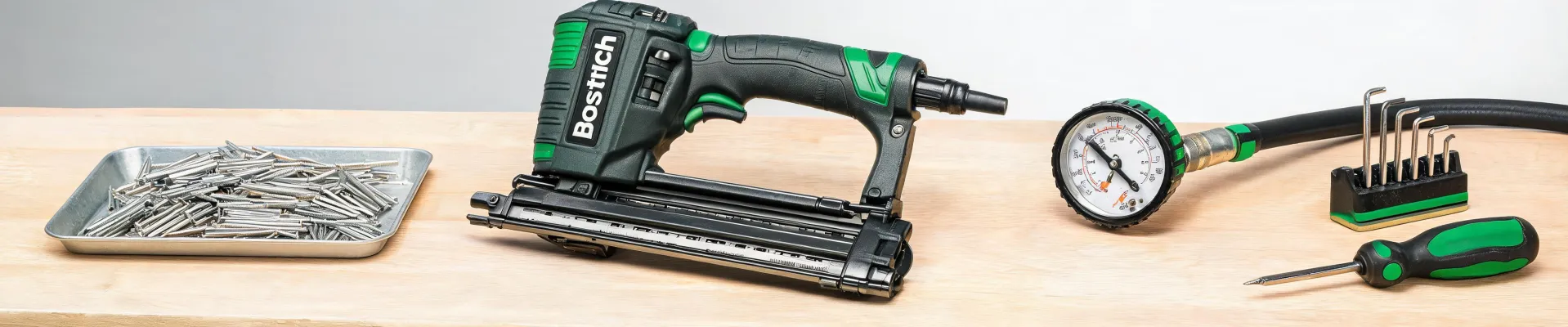
Look, a Bostitch repair kit is not glamorous. It is o-rings, seals, springs, sometimes a driver blade or bumper. But in our shop, a $25 to $45 kit has kept $200 to $400 nailers and staplers running for years. We track downtime in hours, not feelings. A nailer that is down for two days while you wait on a part can cost more in rescheduled labor than the tool is worth.
What most people do not realize is that repair kits are often model-specific. Bostitch on the box does not mean the kit fits every Bostitch nailer. You need the exact model number and often the type or series. I assumed once that a kit for one Bostitch finish nailer would fit another. Did not verify. Turned out the o-rings were different. We lost a half-day and a $90 service call over a $12 part.
Bostitch 6 gallon air compressor review: the cost-controller version
A typical Bostitch 6 gallon air compressor review will tell you it is portable, has a 6-gallon tank, and often runs around 150 PSI max with roughly 2.6 CFM at 90 PSI. That is fine for trim nailers, staplers, and small blow guns. It is not a good match for a 1/2-inch impact wrench, a die grinder, or a DA sander. Those tools eat air. CFM at 90 PSI is the number that matters for running tools; tank size mostly affects how often the motor cycles.
Here is something vendors will not always tell you: the compressor is only half the system. Fittings, hose diameter, and quick-connects can choke airflow. We standardized on 3/8-inch hose for most nailers and 1/2-inch for high-consumption tools. That change alone made our 6-gallon units feel way more capable on trim work.
For a Bostitch 6 gallon air compressor review, I would check:
- CFM at 90 PSI, not just max PSI.
- Drain valve type, because easy access matters for maintenance.
- Noise level. In an occupied building, a loud pancake compressor is a red flag.
- Repair parts availability for the compressor itself, not just the nailers.
- Whether the regulator holds pressure without creeping.
We bought two Bostitch 6-gallon units in 2022 for punch-list work. They have been fine, though I should note we do not run them all day. For continuous production, they are not the right tool.
Per OSHA 29 CFR 1910.242(b), compressed air used for cleaning must be reduced to less than 30 psi at the nozzle and fitted with effective chip guarding. That means the blow gun, not just the compressor, belongs in your budget.
15 hp rotary screw air compressor: do not compare it to a 6-gallon
A 15 hp rotary screw air compressor is a completely different purchase. It is not a portable pancake. It is a three-phase, continuous-duty machine that usually comes with a dryer, tank, and controls. Quotes I received in Q1 2025 ranged from the low $8,000s to mid-$14,000s installed, depending on air dryer, tank size, and controls. Your numbers will vary, so get current quotes.
Why does this matter? Because the TCO is not the sticker price. A 15 hp rotary screw can run 24/7 in a shop, but it needs proper maintenance: oil changes, filters, separator, and a dryer that actually works. If you skip the dryer, you will pay for it in water in the lines, ruined tools, and paint defects. We learned that the hard way in 2023 when a cheap install skipped the refrigerated dryer. Ended up spending around $2,400, maybe $2,600, I would have to check, on repairs and rework in six months.
If you are comparing a 15 hp rotary screw air compressor to a Bostitch 6-gallon, stop. They solve different problems. The 6-gallon is for portability and intermittent nailer use. The 15 hp rotary screw is for a shop that needs constant air. The only thing they share is the word compressor.
For rotary screw comparisons, ask for CAGI performance data sheets from cagi.org. They are more useful than brochure horsepower.
Tools wrench set and angle grinder discs: the cheap stuff that stops a job
A tools wrench set is one of those purchases that looks boring until you are missing a 15mm or the ratchet skips. For pneumatic tool repair, you need good hex keys, a torque wrench, and a set of open-end and box-end wrenches that actually fit the fittings. I look for chrome vanadium steel, clear size markings, and no skipped sizes in the range we use. A $40 set that skips 13mm and 15mm is a no-brainer to avoid.
Now, what are angle grinder discs made of? Most bonded abrasive discs are made of abrasive grain, such as aluminum oxide, zirconia alumina, or ceramic, held together by a resin bond and reinforced with fiberglass mesh. Aluminum oxide is common for general steel. Zirconia alumina lasts longer on heavy grinding. Ceramic cuts faster and runs cooler on stainless and hard steel. Diamond discs are different; they are for masonry, tile, and concrete. The material matters because using the wrong disc on the wrong metal can load up, overheat, or shatter.
ANSI B7.1 is the safety standard for abrasive wheels. The short version: match the wheel max RPM rating to the grinder RPM, inspect for cracks, and use the guard. We had a near-miss in 2021 when someone put a 13,000 RPM disc on a 15,000 RPM grinder. Nobody got hurt, but that is the kind of thing that changes your purchasing policy. Now we only buy discs with clear RPM ratings and keep a few spares in the shop.
What I got wrong
I used to treat small air tools as disposable. If a Bostitch nailer jammed or leaked, we would toss it and buy another. That was dumb. Over three years, we spent about $3,100, give or take, on replacement nailers. When I finally added Bostitch repair kits and a simple parts cabinet, our replacement spend dropped by roughly 40% the next year. The kit did not fix everything, but it fixed enough.
I also assumed a bigger compressor would always solve low air pressure. Did not verify. Turned out our main restriction was undersized hose and fittings, not the compressor. We spent $600 on a larger portable unit before diagnosing the real issue. That one still stings.
Boundaries: when this advice does not apply
This is a cost-controller view, not a universal rule. If you are running a high-volume production line, a 15 hp rotary screw with a dryer and proper piping is a different conversation. If you are a DIYer doing one trim project, a Bostitch 6-gallon compressor and a basic repair kit may be more than enough. If you need a tools wrench set for engine work, buy the sizes and quality that match the job, not the cheapest set on the shelf.
And always verify compatibility with your exact model. Bostitch makes many nailers, staplers, and compressors. A repair kit or accessory that fits one may not fit another. Check the manual, check the parts diagram, and do not assume. That is not a brand issue; it is a system issue.
Bottom line: buy for repair, match air delivery to the tool, and treat safety consumables like angle grinder discs as specification items, not commodity afterthoughts. That is how you keep the job moving without blowing the budget.

Leave a Reply