-
Questions I get every week as a quality inspector
-
Does Bostitch make a circular saw?
-
Is the Bostitch Speede II electric screwdriver still worth it?
-
Are Bostitch socket sets a real product line?
-
What's a fair hammer drill price in 2026?
-
Can I use a cordless drill for masonry?
-
Do I have to use a Bostitch compressor with a Bostitch nailer?
-
Which Bostitch tools are actually worth buying?
Questions I get every week as a quality inspector
I'm a quality and compliance manager for a regional tool distributor. We ship roughly 40,000 units a year, and my job is to catch spec errors before they reach a customer. Over the last seven years, I've reviewed more SKUs than I can count, checked model numbers, and rejected boxes that didn't match their descriptions.
With Bostitch, I hear the same questions again and again. Here are my answers, current as of March 2026.
- Does Bostitch make a circular saw?
- Is the Bostitch Speede II electric screwdriver still worth it?
- Are Bostitch socket sets a real product line?
- What's a fair hammer drill price in 2026?
- Can I use a cordless drill for masonry?
- Do I have to use a Bostitch compressor with a Bostitch nailer?
- Which Bostitch tools are actually worth buying?
Does Bostitch make a circular saw?
Not in the current U.S. lineup as of March 2026. I check Bostitch's catalog on our vendor portal, and the brand is focused on nailers, staplers, compressors, and accessories. I don't see circular saws in the new product data.
So if you see a listing for a Bostitch circular saw, be careful. It might be an old discontinued unit, a gray-market import, or a seller trying to get clicks. I've rejected inbound shipments where the logo and the model number didn't match the spec sheet. That doesn't automatically mean the tool is fake, but it means you shouldn't assume the brand badge makes it right.
If you need a circular saw, buy from a brand that still makes them. You'll get current safety documentation, a real warranty path, and easier replacement parts. That matters more than having one logo on everything you own.
Is the Bostitch Speede II electric screwdriver still worth it?
Depends on who's asking. The Speede II is a specialty electric screwdriver for drywall, not a general-purpose drill. It's designed to drive drywall screws quickly while keeping depth consistent, and it's been around long enough that most crews have used one at some point.
If you're hanging drywall full-time, yes, it's worth buying or keeping. The speed and depth control are exactly what you want when you're feeding screws all day. If you're a homeowner doing an occasional drywall patch, you don't need a dedicated Speede II. A normal drill/driver with a drywall bit will handle it.
If you're buying a used one, check the chuck and the gear housing. A Speede II that's been dropped off a ladder will often show damage near the nose. I've seen used units listed as mint condition with stripped drive teeth. Ask for a photo of the collet before you pay.
Are Bostitch socket sets a real product line?
This one surprises people. Bostitch built its reputation on fastening tools, not mechanics' hand tools. As of this year, our distributor database doesn't show a current Bostitch socket set SKU.
That doesn't mean you're holding a fake if you already own one. Some older Bostitch promotional kits exist, and they work fine. But if you're in the market for sockets, I'd buy from a hand-tool specialist. Sockets are a commodity product, and brand loyalty won't help you when the 10mm socket disappears and you can't find a matching replacement.
Here's the thing: don't buy a socket set just because the brand name feels familiar. Buy one because the set covers the sizes you need and the warranty is easy to use. If you find an older Bostitch socket set at a garage sale, treat it like any other used set. Pay a fair used price, not a premium for the badge.
What's a fair hammer drill price in 2026?
Prices move, so I'll give you ranges based on major U.S. retailer listings as of March 2026. Verify current pricing before you order, and treat sales prices as temporary.
- Corded 1/2-inch hammer drill: $70 to $120.
- Cordless hammer drill/driver kit with battery and charger: $150 to $300.
- SDS rotary hammer for serious concrete work: $200 to $500+.
If someone quotes you $400 for a basic corded 1/2-inch hammer drill, that's too much. If it's an SDS-plus rotary hammer with a chipping mode, $400 is a normal professional tool price.
Corded models are getting less shelf space every year, so if you see a brand-name unit at a clearance price, check the return policy. Cordless kits cost more but make sense if you're working without power on site.
The real question isn't just hammer drill price. It's what you're drilling. A cheap hammer drill works for small anchors. A rotary hammer is for deep holes and punchouts. Don't buy a $400 machine for a $50 anchor job unless you know you'll need that capability later.
Can I use a cordless drill for masonry?
Yes, but only for light work. A cordless drill with a hammer-drill function can handle a 1/4-inch hole in brick or soft block for a wall anchor. Use a carbide-tipped masonry bit and let the tool do the work. Pressing harder just wears the bit and the motor.
What a regular cordless drill can't do is handle a 3/4-inch hole in poured concrete, especially if you hit rebar. I've seen drills burn out on jobs like that. The tool might spin the bit, but that doesn't mean it's designed to survive the impact and heat for long.
If you need more than a few holes in concrete, use an SDS rotary hammer. That's not a marketing opinion. It's about matching the tool to the task.
Do I have to use a Bostitch compressor with a Bostitch nailer?
No. Air tools don't need to match the compressor brand. What matters is that the compressor delivers enough CFM at the right PSI for the nailer's requirement. A finish nailer might need around 1 CFM at 70 PSI, while a framing nailer needs more. Any compressor that meets those numbers will run it. Also, a longer hose needs a larger diameter to reduce pressure drop. But that's a compressor question, not a Bostitch question.
That said, I still like Bostitch combos for one reason: they're designed and tested together. If something doesn't work on a job, you're dealing with one vendor instead of two. That's worth a lot when you're working to a schedule.
Which Bostitch tools are actually worth buying?
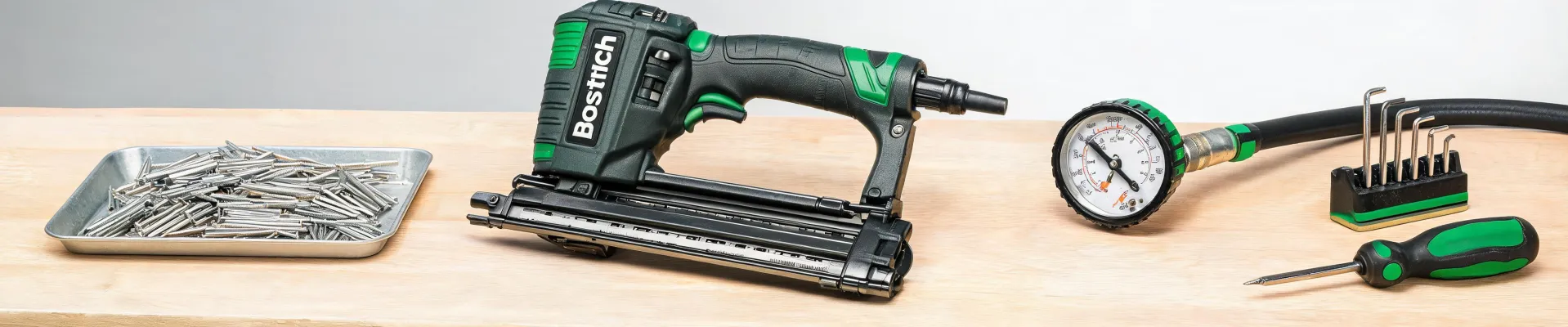
If I'm being honest, Bostitch is strongest where it started: pneumatic and cordless fastening tools, air compressors, and the accessories that support them. A Bostitch nailer and compressor combo is a proven system for professional crews. Parts diagrams are available, and service support is real.
A used Bostitch nailer can be a smart buy if you inspect it for piston wear and damaged o-rings. I've seen simple rebuilds bring them back to daily service.
But Bostitch doesn't need to be your only tool brand. If your job is cutting plywood, buy a circular saw from a brand that still makes them. If your job is concrete, buy a rotary hammer from a company that specializes in drilling. The best tool for the task is the one that can be serviced and supported when something wears out.
That's the honest answer: buy Bostitch for fastening, buy the right specialty tools for everything else, and verify the model number before you pay.

Leave a Reply