-
Bostitch Tools FAQ for Admin Buyers: What I Wish I Knew Before Ordering
-
1. Is Bostitch a good fit for a small facilities maintenance toolkit?
-
2. What should I check before buying a nail gun Bostitch model for my crew?
-
3. Do I need a cast iron series air compressor to run a Bostitch nail gun?
-
4. Is the Bostitch Antivibe hammer worth it for facilities work?
-
5. Are anti slip wrench set tools worth adding to a maintenance kit?
-
6. What is the average cost to replace a sump pump?
-
7. What's the one thing admin buyers miss when ordering Bostitch tools?
-
8. Should we standardize on Bostitch for everything?
-
1. Is Bostitch a good fit for a small facilities maintenance toolkit?
Bostitch Tools FAQ for Admin Buyers: What I Wish I Knew Before Ordering
I'm the office administrator for a 140-person company. I manage facilities and MRO ordering—roughly $180,000 annually across 12 vendors. I report to both operations and finance. That means I care about whether a tool gets the job done, whether the invoice is clean, and whether we can repair it instead of replacing it. These are the questions I actually get from ops managers, and the answers I wish I'd had before I started buying fastening tools and maintenance gear.
I'm not a tool reviewer. I'm a buyer. So the limits are up front, and the recommendations are based on what has worked in our buildings.
1. Is Bostitch a good fit for a small facilities maintenance toolkit?
Short answer: yes, for the right tasks. Bostitch makes professional-grade pneumatic and cordless fastening tools, air compressors, and accessories. What I like is the repair and parts side—when a nailer goes down, I can usually find a parts diagram or replacement kit instead of buying a whole new tool. That matters when you're managing a budget. But if your team only needs a hammer drill once a year and a random orbital sander, I wouldn't force Bostitch into every slot. Standardize where it makes sense, not just because a brand looks tidy in a spreadsheet. Honest limitation: Bostitch is not automatically the cheapest or the only option. It's a practical fit when you want a supported fastening system and predictable consumables.
2. What should I check before buying a nail gun Bostitch model for my crew?
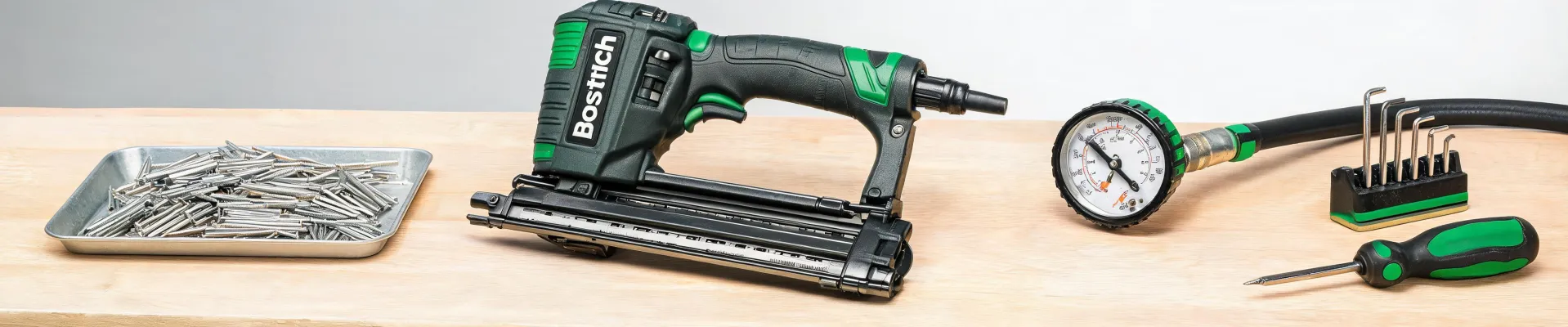
Don't start with the gun. Start with the fasteners and the air supply. For a nail gun Bostitch purchase, check fastener type and angle, magazine capacity, operating pressure, and air consumption in CFM at 90 PSI. What most people don't realize is that CFM at 90 PSI matters more than tank size for nailers. A big tank with a weak pump can still run out of air on a long run. Also confirm the tool's required pressure range against your compressor. Bostitch nailers work well in many setups, but they're not guaranteed to run on every compressor on the market. Read the manual or spec sheet before you click buy. That one check saved me from a return.
3. Do I need a cast iron series air compressor to run a Bostitch nail gun?
Not always. A cast iron series air compressor is usually a better choice if you're running tools for longer periods, doing finish work, or need a pump that can handle repeated cycles. Cast iron pumps tend to be designed for heavier duty and can run cooler than some aluminum models. But if your team is only shooting a few hundred brads during a small repair, a smaller compressor may work fine—as long as it meets the nailer's CFM and pressure requirements. I made the mistake of buying a cheap compressor first, then realizing it couldn't keep up with a framing nailer. I ended up paying twice. If you're buying for occasional use, match the compressor to the tool, not to the biggest number on the box.
4. Is the Bostitch Antivibe hammer worth it for facilities work?
For repetitive striking—demo, stake driving, light framing—the Bostitch Antivibe hammer can make sense. The antivibration design is meant to reduce shock, and for someone swinging a hammer for an afternoon, that's not a gimmick. But if your maintenance team uses a hammer once a month to tap a crate open or set a small anchor, a basic hammer is probably enough. I recommend the Antivibe hammer for teams doing repeated impact work, but if you're dealing with occasional light use, you might want to consider putting that budget into a better socket set or a spare battery platform instead. Honest limitation: no hammer eliminates fatigue if you're using the wrong technique or the wrong size for the job.
5. Are anti slip wrench set tools worth adding to a maintenance kit?
Yes, with one caveat. An anti slip wrench set can save a rounded bolt from turning into a two-hour project. The better sets grip the flats rather than the corners, which helps on rusted or damaged fasteners. I keep a set in our facilities cabinet because plumbing and HVAC repairs often involve older, soft metal fittings. But they're not a replacement for proper sockets, hex keys, or penetrating oil. Also, don't buy the cheapest anti-slip set and expect it to handle high-torque work. For normal maintenance, a mid-range set is usually fine. If your team is working on critical equipment, check the warranty and whether individual pieces can be replaced. That's the same logic I use with Bostitch parts—support matters.
6. What is the average cost to replace a sump pump?
I can't give you a credible national average from my own data, and I'd be suspicious of anyone who gives you one without a recent source. What I can share: in our 2024 facilities invoices, a standard 1/3 HP submersible replacement in a mid-cost U.S. metro ran about $550–$850 total, including labor. The pump itself was roughly $150–$300. Emergency calls, high-cost areas, or code upgrades can push it past $1,000. That's not a quote—it's a budgeting range. To get a real number, call three local plumbers and ask for a written estimate that includes the pump, labor, disposal, and any permit. Also ask whether the discharge line, check valve, and basin are in good shape. I've seen a cheap pump replacement turn expensive because the discharge line was undersized. Don't hold me to this, but I'd plan for $700 as a middle-of-the-road placeholder and adjust from there.
7. What's the one thing admin buyers miss when ordering Bostitch tools?
The fasteners and parts. The tool is the visible cost; the consumables and repair parts are the budget leak. If you buy a nail gun Bostitch model but don't standardize the nails or staples, you end up with three boxes of almost-right fasteners and a crew that can't use them. I now keep a simple list: tool model, required fastener, air requirement, and part numbers for common wear items. Bostitch's parts diagrams and service support are genuinely useful here, but you have to use them. Also, don't buy a kit just because it's on sale. If it duplicates tools you already have, it's not a deal. If it fills a real gap and uses fasteners you'll keep in stock, then it's worth considering.
8. Should we standardize on Bostitch for everything?
No. I like Bostitch for fastening tools, compressors, and accessories, but I wouldn't force one brand across every category. Your electricians may need a specific meter; your HVAC tech may need a specific gauge set. Standardization helps with batteries, fasteners, and parts, but only where it reduces complexity. If your team is already using another brand for a certain tool and it works, switching just for consistency can create more problems than it solves. My rule: standardize the system, not the logo. For Bostitch, that means standardizing nailers, fasteners, and compressor specs where it makes sense. For other tools, buy the best fit for the job and the support you can actually get.

Leave a Reply