The Tuesday That Started With an Air Leak
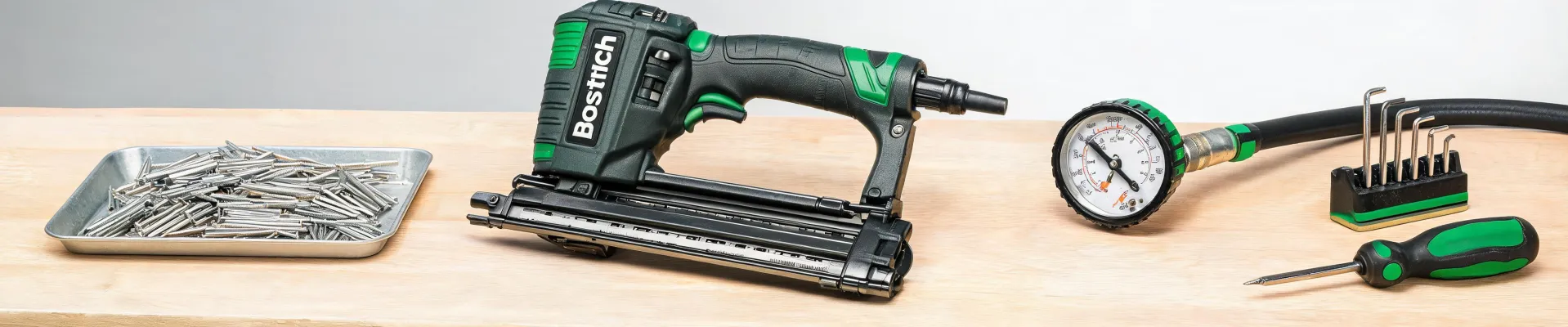
At 7:42 on a Tuesday, our lead tech sent me a video. The Bostitch P51-10B pneumatic stapling plier in the mechanical room was clicking, but it wasn't driving staples. Air was hissing out around the trigger. He zoomed in on the gap. I could see the problem before I even picked up the phone.
The trigger valve.
If you've ever had a crew standing around waiting on a $20 part, you know the feeling. That morning, I had two crews waiting: one for the stapler, and one for a dead high temp sump pump in the boiler room.
I manage procurement for an 18-person mechanical maintenance company. My job is to buy the right parts, at the right price, and keep the schedule from falling apart. It took me six years and about 1,400 purchase orders to learn that the right part is rarely the cheapest part.
I had already created one communication headache that morning. I told the lead tech I'd handle it. He heard I'd have it here by 8:30. At 8:15, my phone buzzed. Again.
One Stapler, Two Kinds of Repair Costs
I pulled up the Bostitch parts page for the P51-10B. The diagram showed the stapling plier's guts in that classic parts-breakdown style: handle, magazine, driver, and the trigger valve assembly. The trigger valve replacement kit included the stem, the return spring, the O-rings, and a small grease packet. Around $24.
I almost ordered just the O-rings instead. They were cheaper by about $7. My cost-tracking brain said save seven dollars. The voice from every repair I'd tracked since 2020 said don't.
The first time I tried to save money on a rebuild like that, I ordered a gasket kit for a different stapler. It was $9 cheaper. Two weeks later, the scored valve stem chewed through the new O-ring. I ended up ordering the full kit, paying rush shipping, and buying lunch for the crew to make up for the mess. The cheap fix cost $60 and a full afternoon.
It's tempting to simplify an air tool repair down to replace the rubber. But the rubber is only part of the system. If the stem is worn, the new seal won't seat. The Bostitch trigger valve replacement was the whole valve assembly with the wear item and the seal, designed to go back in as one unit.
So I placed the order. Overnight shipping. The shipping charge stung. But the alternative, two days of stapler downtime on a job that was already behind, would cost a lot more in labor.
Then the Sump Pump Got Complicated
While I was on the same call, the lead tech added the second request. The high temp sump pump in the boiler room had tripped twice overnight. It was moving 160°F water from a condensate pit, and the float switch looked fine. The motor was drawing high amps. We needed a replacement.
In my opinion, this is where maintenance procurement actually earns its keep. The pump itself was a known item from our distributor. There shouldn't be a Bostitch-built pump, and there isn't. Bostitch focuses on fastening tools and air systems. It's not a pump company, and I don't expect it to be. That focus is why I trust the stapler parts diagram.
But the new pump had a different flange bolting pattern than the old one. The manufacturer's manual called out M10 and M12 bolts. Our shop kit was almost all SAE, because most of our facility equipment was old American iron. The new pump bolts were metric.
So I added a metric ratchet wrench set to the order. Not a giant 200-piece chest. The size range I needed was 10 to 14 mm, so I searched for a ratchet wrench set metric and picked a mid-priced set with sockets, not the cheapest one. It cost less than $50 and saved a trip to the hardware store at 4:45 p.m. in a work truck.
The 2-inch PVC discharge line came next. The crew needed to pass it through the concrete block wall. The lead tech texted a photo with a tape measure. What size hole saw for 2 inch pvc pipe? I already knew the answer from the last time this came up.
A 2-inch hole saw is not the right tool for 2-inch PVC pipe. Schedule 40 PVC's outside diameter is about 2.375 inches. A 2-inch hole saw cuts a hole that's just a hair too tight, especially if the pipe has any burr or tape. The correct answer is a 2-1/2-inch hole saw, which leaves about an eighth of an inch of clearance. If you're passing a coupling through the wall or adding insulation, you'd want to bump up to 2-3/4 or 3 inches.
What Arrived, and What It Cost
Everything showed up the next morning. The pump arrived first, and the metric ratchet wrench set proved its value by 9:15. The Bostitch trigger valve replacement took about twenty minutes to install. I knew it was done when the lead tech sent a short video of the stapling plier driving crown staples into a test board. We're back, he said. That was it.
The hole saw showed up with the rest of the parts at 8:50. The 2-1/2-inch hole saw made a clean cut through the block wall in about six minutes. The pipe ran through with enough clearance to avoid binding.
Here's the funny part. The total cost of ownership for that day included the trigger valve kit, overnight shipping, the metric ratchet wrench set, the 2-1/2-inch hole saw, and the high temp sump pump itself. It was not the cheapest version of the day. But the cheap version, the one where I buy just the O-ring, borrow an SAE wrench, and hope the old hole saw gets it, would have added a second day to every trade on the site.
What I'd Tell Another Cost Controller
To be fair, not every repair needs a full kit. Some jobs are just a worn seal. But I've stopped pretending I can tell without opening the tool and looking at the parts diagram.
The first lesson is that a part number is not a cost. The second is that a vendor who knows its lane is worth more than one that promises everything. Bostitch doesn't make high temp sump pumps. They don't make metric wrenches, and they don't make hole saws. But the trigger valve replacement for the P51-10B was exactly the kind of repair they've made easy: the right parts, a clear diagram, and instructions that don't assume I'm a repair tech.
Personally, I now keep a metric ratchet wrench set in the shop, even though our internal line was we don't work on metric equipment for years. That was wrong. The pump manufacturer changed the spec, and I didn't change my inventory. The best procurement is the kind that expects change.
So, bottom line: if someone asks you what size hole saw for 2 inch pvc pipe, tell them 2-1/2-inch. If they ask you whether the Bostitch trigger valve replacement is doable in the field, say yes, if you buy the whole kit, not just the O-ring. And if they ask how much it costs, don't quote the invoice. Quote the downtime.

Leave a Reply