Tuesday, 4:37 PM — The Call
Back in March 2025, I was packing up for the day. The phone rang, and the caller ID showed a number I didn't recognize. It was the facilities manager at a downtown law firm. She had a walkthrough with the building inspector and the insurance agent scheduled for Thursday morning. The storage room was a problem: sagging wire shelves, water-stained drywall, legal records stacked on the floor.
"Can you fix it?" she asked. "We need heavy duty shelf brackets, the drywall patched, and all of it has to pass a visual inspection in about 40 hours."
Rush jobs are my lane. I've been doing commercial repair work for about a decade now, mostly for clients who need things done yesterday. But this one had teeth, and I didn't know it yet.
The Load-Out
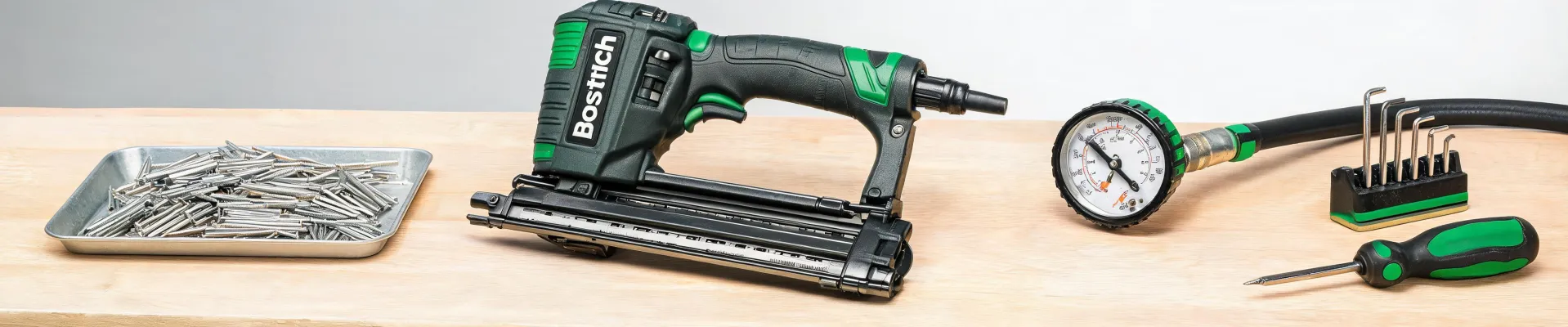
My work truck is organized so the fastening tools live in the back. I run Bostitch for most of my pneumatic work. That night I loaded a finish nailer, a framing nailer, and an air compressor. I also grabbed my 68 piece tool set from the cab. That thing has rescued me more times than I can count.
As I pulled out of the driveway, I ran through the checklist: brackets, anchors, drywall, screws, mud, tape. Thought I had it all. I was wrong about one item — just not the one you'd guess.
The Drywall Question Nobody Asks Early Enough
Wednesday morning, the water damage looked worse than the photos. A four-foot section of drywall had to come out, right behind where the new shelves were going. Straightforward stuff.
Until you ask the real question: how do I choose the right size drywall screw?
It's not complicated, but it matters. The screw does two jobs at once: it pulls the panel tight to the stud, and it carries the weight of whatever is mounted on the wall. Too short, and it doesn't bite. Too long, and it punches through the paper and loses all holding power. What I mean is, there's no screw length that saves you if you pick the wrong one. The wall doesn't care about your timeline.
Here's the rule I use:
- For 1/2-inch drywall — the most common thickness in commercial interiors — I use #6 screws at 1-1/4 inches.
- For 5/8-inch drywall — common in corridors and garages — I step up to 1-5/8 inches.
- For double-layer board, you're looking at 2 inches or more, but that's rare in a storage room.
I explained that to the client in about two minutes. She took notes. I'd rather spend 10 minutes explaining my choices than deal with popped screws and callback complaints a year from now. An informed customer asks better questions and makes faster decisions.
The Brackets Were Wrong
Midmorning, I shifted from patching drywall to installing the shelving. The spec called for heavy duty shelf brackets rated at no less than 200 pounds per pair. These shelves were going to hold legal binders and archived client files, not decorative knickknacks.
The client had ordered brackets, and they were supposed to arrive by 9 AM. They showed up at 11:30. When I opened the box, my stomach dropped. The stamp on the packaging said 50 pounds per pair.
Not heavy duty. Not even close.
I made the call right there: "These won't work. I can run to the supplier, pick up proper heavy duty shelf brackets, and be back in 45 minutes." She said go.
That's when the day really turned.
The Nailer Quit
Back from the supply run, I grabbed my finish nailer to secure the trim around the patched drywall. It sank a nail halfway. Then it stopped firing entirely.
In my role coordinating time-sensitive repairs, a tool failure mid-job is the thing I dread most. But stopping to diagnose was cheaper than pushing forward and leaving a sloppy finish.
I have mixed feelings about tool maintenance. On one hand, I know it's the responsible move — check the O-rings, wipe down the magazine, listen for air leaks. On the other hand, when the clock is ticking, you want to work, not wrench. But there I was.
The Bostitch Repair That Almost Wasn't
I pulled the nailer apart far enough to inspect the driver guide. This was a newer model than the one I'd cut my teeth on, and I didn't trust my memory for the disassembly sequence. I needed the Bostitch air compressor manual — it had the tool specs AND the troubleshooting section — but it was in the truck.
Buried.
Honestly, I'm not sure why I hadn't put that manual on my phone months earlier. My best guess is one of those "I'll do it later" things. A lesson learned the hard way.
While I was digging through the filing bin, I remembered what the manual's troubleshooting page says: when a pneumatic nailer won't seat fasteners, it's almost always one of three things — low air pressure, a worn O-ring, or a dirty magazine.
The compressor was holding 90 PSI. The magazine was clean. That left the O-ring.
This is where the 68 piece tool set earned its keep. It has an O-ring pick — a small curved plastic tool that costs maybe $8 on its own. Without it, I'd have been jamming screwdrivers into the seal and hoping for the best. I swapped the O-ring, reassembled the nailer, and test-fired on a scrap board.
Perfect seating.
Fifteen minutes. That's all it took. I don't have hard data on how many O-rings fail mid-job, but based on years of pneumatic tool work, my sense is it's one of the most common failure points. Now I keep a small bag of O-rings in the compressor case at all times.
Could I have brought the nailer to a repair shop? Sure. But on a 40-hour deadline, being able to do Bostitch repair on-site is what saved the schedule. We didn't have a formal pre-job checklist for tool condition back then. Cost us about half an hour that day. I wish I'd tracked those incidents, because anecdotally, it's happened at least five times in my career.
What the Manual Taught Me
That evening, after the trim was up and the shelves were anchored, I sat in the truck and did the thing I'd been meaning to do for years: I downloaded the Bostitch air compressor manual as a PDF and put it on my phone. I also bookmarked the Bostitch support page, which has exploded-view diagrams for most of their tools. Turns out you can register tools there too and pull exact part numbers. Wish I'd known that before.
Here's the thing about that lesson: it wasn't really about the nailer. It was about what I carry in my head. The manual had the information I needed, and I couldn't get to it because I'd filed it somewhere inconvenient. In the middle of a rush job, that's a self-inflicted wound.
The Walkthrough
Thursday, 8 AM. The inspector walked into a transformed storage room. Smooth drywall, freshly painted. The heavy duty shelf brackets were anchored into studs at 16 inches on center, each bracket rated for 250 pounds. I leaned on the top shelf, and it didn't move. The trim was clean, every nail seated flush.
The client looked at the wall, then at me. "These are rated for what?"
"250 pounds per bracket. The shelves won't see that load, but the safety margin is the point."
Because that's what a heavy duty shelf bracket really means: it's the difference between a shelf that holds the archive files and a shelf that becomes the archive file. I walked her through the stud placement, the screw choice, and the rating logic. She asked the kind of questions that told me she was actually listening. That's the part of my job I genuinely like — not lecturing, but giving someone a decision framework so they can make the right call themselves.
The Takeaway
Three things from that job have stayed with me:
- Read the manual and keep it where you can actually find it. Your Bostitch air compressor manual isn't just a booklet. It's the first line of defense when a tool misbehaves under pressure. Download it to your phone before you need it.
- Don't trust the label. A "heavy duty" shelf bracket isn't heavy duty because the box says so. Check the rating stamp. Check the studs. When in doubt, go bigger.
- Spare parts and a decent tool set are cheap insurance. The 68 piece tool set plus a small bag of O-rings cost me less than $100 combined. A trip to a repair shop during a rush job would have cost the entire deadline.
Did the job get done? Yes. Was it because I'm some kind of genius under pressure? Not really. It was because I had the right tools, the right spare parts, and — eventually — the right manual on the right screen. The only lasting change was making sure the information lives where I can reach it.
That's it. That's the story.
Sometimes doing the job well isn't about muscle. It's about the screw size, the bracket rating, and knowing where the manual is when the tool that's supposed to save you starts acting up instead.

Leave a Reply