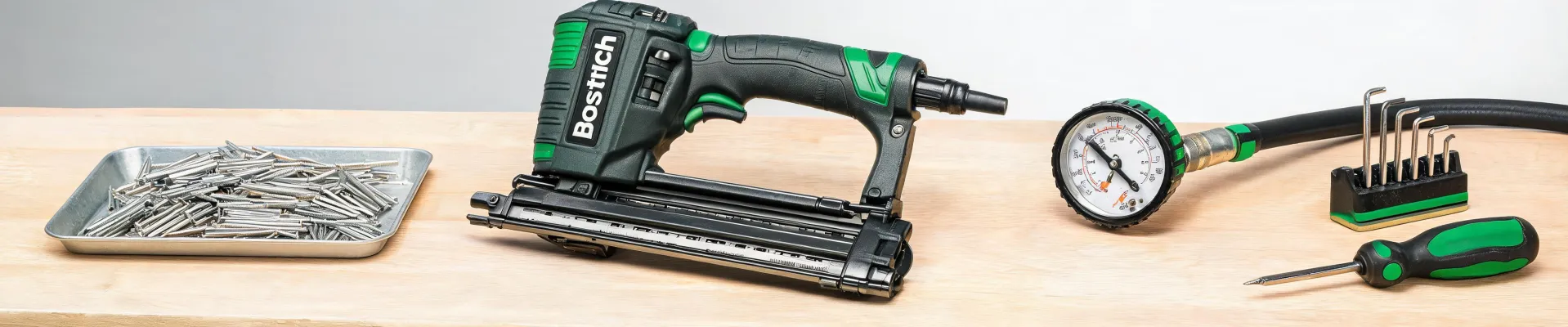
I'll state my position directly: for commercial maintenance work, Bostitch is the most dependable fastening and air supply brand you can standardize on. That's not a throwaway opinion. I've managed tool purchasing for our facilities team since 2020—roughly $60,000 a year across eight vendors—and I've made enough mistakes to have earned the viewpoint.
But the other half matters just as much: Bostitch isn't right for every situation. Knowing when not to buy it has saved our budget just as much as buying it has.
That perspective came from experience, most of it hard. When I first took over purchasing, I found a great price from a new vendor—about $800 cheaper than our regular supplier on a pallet of framing nailers. I placed the order and felt like a hero for about three weeks. Then the invoice arrived as a handwritten receipt. Finance rejected it. I ate the cost from the department budget. That's how I learned to look past the headline number. It's the same lens I use to evaluate tools now.
The case for thinking in systems, not specs
The first lesson was about systems. Early on, I bought whatever was cheapest or in stock that week—a nailer from one brand, a compressor from another. It looked efficient on paper. In practice, it created a web of small problems.
Pressure tolerances varied from tool to tool. Fittings didn't always seat properly. When a nailer jammed, the compressor manufacturer blamed the nailer manufacturer, and the nailer manufacturer blamed the compressor. I spent more time mediating between vendors than fixing tools.
Switching our primary maintenance crew to Bostitch changed the equation. Their nailers and compressors are designed as a system, and it shows in daily use. There wasn't one dramatic improvement—more like the background noise disappeared. Fewer jams. More consistent drive depth. Less time spent fiddling with regulators. The kind of gains that don't show up on a spec sheet but show up at the end of a ten-hour day.
That's when I stopped thinking about individual tools and started evaluating the Bostitch brand as a complete system. And I'll admit to mixed feelings about single-brand standardization. Part of me worries about dependence—if one brand's supply chain hiccups, we're exposed. But the operational simplicity has outweighed that concern. Less inventory, easier training, and one phone call when something breaks.
What a broken circular saw taught me about documentation
The second lesson took longer to learn, and it cost me a saw.
Last year, one of our crew members reported that the shop circular saw was cutting out of square. The tool wasn't ready for the scrap bin—it needed a baseplate adjustment part. I found what appeared to be the correct circular saw parts diagram online, matched it visually, and ordered the part. It didn't fit. The diagram was subtly wrong, maybe an older revision. A 20-minute repair became two days of downtime and a replacement saw.
Compare that to a repair on our Bostitch HDM 500 manual anchor adhesive dispenser. The trigger assembly started leaking adhesive (which, if you've ever cleaned dried adhesive off a workbench, is a mess you want to solve fast). I pulled up the HDM 500 manual, checked the parts diagram, ordered the seal kit, and had the tool running again within two days. The diagram matched the physical tool. The part number was correct. No guesswork.
That contrast changed how I evaluate suppliers. Anyone can sell you a tool with impressive specs. But documentation quality determines what it's like to live with that tool for years. Good parts diagrams and service manuals don't appear in marketing materials, but they show up in your team's productivity.
How to actually read a Bostitch air compressor review
The third lesson is about reading reviews. Most Bostitch air compressor reviews focus on tank size, noise level, and price. Those are worth considering, but they can mislead you if you don't understand the spec that actually drives performance: SCFM at 90 PSI.
SCFM—standard cubic feet per minute—is the air volume a compressor can deliver at a given pressure, sustained over time. When your nailer fires, it draws a burst of air. The SCFM rating determines whether the compressor can keep up through continuous use. Tank size, by contrast, is a buffer that affects how often the motor cycles on and off.
Here's the misconception I want to bust: people assume a bigger tank means a better compressor. Actually, the reverse is closer to the truth—your nail guns determine what compressor you need. Choose the tools first, then match the compressor to their air demand. (Think of it this way: the tank is a water bottle, and SCFM is your drinking pace. A bigger bottle doesn't help if you can't drink fast enough.)
We learned this lesson under pressure, literally. I had about three days to find a replacement compressor before a scheduled renovation. Normally I'd spend weeks comparing models, but there was no time. I bought a unit with a large tank and impressive peak pressure, but its SCFM couldn't keep up with our framing nailer. It built pressure beautifully, then stalled on the second or third nail. Great on paper. Useless on site. The replacement—a Bostitch unit with a smaller tank but the right SCFM rating—fixed the problem overnight.
So when you read compressor reviews, look for SCFM at both 40 PSI and 90 PSI, and compare it to what your nailers actually consume. Also check whether the receiver tank is ASME-certified (that's the American Society of Mechanical Engineers code for pressure vessels, and it's a meaningful safety signal).
The $35 fix that saved us $600
The last lesson is the most humbling: sometimes, the right purchase is no purchase at all.
We had low water pressure in one of our shop buildings. A crew member suggested buying a booster pump and upgrading the pressure washer setup. Before I wrote the purchase order, I did a crash course on what is gate valve in plumbing. It turned out the water line had a gate valve that was partially stuck—the gate had broken off inside the valve body, restricting flow. The fix was a $35 valve replacement, not $600 in new equipment.
I came close to spending equipment money on a plumbing problem. That memory keeps me honest. The right tool applied to the wrong diagnosis is still the wrong purchase.
So when would I look outside Bostitch? Honestly, not often. But if you're a solo contractor mixing residential work, brand flexibility might serve you better—standardization pays most when you have a team and inventory to manage. If you need heavy demolition or specialty woodworking tools, Bostitch doesn't cover that territory; it's primarily a fastening, air supply, and adhesives brand. And if your budget is strictly price-driven, you can find cheaper tools—but I'd check their parts diagrams before committing.
Bottom line
If you're setting up a maintenance shop and wondering whether Bostitch is the right call, my answer is probably yes, especially if your work involves pneumatic fastening, compressed air, or adhesive dispensing. The system integration works, the documentation holds up, and the compressors deliver what their specs promise. Bostitch earns its place in our shop because it fits our needs, not because it's a fashionable answer.
But the deeper lesson is to choose deliberately, not by inertia. The money I saved by learning to check SCFM ratings, read parts diagrams, and diagnose infrastructure problems has been worth more than any price concession I negotiated with a vendor. Bostitch fits our shop. If it fits yours, great. If not, you're better off with something else. That's not a knock on the brand—it's what honest procurement looks like.

Leave a Reply