-
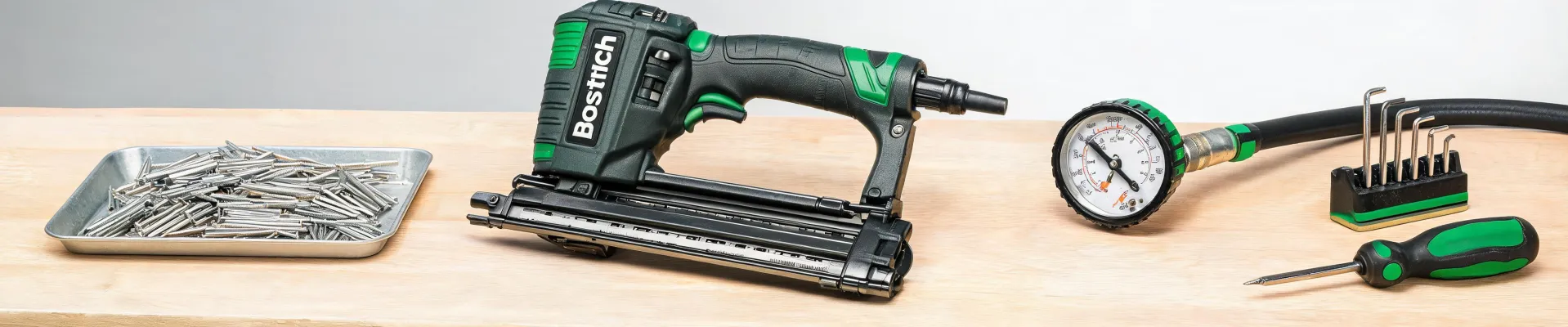
How to use a Bostitch air compressor
-
Is the Bostitch 1.5 hp air compressor enough for job-site work?
-
Can a Bostitch air compressor run a submersible sump pump 457-2?
-
Is a 171 piece tool set worth it?
-
Which Screwdriver Sets Deliver Optimal Value?
-
What else should I check before an emergency repair call?
I coordinate emergency repairs for commercial buildings. That means I'm the person who takes the call when a door isn't closing, a ceiling tile fell, or a store has to open with loose trim everywhere. In that role, I've tested more field shortcuts than I like to admit. These are the answers I would give a new tech in the van with me, with the site clock running.
How to use a Bostitch air compressor
The short version: put it on a level surface, make sure the tank is drained and the drain valve is closed, plug it into a grounded outlet, let it fill, set the regulator for the tool, and test-fire into scrap before you start. Every step matters, but if you're in a hurry, do not skip the last one.
- Inspect the hose and connections. A pinhole in a cheap hose makes the compressor cycle constantly and the nailer lose power. I've wasted 30 minutes on a bad hose.
- Close the tank drain valve. It's usually on the bottom of the tank. Turn it clockwise until snug. If it's open, your tank will never build pressure and you'll think the pump is broken.
- Plug into a real outlet. If possible, skip the extension cord. If you have to use one, use a 12-gauge cord and keep it short. A 16-gauge cord can cause voltage drop, and the motor won't start.
- Turn it on and let the tank fill. Wait until the pressure switch stops the motor. This tells you the tank is at the unit's cut-out pressure.
- Set the regulator. The regulator is the dial near the hose outlet. Turn it to the PSI range your nailer or stapler calls for. Not the tank pressure—the regulator output.
- Test-fire through scrap. Nail depth changes with wood density. If nails sink too deep, lower the pressure. If they stick up, raise it in small steps.
- Shut down and drain. When you finish, unplug the compressor, bleed the air, and open the drain valve. Water collects inside the tank. If you leave it there, the tank can rust from the inside.
I'll admit, in the beginning I thought draining the tank was optional. Then a customer's workshop got a rusty water spray out of the airline during an emergency call. I drain systems now.
Is the Bostitch 1.5 hp air compressor enough for job-site work?
For the work I do—finish nails, brads, pin nails, air staplers, and the occasional repair—yes. The Bostitch 1.5 hp air compressor is one of the first compressors I load onto a service van. It has enough air for trim packages and cabinet work, and it fits in a corner of the van without taking up the whole bed.
But I don't pretend it replaces a large stationary compressor. If a crew is running a framing nailer nonstop, or there are three people pulling from the same outlet, you need more tank volume and a higher CFM rating at 90 PSI. The 1.5 hp model will keep up with a guy shooting finish nails. It won't keep up with a framing crew laying sheathing all morning. I learned that while trying to frame a storage shed with a 6-gallon tank. It worked, sort of, but I spent a lot of time waiting.
To be fair, that's not a flaw in the compressor. It's the difference between a compressor designed for intermittent fastening and one designed for continuous high-volume tools. Look at the CFM at 90 PSI before you buy, not just the max PSI number.
Can a Bostitch air compressor run a submersible sump pump 457-2?
No. A submersible sump pump 457-2 is an electric water pump, not an air tool. You do not plug it into a Bostitch compressor. The compressor produces compressed air for nailers, staplers, and air tools; the pump produces water pressure so it can push water out of a pit or basin.
I realize this question looks odd. It usually comes up when someone is pulling up spec sheets late at night, sees model numbers, and wonders whether the air compressor can somehow drive the pump. It can't. If you're dealing with standing water, the pump needs a dedicated electrical circuit and a discharge line. The Bostitch 1.5 hp air compressor is not a substitute.
I should add: if this is a water emergency, verify the pump's voltage and amp draw before you replace anything. Most submersible sump pumps run on standard 115V, but I don't know your exact model's nameplate, so check it.
Is a 171 piece tool set worth it?
As an emergency backup, yes. As your only professional tool kit, maybe not.
A 171 piece tool set usually includes sockets, hex keys, screwdriver bits, pliers, and a case. I keep one in a service van. When a repair turns out to need a 10mm socket and a #2 Phillips while I'm on a ladder, it saves me a trip to the truck. It is useful because it covers a lot of small, common jobs.
However, I'd rather see a tradesperson buy a smaller set of real working tools than spend the same money on a 171 piece set where every piece feels thin. The problem is not the number; it's the quality per piece. If the sockets feel sloppy or the included screwdrivers flex, you won't use it after the first week.
If you are considering a 171 piece tool set, open the case and test the 10mm socket and the #2 Phillips. If either one feels weak, keep it as a trunk spare and buy a better primary kit.
Which Screwdriver Sets Deliver Optimal Value?
This is the question I wish more people asked before buying a giant driver set. Optimal value doesn't mean cheapest, and it doesn't mean biggest. A screwdriver set is worth the money if the tips grab the screw instead of camming out.
For commercial maintenance, I'd rather have a 6-to-10 piece set with heat-treated steel than a 30-piece set from a discount rack. Look for:
- Chrome-vanadium or S2 steel. The tip stays sharp much longer.
- A well-formed #2 Phillips. Loose tolerances are what strip screws.
- Flatheads with a flat, square tip. Rounded flatheads just gouge the screw slot.
- Handles that don't roll. Round handles may feel fine until they roll off a steel beam.
- Tips that are actually hardened. Some cheap sets paint over soft steel.
Value also depends on the job. If you are doing electrical work, an insulated screwdriver set is value. If you're doing finish carpentry, a set with larger handles gives more torque for less hand fatigue. If you only turn the occasional loose screw, then yes—a cheaper set is okay. The honest answer is that no one set is optimal for everyone.
I used to think a professional screwdriver set was a marketing excuse. Then I put a cheap Phillips next to a properly fitted one and realized the tip geometry was why I was stripping screws. The difference shows up within the first hour, not the first year.
What else should I check before an emergency repair call?
One more thing I've learned the hard way: check the circuit and extension cord before you drive. If you show up at a client's building and the Bostitch 1.5 hp air compressor won't start, it might not be the compressor. It could be a long cord, a shared circuit, or a GFCI outlet that tripped.
Compressors draw a big inrush current when the motor starts. A 12-gauge extension cord under 50 feet works for many units; anything thinner and longer causes voltage drop. And if a compressor is on the same circuit as a refrigerator or a table saw, you may trip a breaker at the worst moment.
I now do a 60-second precheck before loading: tank drained, intake filter clear, drain valve closed, and correct regulator setting for the expected tool. In an emergency, that precheck saves more time than the extra speed on the drive.

Leave a Reply