-
The Mistake That Made Me Change How We Buy Tools
-
When a Bostitch Nail Gun Stops Firing — Check These Before You Send It Out
-
What I Actually Look for in a Bostitch Air Compressor
-
Demolition Hammer 20 lb: My Rental-vs-Buy Rule (With Math)
-
The 6-in-1 Pliers Problem I Didn't See Coming
-
Does a Saw Blade With More Teeth Cut Better? Usually Not
-
Where My Math Doesn't Work
I approve tool purchases for a living, and I'll start with a confession: I don't care much about tool brands. I care about what a tool costs over two years, not what it costs on the day of the invoice. That gap—two years instead of two days—is where budgets quietly die.
For the past six years, I've handled purchasing for a 12-person remodeling crew. Since 2020, I've signed off on roughly $180,000 in tools, parts, and repair bills. Here's the part that surprised me: most of those dollars weren't spent on tools. They were spent on assumptions.
Assumption #1: If a Bostitch nail gun isn't firing, it's broken. Assumption #2: If the crew asks for an air compressor, a 20 lb demolition hammer, or a set of pliers, we have to buy it. Assumption #3: A saw blade with more teeth cuts better.
All three are usually wrong. Now I have the invoices to prove it.
The Mistake That Made Me Change How We Buy Tools
When I first started this role, I thought the biggest risk in the tool budget was paying too much at the register. I negotiated hard with vendors and felt good about the discounts. But after tracking every work order for a couple of years, I realized the real overruns never showed up on purchase orders. They showed up as downtime.
Here's a concrete example from our own cost tracking system. In 2023, we spent about $2,900 on outside tool repairs. In 2024, we spent about $1,100. Same crew, same tools, different process. We didn't find a cheaper repair shop. We found a way to stop sending tools out before anyone looked at them.
That single change probably saved us more than every vendor discount I negotiated in the same period. Which brings me to the questions that actually show up on my desk.
When a Bostitch Nail Gun Stops Firing — Check These Before You Send It Out
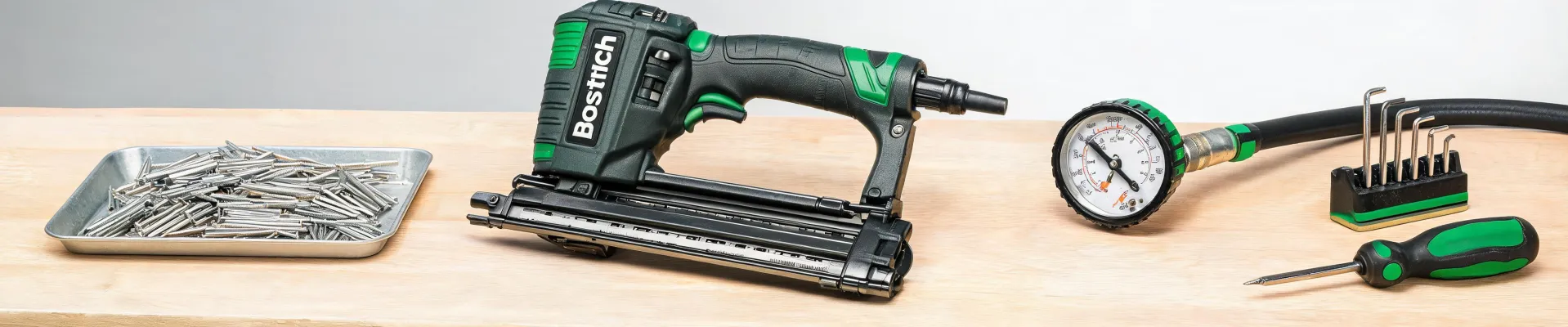
Let's deal with the subject that probably brought you here. A Bostitch nail gun not firing is usually not a dead tool. In my experience, it's one of three things:
- It's not getting enough air. Pneumatic nailers need a certain pressure range—most Bostitch models list 70–120 PSI in the manual. A tired compressor, a wrong regulator setting, or a worn quick-connect can all starve the gun. We've diagnosed two separate intermittent failures that turned out to be a $9 coupler, not a $300 gun.
- It's dry. Pneumatic tools need a few drops of pneumatic tool oil before heavy use. Tools that run dry develop sticky O-rings and act like they're dying. One of our guns started skipping every few fasteners; the fix was three drops of oil. Simple.
- The magazine or driver is jammed. Slightly bent collated nails, debris in the magazine, or a worn driver hitting a fastener at the wrong angle can all stop a gun cold. Take the magazine apart, clear it, and inspect the driver before you assume the internals are gone.
None of this means repair shops are a waste of money. We still use one for real problems—internal seal kits, trigger valve issues, things that require a bench and a manual. But sending a dry, starving, or jammed tool to a shop is how you turn a 10-minute fix into a $90 invoice plus a week of downtime.
What I Actually Look for in a Bostitch Air Compressor
People ask whether the Bostitch air compressor lineup is worth the money. I think that's the wrong question. The right question is whether the compressor matches the tools you're feeding.
I watch crews buy a compressor because the tank is big and the price is low. Then they wonder why a framing nailer won't cycle properly. Tank size stores air; it doesn't create it. The numbers that matter are the SCFM rating at the PSI your tools actually require. If you're comparing a Bostitch air compressor against another option, compare those specs at the same pressure, not the decal on top.
We run a Bostitch compressor in our shop because it delivers enough volume at the pressure our nailers need and because replacement parts are easy to source. The logo was never the main reason. The spec sheet was. If the spec sheet lies, the logo won't save your schedule.
One more thing: leave yourself room to grow. A compressor that barely covers one nail gun will struggle the day you add a second gun to the same hose run. System compatibility matters more than most buyers realize.
Demolition Hammer 20 lb: My Rental-vs-Buy Rule (With Math)
A request line reading demolition hammer 20 lb can be a trap. It looks like a straightforward purchase decision. It isn't.
When a project manager asked me to buy one last year, I went back and forth for longer than I'd like to admit. On paper, owning a tool you'll use for years sounds responsible. But our records showed we only needed it for two days on that job. The local rental yard where we have an account charges about $86 per day—as of April 2026, local rates. Two days cost us $172. Buying a mid-range unit would have cost more than $600, and then it would sit in storage for months, needing maintenance before the next time we touched it.
Our internal rule after that analysis: if a 20 lb demolition hammer will be on a jobsite fewer than eight days a year, rent it. If it's going to work more than that, buying starts to make sense. Your break-even point will depend on your local rental rates and the price you can actually get. Run the numbers before you romanticize owning a breaker.
Also, 20 lb is heavy after a morning of overhead work. Whoever is swinging it will care more about vibration control and a functioning handle than about the logo on the side.
The 6-in-1 Pliers Problem I Didn't See Coming
When the order list just says '6 in 1 pliers', nobody looks twice. The line item is cheap. That's exactly why it hides in the budget.
We bought inexpensive 6-in-1 pliers in bulk because the price per unit looked harmless. Then we tracked replacements. A $7 pair lasted about four months on a job site—if it didn't disappear first. A $22 pair with better steel and a pivot that doesn't flex has lasted one of our electricians more than two years. That isn't a brand claim. It's in our inventory log.
The pattern applies beyond pliers. The cheapest version of a multi-function tool usually fails at one of its functions, and then the worker carries two tools anyway. That defeats the entire reason to buy a 6-in-1 in the first place.
I'm not saying you need the most expensive pair on the rack. I'm saying look at cost per month of actual use, not cost per unit on the purchase order.
Does a Saw Blade With More Teeth Cut Better? Usually Not
The short answer: a saw blade with more teeth doesn't cut better. It cuts smoother. There's a difference, and paying for smoothness when you don't need it is a classic budget leak.
More teeth means more cutting edges touching the material. That produces a finer finish, but it also means slower cuts and more heat. For ripping dimensional lumber or breaking down framing stock, a blade with fewer teeth clears material faster and runs cooler. For finish crosscuts or sheet goods where tear-out matters, a higher tooth count earns its keep.
What actually matters more than the number of teeth is the tooth geometry and the application. A blade designed for ripping will beat a high-tooth finishing blade at ripping every time, no matter how many teeth it has.
I noticed our framing crew using finish blades for rough work because the blades were already in the trailer. It cost us time, blade life, and money. We now keep two blade types on the truck and label the cases. It sounds stupidly simple. It saved us a real chunk of the blade budget.
Where My Math Doesn't Work
I want to be honest about the limits of what I just told you.
- My $86 per day rental rate is from our local yard in April 2026. Your market may be different. Re-run the math before you make a rental or purchase call.
- The eight-day rule for a demolition hammer is based on our crew size and utilization. A commercial crew doing demolition weekly will hit the buy break-even point much faster.
- Our repair spend numbers come from one company, not an industry study. Your failure patterns will differ if your tools are maintained differently than ours were.
- Prices and product specs change. Verify current details before you write a purchase order.
Tools wear out. O-rings dry out. Rental counters close early on Saturday. The system will never be perfect. But after six years of watching budgets, I'm convinced of one thing: most tool problems are really decision problems. Buy the wrong thing and you'll feel it for years. Fix the decision and the tool budget starts fixing itself.

Leave a Reply