-
1. Check the compressor's airflow before you check its maximum pressure
-
2. Confirm it's the stapler you need, not the nailer
-
3. Buy for the crew's next two projects, not just the current one
-
4. Verify parts and service support before you commit (this is the step everyone skips)
-
5. Put fasteners, fittings, hose, and a test run into the same order
-
6. If 'what is the best brand of welding machine' is part of your search, use the same sequence
-
The mistakes I still watch for
I handle purchasing for a 40-person construction and maintenance company. Since 2021, I've managed tool orders, fasteners, and repair parts—roughly $90,000 a year across about a dozen vendors. I'm not the one installing hardwood floors or running a framing crew. I'm the one who signs the purchase orders, which means I'm also the one who gets the call when a piece of equipment doesn't work on the day it's supposed to.
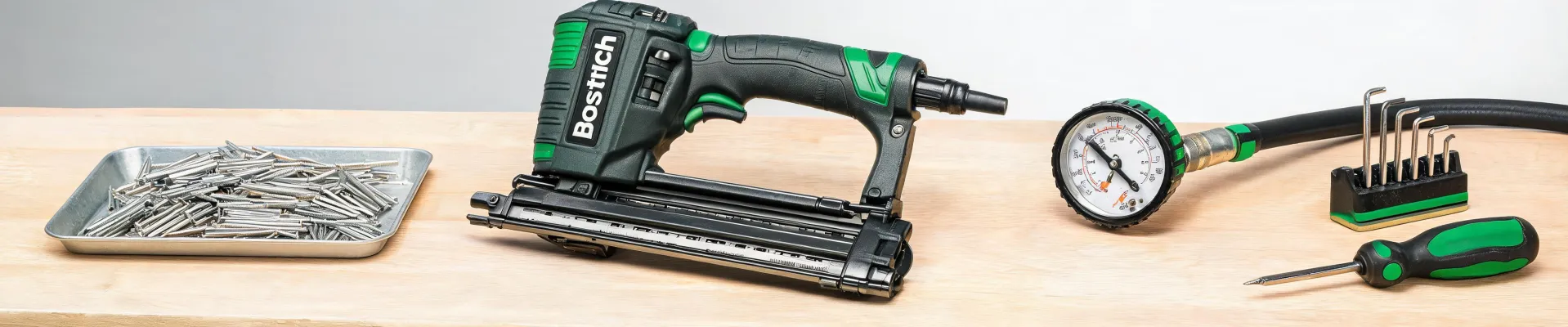
This is the checklist I've built after enough of those calls. Use it when the request is for a Bostitch 150 psi air compressor, when the crew lead asks for a Bostitch MIIIFS pneumatic floor stapler, or when you're ordering both and need the purchase to be right the first time.
1. Check the compressor's airflow before you check its maximum pressure
Bostitch makes air compressors with a 150 PSI maximum tank pressure, and that number is useful. But maximum tank pressure is a ceiling, not a running pressure. A pneumatic stapler or nailer should be run within the pressure range listed on its own spec sheet. Cranking the regulator to 150 PSI will not make the tool faster—it will make it wear out faster.
The spec that determines whether a compressor keeps up is airflow, usually listed as SCFM at 90 PSI. When I'm scanning a tools air compressor category, I start with the SCFM number at the pressure my tools actually need. Take the CFM requirement for every tool you expect to run, add at least 25 percent as a buffer, then compare compressors.
I assumed a bigger tank and higher PSI rating meant a stronger system—or rather, I did not realize I was making an assumption until a crew tried running a stapler and a nailer from the same compressor and the pressure gauge kept dropping. There wasn't enough airflow to run both tools at working pressure.
Checkpoint: Write down every tool this compressor will power, including future jobs, and total the CFM at each tool's operating pressure before you choose a model.
2. Confirm it's the stapler you need, not the nailer
In flooring work, stapler and nailer are not interchangeable terms. Bostitch sells the MIIIFS pneumatic floor stapler, which drives flooring staples, plus a separate flooring nailer model that drives cleat nails. They are different tools with different fasteners.
I learned this one the awkward way. I called our supply house and said we needed the Bostitch floor stapler. The person on the other end heard floor nailer. Same words, different machine. The mistake showed up when the box was opened on the job site and the fasteners we ordered did not fit the tool.
Checkpoint: Put the full model number on the purchase order, not just the trade name. If the request says MIIIFS, the PO should say MIIIFS.
3. Buy for the crew's next two projects, not just the current one
A compressor often outlasts every other tool in the container. The unit bought in 2026 may still be on the truck in 2032. If the compressor is being ordered for a flooring crew today, the next project could bring a framing nailer, a roofing nailer, or a second crew working on the other side of the building.
Ask the person who will actually use it what else this compressor will run. I nearly ordered a lighter, smaller compressor because it was about $80 cheaper. The crew lead mentioned they would want two nailers running off the same unit the following month. That one sentence saved me from buying a second compressor later.
Checkpoint: Talk to the crew lead or maintenance supervisor before the PO goes out, and confirm their answer in writing if you can.
4. Verify parts and service support before you commit (this is the step everyone skips)
No compressor or pneumatic tool brand makes a product that never needs a replacement part. The practical question is how easy the part is to get when it fails.
Before approving an air compressor or pneumatic tool order, I look up the parts diagram and check whether common replacement parts are available. If a $20 check valve fails and nobody local stocks it, a $300 compressor becomes a very heavy paperweight for weeks.
One of my early purchases was from a discontinued model line, and I checked nothing except the price. When the check valve failed six months later, the repair took three weeks and the lost crew time cost more than the compressor. I still kick myself for that one.
This is the same habit I use with invoices: verify the support chain before you commit, not after. According to Bostitch's service and parts pages on its public website (accessed April 2026), the brand publishes parts diagrams and offers replacement parts for many of its compressors and tools. That type of information is much easier to confirm before the order than after the breakdown.
Checkpoint: Locate the parts diagram for the exact model, confirm common replacement parts are orderable, and identify the nearest authorized service center before you buy.
5. Put fasteners, fittings, hose, and a test run into the same order
A tool order that arrives without the right fasteners is not really an order. For a flooring stapler, fastener type and size are part of the specification. Check the manual for the approved staple and confirm the supplier has it in stock before the tool ships.
Order hoses rated for the working pressure, good quality couplers, tool oil, and any extra parts the tool uses in the same order. Then run a test on scrap material before the scheduled install day. It's a five-minute check that can prevent a five-day delay.
The one time I skipped the test, the tool had a loose fitting from shipping and would not hold pressure on the job. A five-minute check in the shop would have caught it. Instead, the installer found it on site. (Surprise, surprise.)
Checkpoint: Make the order complete: tool, fasteners, hose, fittings, oil, and a scheduled test run on scrap.
6. If 'what is the best brand of welding machine' is part of your search, use the same sequence
Bostitch does not make welding machines. So I will not give a brand ranking for welders here—that would be pretend expertise about equipment we don't build. The useful answer is the same framework: start with the job, then the specifications, then the support chain, then the brand.
For a welder, the checks are: what material and thickness will you weld, which process fits that work (MIG, TIG, stick, or flux-core), what duty cycle does the machine deliver at the amperage you will use, where can you buy wire, gas, rods, and tips, and who services the unit locally. Answer those first, and the brand decision becomes much easier.
Checkpoint: Apply the same five checks used for the compressor. Airflow doesn't apply to a welder, but duty cycle, consumables, service, and spare parts absolutely do.
The mistakes I still watch for
The ordering mistakes that cost us the most were rarely exotic. They were choosing a name before checking the numbers, and buying the tool without planning for its support and consumables. Both are preventable. I keep a folder with parts diagrams and current spec sheets for the models we use (mental note: update that folder every January). Checking it costs five minutes. Correcting an order costs days.
Reference note: Model and product references, including Bostitch 150 psi air compressors and the Bostitch MIIIFS pneumatic floor stapler, are based on Bostitch's public product pages as accessed in April 2026. Product lines and specifications change, so verify current CFM, operating pressure, and approved fasteners against the manual for the exact model you order.

Leave a Reply