-
Before Anything Else: Which Scenario Are You?
-
Scenario 1: Production Work — Go Pneumatic
-
Scenario 2: Service Calls and Punch Lists — Go Cordless
-
Scenario 3: Emergency Work — Here's the Unpopular Answer
- Air Compressor Review: What Actually Matters
-
How to Keep a Hole Saw From Walking
-
Thirty Seconds to Your Answer
At 4:17 on a Friday morning in February 2026, the phone woke me. A property manager on the other end had a third-floor laundry room full of water — a sprinkler-fitting union had let go around 2 a.m., and the leak had been running into the unit below for two hours before anyone noticed the ceiling stain. She didn't ask if we could help. She asked what time we'd be there.
I run field operations for a commercial restoration and repair company. In my role, I've coordinated more than 200 emergency callouts over 14 years, and they all share the same shape: a deadline, a building that has to work again, and zero time to fool with tools that won't perform. That's why, when someone asks me which Bostitch nail gun they should buy, I don't answer with my favorite model number. I ask them what their week looks like.
If you came here hoping for one universal answer, here's the honest version: there isn't one. A Bostitch cordless nailer is the right answer for some work patterns. A pneumatic nail gun Bostitch has been building for decades is the right answer for others. And plenty of tradespeople genuinely need both. The trick is knowing which one belongs on your truck first.
Before Anything Else: Which Scenario Are You?
I'm not gonna pretend there's a tool that works for every job, because there isn't. But there are three common work patterns, and once you identify yours, the product choice gets a lot clearer.
- Scenario 1: The production week. You're framing walls, setting trusses, sheathing, laying subfloor, or building all day in one spot. Power is usually available, and you shoot nails for hours without stopping.
- Scenario 2: The traveling week. Trim, punch lists, service calls, repairs in occupied buildings. You work in short bursts — 20 minutes on a ladder, 30 minutes at a door — then pack up and move.
- Scenario 3: The emergency week. You don't know at 7 a.m. what you'll be doing by 11. Restoration, storm response, deadline-driven repairs. This is my week.
Each of those patterns makes a different tool the smart buy. Here's what I've settled on after years of watching good crews waste money on the wrong one.
Scenario 1: Production Work — Go Pneumatic
If you're shooting nails at volume all day, buy a pneumatic nailer. Not because the current battery-powered Bostitch models are weak — they aren't — but because production work turns your day into a charging problem. Every nail gun that runs on batteries eventually needs to sit on a charger, and the charger becomes the bottleneck on a jobsite. Pneumatic tools don't care about battery health, cold weather, or the apprentice who forgot to plug things in overnight.
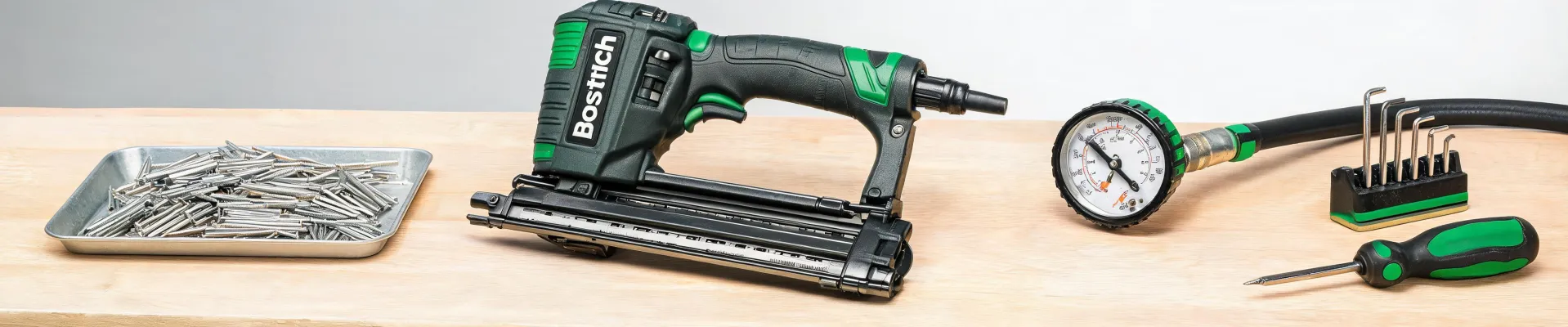
For framing, the Bostitch F21PL is the tool I compare everything else against. Bostitch specs it as a 21-degree, plastic-collated framing nailer that drives 2- to 3-1/2-inch full round-head nails. It doesn't have the flashiest features on the market, and that's sorta the point. It's boring, predictable, and still firing at the end of a ten-hour day.
But the nail gun is only half the system. I have watched guys spend real money on a good nail gun and then hook it to a compressor that runs out of breath after ten fasteners. That's not a nail gun problem; it's a compressor problem, and it deserves a full explanation below.
Scenario 2: Service Calls and Punch Lists — Go Cordless
If your week is a string of short jobs in buildings where people are trying to work, buy a Bostitch cordless nailer and ignore anyone who says battery tools are toys. The reason isn't freedom from the hose, although that helps. It's that your work cycle is short. You pull up, you shoot twenty nails, you pack up. A cordless nail gun is ready before you've found an outlet. A pneumatic setup means dragging a compressor out of the truck, waiting for the tank to fill, and listening to it cycle on and off in a client's hallway.
Here's where my advice goes against the grain: if you can only own one cordless nailer for service work, don't start with an 18-gauge brad nailer. Start with a 15-gauge angled finish nailer. The pin hole is a little bigger, sure. But doors, case molding, window trim, and the repair calls that actually pay your invoices hold better with a heavier nail. An 18-gauge brad is a great second nailer. It's a weak first nailer.
One warning: if your service day keeps turning into 400 nails before lunch, you're actually living in Scenario 1. Buy the air compressor and the pneumatic gun, and thank me later.
Scenario 3: Emergency Work — Here's the Unpopular Answer
You would think the emergency week is the best use case for a cordless nailer. No compressor to drag around, no hose, grab-and-go. That's what the marketing says. But if you actually get paid to hit a deadline in an unknown building, I'd argue the opposite: buy the pneumatic setup first.
Here's why. When the call comes in, you don't know the conditions. You might be framing a temporary wall at 9 a.m. and hanging door frames in a finished corridor at 2 p.m. Batteries die. Chargers get left behind. Crew members grab the wrong battery out of the truck. But if there's a generator running, there's air, and a compressor with 100 feet of hose feeds more than a nailer. It runs a blow gun to clean debris, a stapler for vapor barriers, an air chuck for tires. One compressor plus several air tools beats five battery tools that all need to be charged the night before.
That's why my truck carries both, but in a specific order: a pneumatic Bostitch nailer and a compressor get unloaded first, and a Bostitch cordless nailer rides as the backup for finish work in spaces where dragging hose isn't practical. If your budget only covers one setup and your weeks look like mine, make it the pneumatic one.
Air Compressor Review: What Actually Matters
Most air compressor reviews spend their word count on tank size and maximum PSI because those are easy for the writer to compare. After 14 years of buying and running these machines on deadlines, I can tell you neither number predicts whether you'll be happy.
Tank size only decides how often the pump cycles. The number that decides whether your nail gun keeps its rhythm is the pump's SCFM rating at 90 PSI. SCFM tells you how much air the pump can deliver at working pressure, and a nailer draws a burst on every trigger pull. If the pump can't refill the tank fast enough, pressure decays, the gun gets sluggish, and fasteners start sinking shallow. A big tank with a small pump just fails more slowly.
Here's how that looks in practice. The Bostitch BTFP02012 — the 6-gallon pancake that's been the standard for trim work for years — is rated at 2.6 SCFM at 90 PSI. That's plenty for a brad nailer or finish nailer at working speed. It is not enough for production framing with a full round-head framing nailer. For that, move up to a wheeled unit that delivers at least 4 SCFM at 90 PSI, and don't get distracted by extra tank capacity. CFM at 90 is the spec that keeps the nailer shooting.
Ball Valve: The Five-Dollar Upgrade That Prevents a Bad Morning
Here is the part of compressor ownership that no one puts on the box. When air gets compressed, it gets hot, and when it cools in the tank, the water vapor in it condenses. On a humid day, even a small tank collects enough water to see. That water is what ruins pneumatic tools over time — not normal wear. It rusts the tank from the inside, and rust scale breaks loose and clogs valves, regulators, and the tiny ports inside your nail gun.
The surprise wasn't a dramatic motor failure on one of our jobs. It was a clogged check valve — rust scale from a tank nobody had drained in years — on the morning of a $40,000 contract. We lost that job in 2023, and it wasn't the compressor brand's fault. It was a maintenance failure, pure and simple. After that, our field policy became: every compressor gets a brass ball valve drain, and the last person to use it drains it before leaving the site.
The swap is easy. Most factory tank drains are awkward little petcocks that you're supposed to open while crouching under the tank with a wrench. So nobody does it. Replace yours with a brass quarter-turn ball valve from any hardware store — typically a 1/4-inch NPT thread, though check your manual — and draining becomes a one-second job. Depressurize the tank completely, remove the old drain, wrap the threads in Teflon tape, and install the new valve. That ball valve is the cheapest reliability upgrade I know of in this industry.
How to Keep a Hole Saw From Walking
A wandering hole saw burns more time on emergency jobs than almost any drill problem I know. Usually it's not the saw's fault. The pilot bit skates before it bites, and once that pilot hole wanders, the saw follows it. Here's what's kept my hole saws exactly where I put them.
- Center punch the start point. This is non-negotiable on metal, and it helps on wood, too. The pilot bit needs a divot to grab, not a flat surface to slide across. A nail set works if you don't carry a center punch.
- Start at slow speed. High speed makes the pilot bit skitter. Let the drill turn slowly until the pilot bit fully seats, then speed up and start cutting.
- Let the pilot bit work before you lean on the saw. In my first year running crews, I made the classic rookie error: I pushed hard to make the cut go faster, and the saw walked almost every time. The drill needs to be steady, not forceful.
- For holes over two inches, use the angled start trick. Tilt the drill so only one edge of the hole saw's outer teeth contacts the surface. Cut a shallow groove, then bring the drill perpendicular once the groove is established. The groove guides the saw and stops it from wandering.
- Use masking tape on smooth or glossy surfaces. Laminate, painted metal, and ceramic tile don't give the pilot bit any purchase. Tape gives it traction.
Thirty Seconds to Your Answer
Still torn? Run yourself through the four questions below. They'll tell you more about the right choice than any spec sheet:
- Do you usually work on one site for days at a time, or are you packing up several times a day?
- Do you shoot more than 300 fasteners in a stretch, or are most of your tasks under 50 nails?
- Do you work in occupied buildings where a compressor cycling on could be a problem?
- When you arrive at a job, do you already know exactly what you'll be fastening?
If your answers lean toward one site, high volume, predictable, unoccupied, buy a pneumatic Bostitch nailer and pair it with the right compressor from the review above. If your answers lean toward multiple sites, short bursts, and occupied spaces, go with a Bostitch cordless nailer and don't look back. If you're in the middle — especially if your week is full of surprises — start with pneumatic for the heavy work and add a cordless finish nailer as soon as the budget allows.
I can't tell you which Bostitch nail gun belongs in your future without knowing your routine. But I can tell you this: buy for the week you actually have, not the week you imagine. The wrong tool fails at the worst possible moment, and in 14 years, I've never had an emergency call wait patiently while I made a second trip to the truck.

Leave a Reply