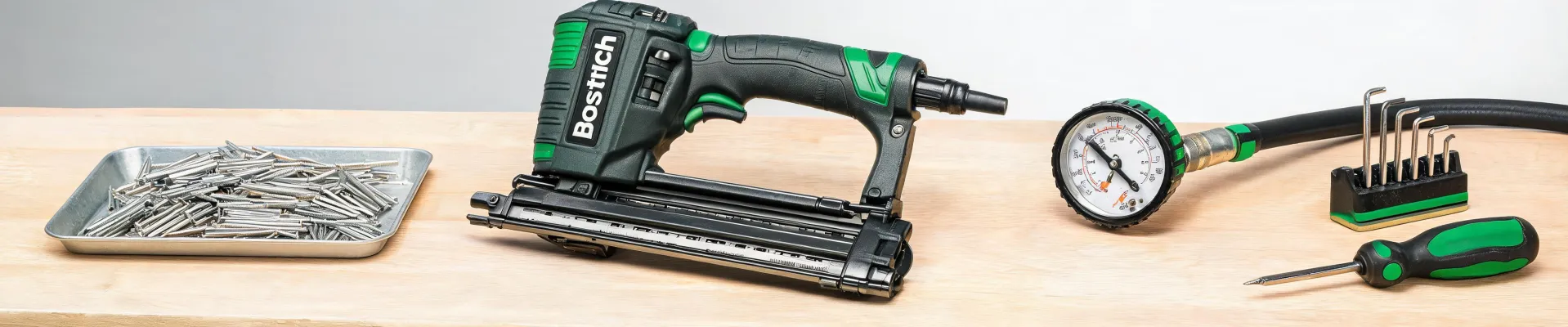
When I first started inspecting completed work, I assumed the Bostitch 6.0 gallon air compressor was the only real choice for professionals. Cordless nail guns seemed like a compromise—handy, maybe, but not for crews expected to deliver tight, repeatable fastening all day. Four years later, I have a different answer. I am not saying the compressor is bad. It is not. I am saying the compressor is not the best tool for every context, and pretending otherwise creates quality problems.
I am a quality/compliance manager for a facilities maintenance company. I review completed work orders—roughly 200 per month, maybe 230 in summer. In Q1 2024, we had a $9,000 redo because a crew drove fasteners with a compressor that was set too low. No one checked the regulator. The nail heads sat proud, the trim looked wavy, and the client stopped trusting our reports. That is when I started tracking which fastening system technicians used on each job and why they chose it.
Our job mix is broader than a typical trim shop. On any given week, we replace an N57 submersible pump in a lift station, test a pressure washer battery before a seasonal fleet, and still get asked how to adjust a cupboard door hinge on a punch list. That variety is exactly why this Bostitch comparison matters. A system that performs in a workshop can fail on a service route, even if the tool itself is fine.
What I Am Comparing
I am not trying to settle a general air-powered versus battery-powered debate. I am comparing two specific Bostitch setups. System A is the Bostitch 6.0 gallon air compressor paired with a pneumatic trim nailer. System B is a Bostitch cordless nail gun with a fresh lithium-ion battery. I looked at setup time, trigger consistency, maintenance, and real-world quality. The focus is not on peak power. It is on which system helps a good crew avoid mistakes.
Round 1: Setup and Mobility
If the job happens in one spot all day, System A is the one I order. You set the regulator once, connect the hose, and the 6.0 gallon tank holds enough air to keep up with a trim nailer while the compressor cycles. There is no charger waiting and no battery memory. It simply works, for as long as you keep it maintained.
But a service route is not one spot. Crews arrive at a building, load a cart, and walk to a third-floor corridor. A Bostitch 6.0 gallon air compressor is not enormous, but it is heavy enough that technicians will find reasons not to carry it upstairs. When that happens, they either hand nail or they rush. Both hurt quality.
The Bostitch cordless nail gun removes that entire path. No hose to untangle, no outlet to fight over, no compressor running unattended in a hallway. In our field audits, crews with cordless guns completed punch list tasks in one visit more often. I expected that convenience to cost consistency. It did not. More consistent work often comes from making the right process easy.
Round 2: Consistency at the Trigger
This is where I expected the compressor to win easily. A tank holds steady pressure, and steady pressure should mean repeatable nail depth. That logic is true only if someone actually maintains the system. If the regulator drifts, the tank has water in it, or the compressor is undersized for the nailer, depth changes during the same run. The nailer is not the problem. The system is.
The cordless nail gun depends on the battery. On a healthy charge it drives consistently. As the battery fades, the tool slows down or stops driving before it produces a long row of proud fasteners. When we standardized fresh Bostitch batteries on service calls, shallow-nail callbacks dropped. The crew could see and control battery state. They could not always see a regulator that had been bumped in the back of a van.
We see the same pattern with a pressure washer battery that dies in its first season. It was not always a bad cell; it was cooked in storage. If you store Bostitch batteries the same way, depth control will suffer as the pack ages.
Round 3: Maintenance, Repair, and Parts
Bostitch earns points from me because I have been able to find repair parts and keep diagrams for the tools we run. I do not have to replace a whole tool or a whole compressor when one component fails. That matters more in a compliance program than any marketing claim.
System A has more maintenance points. The compressor needs its air filter cleaned, its tank drained, and its moving parts checked. The pneumatic nailer needs regular lubrication. If that maintenance is skipped, moisture can get into the air line and cause jams or rust. None of this is complicated, but it is a discipline.
System B has fewer daily maintenance points. You keep the nose clean, keep the moving parts lightly lubricated, and charge batteries. The catch is batteries become consumables after a few years. We budget for replacement battery packs the same way we budget for saw blades. That is not a reason to avoid cordless; it is a reason to plan for it.
If you ask which system is cheaper to maintain over five years, the compressor and pneumatic nailer usually wins—provided someone cares for it. If you ask which system is more likely to get used correctly in scattered work, the cordless wins. Those are different questions.
What Would I Choose Now?
If you are at a fixed workstation or doing high-volume trim in one building, choose the Bostitch 6.0 gallon air compressor. It is predictable, the tool is light in the hand, and with a basic maintenance schedule it will run for years.
If you are on a maintenance route, doing punch list work, or moving between rooms and buildings, choose the Bostitch cordless nail gun. The mobility advantage is real. With fresh batteries, our field data shows fastener consistency is good enough for finished work—and sometimes better than pneumatics, because the tool is less likely to be misused.
And if the job is literally how to adjust a cupboard door hinge, do not buy either. You need a screwdriver, a level, and probably no more than two millimeters of adjustment. The fastening system matters for the trim around the cupboard, not for the hinge plate itself. Recommending a nail gun for that task would be wrong.
The honest limitation is that neither system is the one-size-fits-all answer. If you buy a cordless nail gun and drive thousands of nails from one location, you will spend more on batteries than necessary. If you buy a 6.0 gallon compressor for service work, you may leave it in the van because it is too heavy to carry up three flights of stairs.
I began this comparison believing the compressor was the professional answer. I still recommend it for production. But I now put the Bostitch cordless nail gun in a service van before the compressor, and I do not feel like I am compromising quality to do it.

Leave a Reply