-
Lowe's Bostitch nail gun: what I check before approving an order
-
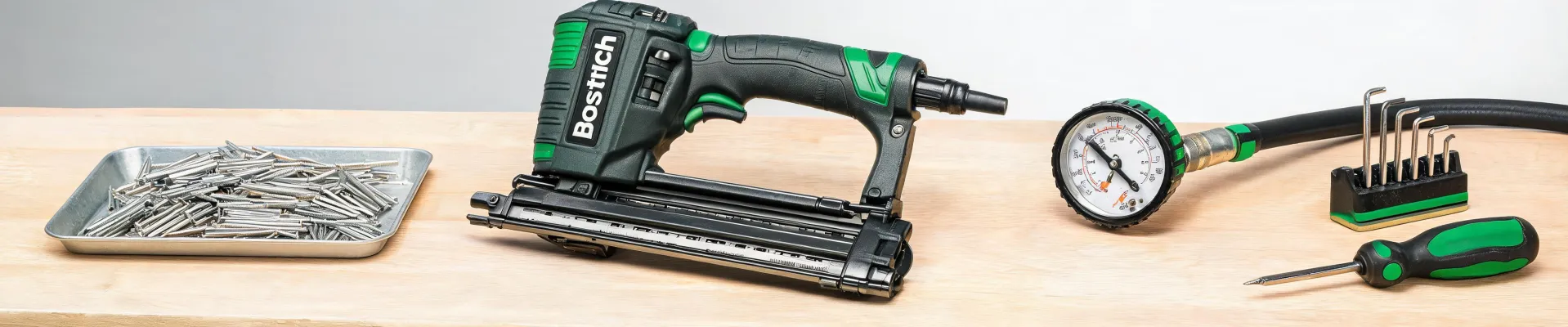
Bostitch pneumatic staple gun: the air supply is half the system
-
12V impact driver: more useful than you might think
-
496304 saw blade: trust the part number, not the picture
-
Why does circular saw kickback happen? It's a pinch, not a power problem
-
What this advice doesn't cover
Before you compare prices on Bostitch fastening tools, compare the specs. Whether it's a Bostitch nail gun from Lowe's, a Bostitch pneumatic staple gun, the 496304 saw blade, or a compact 12V impact driver, the model number is a promise. It describes the fastener, compressor, or arbor configuration the tool was built for. Ignore that promise and you get returns, skipped staples, trashed stock, and in the worst case, circular saw kickback that sends the saw backward into your hands.
I work as a quality and brand compliance manager at a tool distributor. I review roughly 300 SKUs a year before they reach contractors, maintenance teams, and production shops. In Q3 2025, 5.4% of first shipments I checked failed because the wrong part number was ordered, not because the tool was defective. That number stayed with me. A lot of jobsite problems start with a mismatched specification.
Here is the short version, in case you are reading this between jobs:
- Lowe's Bostitch nail gun: shop by fastener family first. A brad nailer is not a framing nailer even on a good sale.
- Bostitch pneumatic staple gun: check the compressor's CFM at 90 PSI, not just the tool's max pressure rating.
- 12V impact driver: use it for cabinet screws, panels, and light steel stud work; leave heavy structural screws to a full-size driver.
- 496304 saw blade: replace by exact part number or an engineer-approved cross-reference, not by looking at a photo.
- Circular saw kickback: the blade isn't jumping for no reason. It's pinching. Support the cut, keep the blade sharp, and let the saw feed at its own speed.
I'd rather spend ten minutes explaining these basics than process a return later. An informed customer asks better questions and makes faster decisions. That philosophy saves both of us money.
Lowe's Bostitch nail gun: what I check before approving an order
Lowe's Bostitch nail gun results tend to mix several tool families: finish nailers, framing nailers, staplers, and pin nailers. The product titles can look similar, but each one is built around a different fastener. A finish nailer drives small angled nails for trim; a framing nailer drives larger nails engineered for load-bearing lumber; a pin nailer drives headless pins for glue-up work. They are not interchangeable.
One purchasing agent ordered two hundred nailers from us because a supply house ad said Bostitch nail gun and the price matched his budget. The tool was an 18-gauge brad nailer. The job was cedar fencing with coil nails. We caught the mismatch before shipment, but only because someone read the spec line. If that conversation had happened at the counter, it could have been a two-week delay and a costly order correction.
When you look at a Lowe's Bostitch nail gun listing, scroll down to the product details and look for three things: the nail gauge, the nail length range, and whether the magazine accepts angled or straight nails. If the manual isn't in the listing, Bostitch's support page has it. That habit will solve more tool problems than a bigger motor will.
Bostitch pneumatic staple gun: the air supply is half the system
A Bostitch pneumatic staple gun is a simple tool. Air enters, piston moves, staple is driven. The problem appears when the air supply cannot keep up.
Most pneumatic staplers list a pressure range, usually in the 70 to 120 PSI zone. But the more important number is the CFM at a given pressure. A production-oriented staple gun can require somewhere around 2.5 to 4.0 CFM at 90 PSI, depending on the model and how fast you pull the trigger. A small trim compressor rated around 1.2 CFM may handle the first twenty staples fine. The tank pressure drops, the driver speed drops, and staples start to skip or stand proud.
I have seen a facility spend $28 less on a cheaper staple gun and then lose $400 in labor because the tool kept skipping on a pallet run. The gun was still under warranty, but the process problem was upstream. The same lesson applies to Bostitch nail gun and compressor combos: manufacturers sell matching systems because matching ratings matter.
12V impact driver: more useful than you might think
The Bostitch 12V impact driver is a tool I have a soft spot for. It's not a full-size driver and it doesn't pretend to be. For cabinet hinges, drawer slides, television mounts, and 2-inch screws into wood or light metal, it is basically ideal. The short body makes it easier to control at awkward angles, which affects how the screw seats.
The phrase impact driver 12v gets paired with budget drill kits in search results, so many people assume it's a starter tool. It isn't. It earns its place in a service bag. What it does not do well is run hundreds of long structural screws into pressure-treated lumber all day. When the motor heats up and the battery drains faster, a full-size driver is the correct choice.
In quality terms, I don't approve a tool because it has the highest torque number. I approve it when the tool's rated capacity matches the user's expected workload. A 12V impact driver with the right screw is faster and safer than a heavy impact wrench with the wrong screw.
496304 saw blade: trust the part number, not the picture
Here is a quality inspector pet peeve: replacement saw blades sold from a photo with no reference to the exact model. The 496304 saw blade is a good example. A blade can look identical to the original, fit on the same arbor, and still have a different kerf, hook angle, or tooth geometry. Those differences change cutting speed, cut quality, and kickback behavior.
My rule is simple. If the tool manual says the original replacement is 496304, search for that exact listing. If an aftermarket blade is the same size but not the same part number, do not assume it is equivalent. Check the manual or have someone qualified verify the arbor and cutting specifications. The $18 you save on an off-brand blade can turn into a ruined workpiece or a dangerous saw bind.
Why does circular saw kickback happen? It's a pinch, not a power problem
Kickback is what happens when the blade gets pinched and the saw reacts suddenly. On a circular saw, the cut can close on the blade when the waste side of the board drops or when the operator pushes the saw so hard that the blade slows down and starts rubbing instead of clearing chips. The motor stays strong, the blade grabs, and the tool body jerks backward.
What surprises most people is that kickback tends to happen near the end of the cut. The offcut starts to sag, the kerf closes, and there is less material holding the blade straight. That is why I preach staging: support both sides of the cut, use a straightedge clamp, and set the depth stop so the blade only goes about one tooth deeper than the material thickness. A sharp blade also helps, but sharpness alone does not prevent a pinch.
If you've been asking why does circular saw kickback happen, the answer is not to squeeze the saw harder. Stop, look at the material support, and let the blade return to full speed before you continue. The goal is no kickback, not catching it after the first jerk.
What this advice doesn't cover
My experience is based on reviewing stocks for a distributor, mostly new construction and general maintenance work. I don't spend every day installing custom trim or doing finish cabinet work. If your application is exotic, your specialized blade or fastener needs may be different. That is fine. The main idea stays the same: start with the spec and check compatibility before you squeeze the trigger.
None of this is about picking the most expensive Bostitch model in the display case. It's about choosing the right fastening system for the work and not letting a bad match turn a simple task into a dangerous one.

Leave a Reply