Procurement manager at a 140-person mechanical and HVAC contractor. I have managed our tool and consumables budget ($310,000 annually) for 8 years, negotiated with 40+ vendors, and documented every order in our cost tracking system.
The $38 part that stopped a $6,800 job
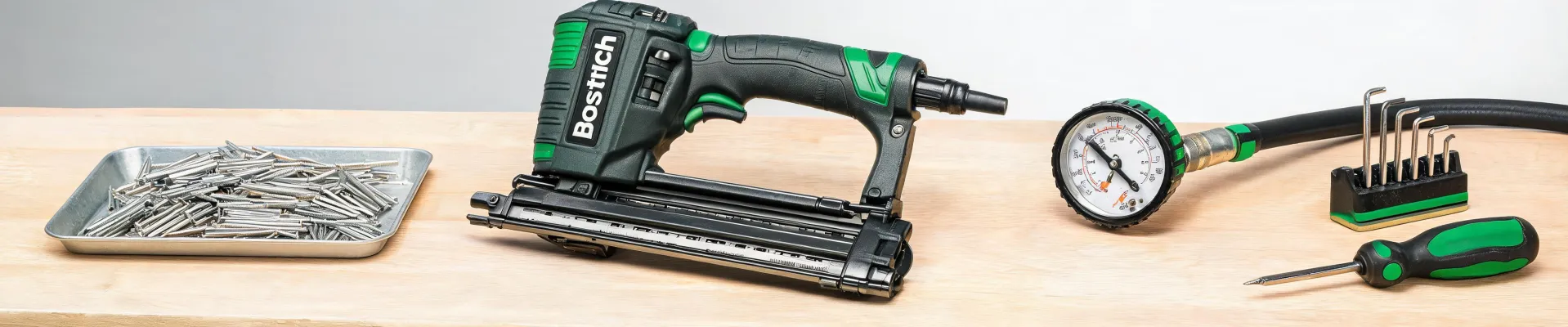
In May 2024, a Bostitch framing nailer went down on a Thursday afternoon. The crew was mid-roof, the compressor was fine, the nails were loaded, and the driver blade had chewed through a bumper. No drama, just a stopped job. Our purchasing lead did what any cost-conscious team would do: found a cheaper replacement kit online, paid $38 with two-day shipping, and told the foreman it would be there Friday morning.
It arrived. It fit. Mostly. Then it failed after about 90 shots. The O-ring was close enough to install and wrong enough to leak. We lost four hours of a six-person crew, plus a rush trip to a local dealer. The kit cost $38. The day cost us roughly $1,900 in labor and schedule movement. That was the moment I stopped treating Bostitch nail gun replacement parts as a price-per-part problem.
The problem everyone sees: parts cost too much and take too long
If you run a tools budget, the surface problem is obvious. Original replacement parts can run $18 to $60 per kit. Some assemblies are higher. Lead times can stretch if the model is older or the part is not stocked locally. Aftermarket kits are often cheaper and easier to find. The spreadsheet says buy the cheaper kit, keep the crew moving, and move on.
My gut said no. That sounds soft for a procurement role, but I had been burned before. The numbers said go with the $38 aftermarket kit. My gut said stick with the authorized channel and pay $52. I went with the cheaper kit because the math was clear. Later, I learned the cheap O-ring material had a lower temperature range than the original spec. It looked like a bargain until the tool got hot. That is the kind of thing that does not show up in a unit-price comparison.
To be fair, not every aftermarket part is junk. Some independent suppliers make good components, and I am not going to pretend the authorized channel is always perfect. But the burden of proof is on the buyer. If you cannot verify material, durometer, dimensions, and heat tolerance, you are not buying a part. You are buying a probability.
What is really going on: tools are systems, not SKUs
The deeper issue is that a Bostitch tool is not a single product. It is a model, a generation, a serial number, a compressor relationship, and a parts diagram. Search for where are Bostitch tools made, and you will find plenty of forum answers that sound definitive. I am not 100% sure those answers are wrong, but they are incomplete. Bostitch is part of Stanley Black & Decker. Manufacturing can vary by product family, generation, and production run. The country of origin that matters legally is on the tool label, the carton, or the manual. For procurement, the practical question is not “Which country makes all Bostitch tools?” It is “Can I get the exact Bostitch nail gun replacement parts for this exact serial number?”
That distinction matters because model drift is real. A bumper, trigger, driver blade, or O-ring can change between generations even when the tool looks almost identical. I have seen two nailers with the same family name and different internal seals. If your PO only says Bostitch nailer, you are asking for a coin flip. If your PO says model, type, and serial, you are asking for a part.
Air tool performance adds another layer. A pneumatic nailer is rated for a certain CFM at a given PSI. If the compressor cannot sustain that air tool demand, the tool still fires, but it may short-stroke, double-fire, or wear the driver faster. The compressor tank size gets all the attention. The CFM at 90 PSI is what keeps the tool healthy. We had a small compressor on a finish crew that looked fine on paper. It cycled constantly. The nailer ran hot. Guess where the extra parts cost came from.
Then there is the category boundary. If your search for a .3 hp sump pump landed you on a fastening-tool page, that is a mismatch. A .3 hp sump pump is a water-removal device. It is sized by head height, basin depth, switch type, and discharge flow, not by nail gauge or magazine angle. Bostitch is a fastening and air tool brand. I would not ask a nailer specialist to size a sump pump, and I would not ask a pump supplier to rebuild a pneumatic nailer. A vendor who says “that is not our strength” earns my trust for the work they do claim.
Small tools matter too. What is a hex key set? It is a set of L-shaped or T-handle wrenches made for hex-socket fasteners. Metric and SAE sizes are not interchangeable. A 5 mm key is not a 3/16 in key, even if they feel close. We keep a decent hex key set in every crew truck because half the “broken tool” calls I used to get were actually loose fasteners or a missing adjustment. A $25 set will not fix a worn driver, but it prevents a lot of unnecessary downtime.
The cost you do not see until payroll gets involved
When I audited our 2023 tool spending, the visible line items were not the problem. The overruns came from downtime, rush shipping, rework, and repeat repairs. I started tracking 214 tool orders over three years. The pattern was ugly. A part that saves 20% on the invoice can cost 10 times that in lost labor if it fails at the wrong time.
Here is a simple example from our Q2 2024 records. Aftermarket kit: $38. Authorized kit: $52. The aftermarket kit failed on day two. Labor to stop and restart: $1,240. Rework on two mis-driven fasteners: $260. Rush replacement and delivery: $95. Total aftermarket cost: $1,633. Total authorized cost, assuming it worked as specified: $52. Even if the authorized part had failed, I would have had a warranty path and a known spec. That is not a guarantee. It is a better risk profile.
Compressed air safety is another hidden cost. OSHA 29 CFR 1910.242(b) limits compressed air used for cleaning to less than 30 psi unless it is reduced to that level and properly guarded. That is not a parts issue until someone uses an air tool to clean a bench and sends debris into an eye. Then it becomes a workers’ comp and downtime issue. The tool, the compressor, the regulator, and the training are one system.
The most frustrating part of this whole category is not the price of parts. It is the repeat. After the third late delivery from the same low-cost supplier, I was ready to drop them entirely. What finally helped was not a better speech to the vendor. It was changing our process. We stopped ordering by brand name alone. We started attaching a photo of the tool label and the parts diagram to every PO. Boring, but effective.
What we changed (short, because the problem is already clear)
Even after we switched to authorized parts for critical tools, I kept second-guessing. What if we were paying more for the same part? The four weeks until our first rebuild came back clean were stressful. But the data settled it. Our repeat repair rate fell, and our crews stopped treating every nailer failure as a crisis.
- Asset register: model, serial number, purchase year, and parts diagram link for every Bostitch nailer and compressor.
- Authorized parts for uptime-critical tools: use Bostitch nail gun replacement parts from authorized channels when a failure stops a crew. If we experiment with aftermarket, it goes on a non-critical tool first.
- Critical spares on the shelf: O-rings, bumpers, driver blades, triggers, and the two most common seal kits. Carrying $180 in inventory is cheaper than one rush delivery.
- Compressor matching: check CFM at 90 PSI for each air tool, not just tank gallons. If the compressor cannot keep up, fix that before blaming the nailer.
- Quality hex key sets: metric and SAE, marked sizes, kept with the tool. What is a hex key set worth? It is worth fewer stripped screws and fewer “the tool is broken” calls.
- Category boundaries: for a .3 hp sump pump, go to a pump specialist. For fastening and air tools, stay with a supplier that knows the system.
Bottom line
Where are Bostitch tools made? Check the label, carton, or manual. The brand does not fit into one tidy answer, and product origin can change by model and run. The better question is whether you can identify your exact tool and get the right Bostitch nail gun replacement parts before the job stops. The cheaper air tool part is not cheaper if it takes down a crew. The .3 hp sump pump is a different problem for a different specialist. And a hex key set is a small purchase that keeps small problems from becoming expensive ones.
Granted, this approach takes more upfront work. But after eight years of managing this budget, I would rather spend ten minutes on a serial number than four hours on a roof with a crew standing around.

Leave a Reply