-
The Two Setups I Actually Compare
-
Dimension 1: Speed and Finish — Nail Gun Wins, But Less Than You Think
-
Dimension 2: Entry Cost and Upkeep — Where People Get Surprised
-
Dimension 3: Portability and Simplicity — Hand Tools Quietly Win
-
Dimension 4: The Surprising One — Nail Guns Don't Automatically Finish Better
-
Dimension 5: Where the Price Tag Actually Lies
-
Which Setup Fits Your Job
-
What I Can't Tell You
-
Bottom Line
The Two Setups I Actually Compare
I review tool specs and deliveries for a facilities maintenance company — roughly 400–600 line items a year, everything from finish nailers to the $12 accessories nobody thinks about until they fail. So when someone asks "can you install baseboards without a nail gun," I don't answer from theory. I answer from the pile of returns on my desk.
Here's the comparison I keep coming back to:
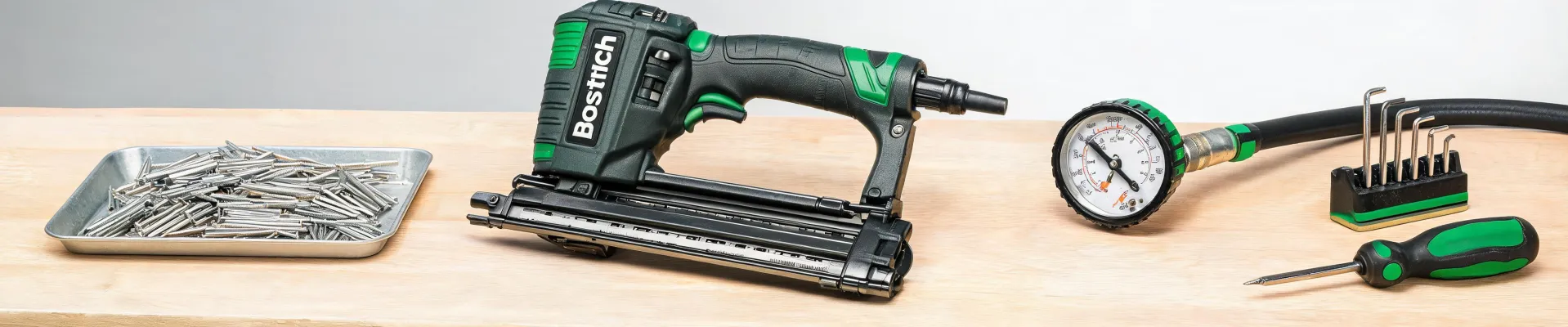
- Setup A (pneumatic): a Bostitch 6 gallon air compressor paired with a 16-gauge finish nailer, hose, fittings, and fasteners.
- Setup B (hand tools): a hammer, nail set, miter box, coping saw, and a long nose pliers 200mm for pulling stubborn brads.
I'm judging both on four things: speed, entry cost, long-term upkeep, and finished quality. Not on brand loyalty — I don't care which sticker is on the housing as long as the specs hold.
Dimension 1: Speed and Finish — Nail Gun Wins, But Less Than You Think
Pneumatic wins on raw speed. A properly set finish nailer on a 6-gallon tank will drive 30–40 brads a minute of actual fastening. The bottleneck isn't the gun — it's you walking the wall. Hand-nailing runs closer to 4–6 nails a minute, and you'll dent trim if your nail set slips.
But here's where conventional wisdom breaks down. Everything I'd read said the pneumatic setup is "10x faster." In practice, I timed it on a 40-linear-foot room. Setting up the compressor, draining it, uncoiling and recoiling the hose, checking pressure — that's about 11 minutes of non-work. Hand-nailing the same run took 22 minutes total. So the real delta was closer to 8–10 net minutes, not the dramatic gap people describe.
On a single small room, the setup overhead basically eats the speed advantage. On three rooms or a whole floor, it doesn't.
Dimension 2: Entry Cost and Upkeep — Where People Get Surprised
Full pneumatic system — compressor, finish nailer, hose, quick-connects, fasteners — lands around $250–$400 as of Q1 2026, depending on the kit. That's the sticker price. What most buyers miss is what comes after.
Bostitch air compressor parts availability matters more than most people realize. Drain valves, pressure switches, safety relief valves — those are the pieces that fail first, usually around year three. If you can't source a replacement, you're buying a whole new unit for one $18 part. Before you buy any compressor, check that the manufacturer actually stocks those components. Not all of them do.
Hand tools are the opposite story. Most households already own the basics. If you're adding a long nose pliers 200mm for pulling bent nails, that's under $20. No oil changes, no tank draining, no winterization.
One thing folks forget on the pneumatic side: consumables. A 2,000-count box of 16-gauge brads runs $15–$25. For one room, who cares. Across a full house of trim, casing, and baseboard, you're looking at a few boxes. Add that to the math.
Dimension 3: Portability and Simplicity — Hand Tools Quietly Win
No hose to trip over. No compressor cycling at 7 a.m. annoying the neighbor. No mystery leak at a coupling that turns out to be a 30-second fix you spent 20 minutes diagnosing. Hand tools don't have a break-in period and don't care what the outside temperature is.
This is a pattern I keep noticing across categories. Last spring I bought a 3 piece garden tool set for a landscaping project — different job entirely, but the same lesson. Simple tools that don't need power, calibration, or setup get used more, because there's no friction to overcome. The best tool for a small job is usually the one you don't have to prepare.
Dimension 4: The Surprising One — Nail Guns Don't Automatically Finish Better
This is the conclusion that surprised me. Conventional wisdom says pneumatic = cleaner, more professional finish. My QA experience says otherwise, at least for a non-professional user.
A pneumatic nailer at the wrong pressure setting will overdrive the brad and leave a crescent-shaped dent in the trim. I've rejected more nail-gun-finished baseboard in quality reviews than hand-nailed baseboard — because with a hammer and nail set, the user is controlling every single depth. Slow, yes. But consistent.
To be fair, a pro with the pressure dialed in and the right gun angle will beat both approaches. The point isn't that hand tools are better overall — it's that the assumption "nail gun = automatically better finish" isn't true for a casual user, and it's the reason a lot of first-time DIY trim work ends up looking worse than the homeowner expected.
Dimension 5: Where the Price Tag Actually Lies
Here's a stance I'll take. The cheapest compressor kit you find online is almost never the real price. Add in:
- Air hose (if not included): $20–$40
- Fittings and quick-connects: $15–$30
- Fasteners: $15–$25 per box
- Compressor oil, if it's an oiled unit: $10–$20
- Replacement parts down the road: variable, but budget something
I've learned to ask "what's not included" before I ask "what's the price." A vendor who lists every fee upfront — even when the total looks higher — is usually the cheaper option once the dust settles. The "low" quote that silently excludes the hose isn't a deal; it's a deposit on the next invoice.
Which Setup Fits Your Job
Go pneumatic if: you're doing trim in three or more rooms, or you already own an air compressor for other work (brad nailing, stapling, tire inflation), or you actively value the time savings over the setup overhead.
Go hand tools if: it's one room, one time. Or if controlling the finish depth matters more to you than speed. Or if you don't want another piece of equipment that needs annual maintenance.
What I Can't Tell You
I'm not a carpenter. I can't speak to which nail angle fits your specific trim profile, or how to cope an inside corner for a particular material — that's the trades' territory, and I'd recommend talking to whoever is actually running the job. What I can tell you, from a compliance and spec-review perspective, is how to evaluate whether the setup you're buying will hold up against the work you're planning.
Bottom Line
Can you install baseboards without a nail gun? Absolutely — millions of houses were built that way, and plenty of them still look fine. But the advice that you need a nail gun isn't wrong either. It's just overgeneralized. Match the tool to the scope, budget the hidden costs, and don't assume one option wins on every dimension. It doesn't.

Leave a Reply