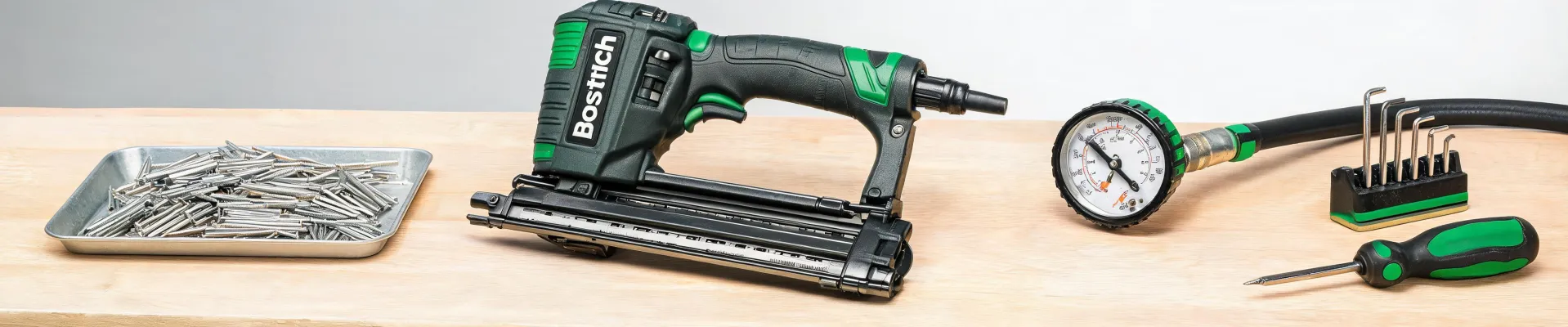
I’m the quality and compliance manager for a commercial construction company. I review every job before a client gets the keys—roughly 180 handovers a year. In 2025, I turned back 9% of first-time finishes because of fastener problems: nails standing proud, the wrong drywall screw length, or a fastener that wasn’t on the approved spec. It is tempting to blame the crew. More often, the setup made the wrong choice easy.
So when I am asked whether a crew should build around a Bostitch system or keep adding tools as jobs appear, I compare them on three dimensions: consistency of the finished fastener, repair cost after the warranty ends, and whether storage makes the correct fastener the easy one to grab.
Here are the two setups I see in the field:
- Setup A — Bostitch-standardized. A Bostitch air compressor 26-gallon model supplies air; pneumatic tools share one compatible platform; repairs use genuine Bostitch replacement parts; fasteners are sorted and labeled; a 72-inch tool box is the home base.
- Setup B — mix-and-match. Compressors and nailers accumulated over years; replacement parts chosen mainly by price; fasteners bought by habit; storage is whatever space is left in the truck.
Please do not read this as a brand-loyalty argument. I have passed mixed-brand crews and failed single-brand crews. The system matters more than the badge, which is why I compare along these three dimensions rather than stickers.
Dimension 1: Fastener Consistency
The final fastener is the one product that literally reaches the client. If it is over-driven, under-driven, the wrong length, or the wrong coating, everything else about the job gets discounted. That is where the air source shows up first.
A Bostitch air compressor 26-gallon tank is there to provide reserve capacity. When two guns run at once, a larger tank reduces pressure swings, and fewer pressure swings means more consistent fastener depth. If the air pressure drifts, every fastener after the drift drifts with it. I check the regulator before I judge the nails.
Framing Screws vs. Pneumatic Nails
On the framing side, I am often asked whether screws are better than nails. The correct answer is: it depends on the connection.
Framing screws have real advantages. They pull members tight, resist withdrawal, can be removed without destroying the wood, and the coated versions are often the right call for treated lumber. But production framing is usually faster and more consistent with a pneumatic nailer, because driving force is set by the tool and the regulator rather than by the operator’s arm. A crew that understands both chooses by spec. A crew with one random box of screws chooses by guess.
Right fastener, right place, right depth. That is the whole job of a fastening system.
How Do I Choose the Right Size Drywall Screw?
This is one of the most common questions I hear on punch walks. The answer starts with the thickness of the drywall and the type of framing. Use #6 drywall screws that meet ASTM C1002 unless the panel manufacturer directs something different. Here is the starting table I use:
| Board thickness | Framing type | Starter screw size |
|---|---|---|
| 1/2-in drywall | Wood studs | 1-1/4-in Type W (coarse thread) |
| 5/8-in drywall | Wood studs | 1-5/8-in Type W (coarse thread) |
| 1/2-in drywall | Steel studs | 1-in Type S (fine thread) |
| 5/8-in drywall | Steel studs | 1-1/4-in Type S (fine thread) |
That table is a starting point, not a substitute for the panel manufacturer’s published installation guide. Local conditions, double layers, and fastener schedules can all change the length. But for a system comparison, the important part is simpler: one crew can keep this schedule inside the tool box and hand it to a new hire; the other crew is working from memory on top of a ladder. That difference shows up in my punch list.
Dimension 2: When It Needs Parts
Every air compressor eventually needs a part, no matter who makes it. The real test is not the first week; it is the week a regulator starts acting up and someone is searching for parts for Bostitch air compressor online. That is when the repair path becomes visible.
Parts for Bostitch Air Compressor: OEM vs. Generic Replacement Parts
I have no problem with independent repair shops. I use them, and a good shop will ask whether you want the OEM part or a generic equivalent. The rule at our company is functional rather than brand loyalty. Generic parts are acceptable for wheels, drain valves, and intake filters. Regulators, safety valves, and anything that controls pressure or fastener depth get genuine Bostitch parts.
Last year, a crew saved $23 on a generic regulator for a Bostitch compressor. At idle, the gauge looked normal. Under load, the pressure crept upward while the framing nailers were running, and the nails sank deeper through the morning. The callback and rework cost more than a whole case of regulators. The next Monday, we installed a genuine Bostitch regulator and added a written rule: no pressure-control part goes in without a Bostitch part number.
I call this paying for certainty. A genuine part has a spec I can verify; a generic part often has a promise. If a compressor fails on Wednesday and the final inspection is Friday, the verifiable part is not the expensive choice. Time is the budget item nobody writes down, but every schedule spends it.
Dimension 3: Storage and the 72-Inch Tool Box
When I implemented our tool-storage protocol in 2022, I thought we were solving the lost-tool problem. The bigger effect was quality: crews reached for the correct fasteners more often because the fasteners were visible, sorted, and labeled.
A 72-inch tool box is not the only way to do that, but it gives enough drawer space to separate fastener types instead of piling them into a tote. In our shop, it is where the Bostitch compressor accessories, spare parts, screw boxes, and one-page fastener schedule all live. On the equipment sheet, it is literally listed as tool box 72, and not as a luxury line item.
The surprise from our audits was that the big tool box did not make crews faster. It made them more consistent. If the correct screw is ten seconds away, a crew will use it. If it requires a trip to the hardware store, someone will improvise. Last-minute improvisation with fasteners is how callbacks are born.
In practical terms, a Bostitch 26-gallon compressor is about stable air, and a 72-inch tool box is about stable access to the right fasteners. Both are consistency tools.
Which Setup Should You Build?
At this point I will not give you a one-line answer, because a one-line answer ignores how you work.
- Standardize with Setup A when two or more people drive fasteners most weeks, your revenue depends on hitting dates, or rework threatens the schedule more than the material cost. This is also the right path if you are tired of inspecting the same fastener mistake over and over.
- Keep a leaner Setup B when you are a solo operator, the jobs are short maintenance and one-off projects, or you already own tools you trust and you are not trying to unify equipment. You can still borrow the parts of the system that matter.
If you fall in the middle, try the minimal version of Setup A regardless of brand: choose a compressor large enough for your busiest simultaneous tool load, write down your drywall screw sizes and approved framing screws/nails, use genuine parts for pressure-control repairs, and add a 72-inch tool box when you see fastener bins starting to mix. You get the quality logic without replacing every tool you own.
One boundary: this is what I have seen in my market through early 2026. Bostitch models, part numbers, and prices change, so verify current specs and availability with an authorized dealer before you buy. The principle will not change: consistency, repairability, and organization beat a badge. And consistency is what I inspect.

Leave a Reply