-
1. Drain the compressor tank before you do anything else
-
2. Check for air leaks once a month
-
3. Oil the pneumatic nailers, including the Bostitch hanger nail gun
-
4. Clean the manual Bostitch H30-8 hammer tacker
-
5. Change the jig saw blade before you make the cut that matters
-
6. How do you maintain a sump pump? Test it on a dry day
-
7. Store the spare parts you actually need
-
Three mistakes I still watch for
-
If this list feels too simple
This checklist is for people like me, who thought they knew which tools needed maintenance and still got burned. I'm not a Bostitch rep, and I'm not getting paid to write this. I've run a small framing and repair crew in the Midwest since 2017, which also makes me the guy who oils the nail guns and drains the compressor tank. This is the monthly checklist I use in my own shop. It's not an official Bostitch service guide. It's the list I wish someone had handed me before I made a few expensive mistakes.
The list has seven parts. If you run one tool or twenty, most of these checks take less than ten minutes. If you run a bigger shop, you'll need to add more. If you don't have a sump pump, skip that part and enjoy your dry floor. But if your tools live anywhere near water, don't skip it.
1. Drain the compressor tank before you do anything else
A lot of my maintenance problems started with water in the air lines. Compressed air holds moisture, and that moisture collects in the bottom of the tank if the drain valve is never opened. I unplug the compressor, open the drain valve at the bottom, and leave it open until no more water comes out. What comes out first is often not air.
After the tank is empty, let the compressor sit on level ground for a few minutes, then check the pump oil if your compressor has a pump that takes oil. The oil level should be at the fill mark. If it's low, add the exact oil type listed on the compressor or in the manual. Not the closest bottle, not the leftover bottle from your snowblower, and not the oil that worked for your buddy's compressor.
Different equipment takes different fluids. An air compressor pump isn't a hydraulic pump. If a piece of equipment calls for hydraulic pump oil, that's what it should get. In 2021, I used the wrong oil in a pump because two bottles looked similar. The pump failed about two weeks later, and the repair bill was over $300.
2. Check for air leaks once a month
Once the tank is full and the compressor shuts off, I turn the compressor off and watch the gauge for two or three minutes. If the pressure drops more than a few psi, there's a leak. A spray bottle with soapy water will find it fast. Fixing a small leak is usually a few minutes with a wrench. Ignoring it means the compressor cycles more often and every tool on the line gets worse air.
3. Oil the pneumatic nailers, including the Bostitch hanger nail gun
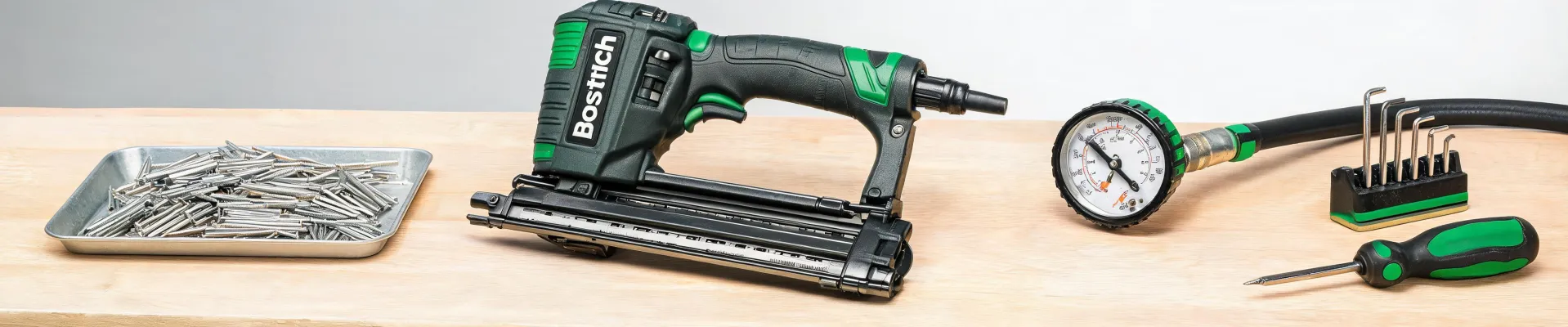
The Bostitch hanger nail gun in my trailer doesn't get used every day, and that's exactly why it's on this list. Tools that sit for a while can dry out. I put two drops of pneumatic tool oil into the air fitting before I use it, fire it a few times into scrap, and wipe the exhaust port. I do the same for every pneumatic nailer on the trailer.
Too much oil causes as many problems as none. If oil is misting out of the exhaust port, I've overdone it.
4. Clean the manual Bostitch H30-8 hammer tacker
The Bostitch H30-8 hammer tacker is easy to ignore because it doesn't have a motor. No battery, no cord, no air fitting. You just swing it. But it still jams, and it still needs a monthly wipe-down.
I clean the staple channel and the strike plate with a dry cloth. If I've been tacking house wrap or roofing felt, there's usually sticky residue on the channel. A dirty channel causes jams, and a jammed hammer tacker is annoying in a completely different way than a jammed nail gun.
Don't oil the staple channel. Oil collects dust and makes the problem worse. This is one of those maintenance checks that sounds too simple to matter until it saves you from buying a replacement.
5. Change the jig saw blade before you make the cut that matters
I used to run a jig saw blade until it left burn marks and wandered off the line, then I blamed the saw. The blade was the problem.
Now I make one test cut in scrap before a visible cut. If the saw pulls sideways, the cut burns, or the blade seems slow, I put in a new jig saw blade. A new blade costs a few dollars. The material and time that a bad blade wastes cost a lot more.
6. How do you maintain a sump pump? Test it on a dry day
You might not expect a sump pump in a Bostitch tool checklist, but I keep my compressor and tool cases in a basement shop. A sump pump failure doesn't just make the floor wet. It can rust a compressor tank, soak boxes of fasteners, and ruin tools that were working perfectly an hour earlier.
My May 2022 basement flood convinced me. The pump didn't turn on because the float was jammed. Here's the monthly test I run:
- Pour a few buckets of clean water into the pit until the float lifts.
- Watch for the pump to turn on by itself.
- Let it run until the pit is mostly empty.
- If it runs but doesn't pump out, inspect the inlet screen and the discharge pipe.
- If the pump has a battery backup, test that battery too.
Ten minutes every month feels ridiculous when the weather is dry. It feels a lot better than cleaning muddy water out of a tool trailer.
7. Store the spare parts you actually need
The last part of my monthly routine is checking my small parts bin. I keep O-rings, bumpers, trigger valves, couplers, and a few blade types where I can find them fast. I write part numbers on the outside of the bin.
This is also where I learned to ask what's not included before I order. Transparent pricing matters. I want the real total, whether that means part price, repair kit contents, or shipping cost. A quote that looks low before hidden fees is not helpful when a tool is down and I need the part now.
Three mistakes I still watch for
- Using one oil bottle for everything. If your shop needs all three, keep hydraulic pump oil, compressor oil, and pneumatic tool oil separate.
- Skipping the sump pump test because there's no storm in the forecast. That's exactly when a pump seizes up.
- Waiting until the jig saw blade is obviously bad before changing it. Test it in scrap first.
If this list feels too simple
My experience comes from running one small crew, mainly residential framing and repair work. I can't speak to industrial maintenance schedules or a crew that runs dozens of tools all day. If you work in a bigger operation, your intervals and spare parts will be different.
Bottom line: drain the compressor, use the right oil, oil the pneumatic tools, clean the hammer tacker, check the blade, test the sump pump, and keep spare parts ready. Do these seven things and you'll catch most problems before they turn into emergency calls.

Leave a Reply