-
Three Types of Buyers, Three Different Answers
- Starting From Scratch: The Kit Makes More Sense Than Buying Separately
-
Already Have a Compressor or Tools: Subtract First, Then Decide
-
Heavy Daily Use: Tools Will Fail—Make Sure They Can Be Repaired
-
Four Questions to Determine Which Group You're In
-
Final Thoughts
If you're searching for the Bostitch BTFP3KIT, you've probably noticed the problem already: reviews of this 3-tool air compressor combo kit are either a one-line "great for the price" or a frustrated "it broke after three months." Very few people actually help you figure out whether this kit is right for you.
Let me be clear about where I'm coming from. I don't sell tools and I don't repair them for a living. My job is quality inspection—I sample-check tools before they're cleared for sale through retail and distribution channels. Nailers, staplers, compressors, hoses, fittings—all of it passes across my bench. After four years of this, I tend to look at a tool differently than most users: I look for how it's going to fail, not how it looks in the box.
Here's my honest take on the BTFP3KIT: it's a solid entry-level pneumatic kit, but it is not a one-size-fits-all answer. It's a great buy for some people and a waste of money for others. This article covers both sides.
Three Types of Buyers, Three Different Answers
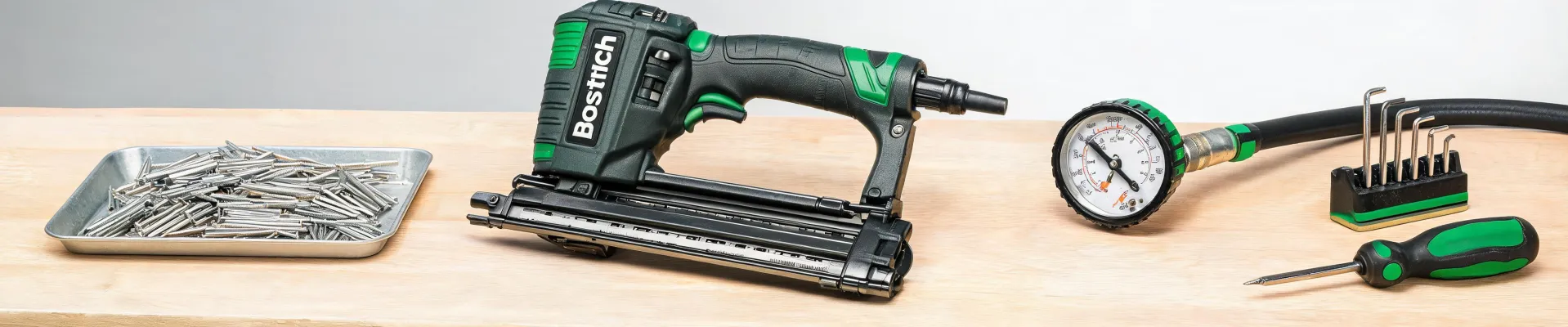
The BTFP3KIT includes a 3-gallon 125 PSI pancake compressor, an 18GA brad nailer, a 16GA finish nailer, an 18GA narrow crown stapler, plus a 25-foot hose and fitting kit. There's nothing inherently wrong with that configuration—the problem is that people buy it for very different reasons.
Based on what I see in return samples and customer feedback (return samples are a quality inspector's best data source), buyers fall into three groups.
Group one: starting from scratch. No compressor, no pneumatic nailer, maybe not even sure what CFM and PSI mean. They want to do baseboards, door casings, shelves, or they just started in the trades and need a kit that works on the job site.
Group two: already have equipment, want to fill gaps. They already own a compressor, or there's a nailer in the drawer at home. The combo kit looks like a deal, and they're wondering whether to pull the trigger.
Group three: professionals who use tools daily. Their workload is measured in hours, not weekends—hundreds of nails a day. They don't care whether the kit is a good entry point; they care whether it will hold up and what happens when it breaks.
Your answer depends entirely on which group you're in. There's no universal recommendation here.
Starting From Scratch: The Kit Makes More Sense Than Buying Separately
If your projects are interior trim, baseboards, door frames, and furniture repair, the BTFP3KIT is a reasonable starting point. Not because it's powerful—it isn't—but because the combination covers a wide range of common tasks without forcing you to buy a heavy-duty machine for one simple job.
What Each Nailer Actually Does
The 18GA brad nailer will be your most-used tool. Baseboards, casing, quarter-round, thin moldings, small jigs—it handles all of it. The pinhole left by an 18-gauge nail is so small that you rarely need filler. If you can only own one nailer, this is the one.
The 16GA finish nailer is a step up in holding power. It's better for door jambs, thicker casing, and trim that needs more bite. The holes are more visible than 18GA, but the connection is noticeably stronger. Together, these two cover about 80% of interior trim work.
The 18GA narrow crown stapler is the one people underestimate. Staples have two legs, which means they resist rotation far better than a single nail. That makes the stapler the right choice for cabinet backs, thin panels, screen frames, and tacking down underlayment or vapor barrier. It's not a nailer substitute—it's a different tool for a specific class of jobs.
One thing I've verified through inspection: the nailers in the kit are structurally identical to the retail versions. At least in the batches I've seen, the cylinders, drivers, and magazines match the individually sold versions. Bostitch didn't build a cheapened "kit edition" to cut costs. That's worth knowing.
The Truth About the 3-Gallon Compressor
A lot of people worry that 3 gallons isn't enough. That worry is half right. A 3-gallon, 125 PSI pancake compressor drives 18GA and 16GA nailers easily—nailers use air intermittently, not in a continuous flow. What it can't do is run spray guns, blowguns, or sanders for sustained periods. Those tools demand constant airflow, and a small pancake compressor will never keep up.
The more practical issues are noise and duty cycle. Small compressors are loud, and after a few hours inside a house, that noise wears on you. They also cycle more frequently than larger tanks. If you're setting a long row of nails, the compressor will kick in often. That's not a defect—it's a physical limit.
Adjust your expectations: this compressor is a portable air source, not a whole-house air system. Set it outside the room, run a longer hose inside, and most of the noise problem disappears.
There's also a hidden cost that nobody mentions: you'll likely need a storage solution. Three nailers, a compressor, a hose, and fittings scattered on the floor is a mess. Budget $100–$200 for a rolling tool chest or at least a heavy-duty tool bag. Don't wait until the tools arrive to think about where they'll live.
A quick quality-inspector tip: when you get any new pneumatic tool, don't immediately load it and start firing. Check the magazine for shipping damage, apply a drop of pneumatic tool oil to the air fitting, then dry-fire it a few times to confirm the action sounds crisp. Most early issues I see come from shipping vibration and packaging, not assembly defects. This routine takes five minutes and eliminates a lot of unnecessary return trips.
Already Have a Compressor or Tools: Subtract First, Then Decide
Group two is where most purchasing mistakes happen. The thought "the kit is cheaper than buying separately" is a powerful psychological trigger.
The simplified advice: if you already own a compressor, don't buy the kit to save money unless you genuinely need a portable backup. Buy the single nailer you're missing instead.
Need a 16GA finish nailer? Buy one. Need a stapler? Buy one. If you buy the kit, you're paying extra for a compressor you don't need—and then you have to find a place to store it.
"But the kit really is cheaper than buying the tools individually." That's true, but only if you count the compressor and hose as value. If you can't use that compressor, its value to you is zero, or negative. This isn't a math problem; it's a needs-matching problem.
There's one legitimate exception: if you frequently move between job sites or work where there's no power (new construction, outdoor maintenance), a small portable compressor as a second station has real value. In that case, the compressor in the BTFP3KIT earns its place—it's compact and fits in a truck box.
And to answer the question people keep asking in forums: are kit tools different from retail versions? In the batches I've inspected, the core components are the same. I can't rule out differences in specific lots or channels, but from a quality-control perspective, Bostitch appears to hold kit tools to the same specification as retail tools. So "kit" doesn't mean "cheapened."
One caveat: kit nailers usually don't come with hard plastic cases. Each tool has minimal packaging. If you're used to putting every tool in its own box on a shelf, the BTFP3KIT will feel bare. If you already have a rolling tool chest, that's actually a benefit—you don't end up with a pile of bulky empty cases.
Heavy Daily Use: Tools Will Fail—Make Sure They Can Be Repaired
Group three has the highest return rate—not because the tools are bad, but because the usage intensity exceeds what this kit was designed for.
Looking at the nailers I've seen come back from heavy users, the failures cluster in the same places: O-rings hardening, valve plates fatiguing, driver blades wearing, and air intakes clogging with dust. These aren't random manufacturing defects. They're normal wear. Every pneumatic tool goes down this road eventually. The difference is how long it takes and how much it costs to fix.
The concept that matters here is serviceability. A good tool isn't one that never breaks—it's one that breaks predictably and can be repaired affordably.
This reminds me of the wear ring in a centrifugal pump. The wear ring is deliberately designed to be the first part that wears out, protecting the more expensive impeller and pump casing. In pump maintenance standards like API 610, there are recommended clearances for when a wear ring should be replaced. You replace the ring when it exceeds the spec—you don't wait until the impeller grinds into the casing. Replacing a wear ring might cost a few hundred dollars; replacing an impeller or casing costs thousands.
The O-rings and seals in your nail gun play the same role. They're consumables, not permanent parts. The problem is that many users don't know replacements exist or where to find them. That's why I always say: before you buy any tool, check replacement parts availability.
Bostitch does a decent job here. Their pneumatic nailers have parts diagrams, each component has a part number, and common replacement parts—O-ring kits, pistons, driver blades, exhaust valves—are available through retail channels. Some budget brands can't do this; when those tools fail, you throw the whole thing away. A $60 nailer that can be revived with an $8 O-ring kit is a different proposition than a $60 nailer that becomes e-waste.
So here's my advice for heavy users: treat the BTFP3KIT as a backup system, not your primary workhorse. If your income depends on daily output, betting your week on a $300 combo kit is risky. A better setup: a heavier-duty primary nailer and compressor, with the BTFP3KIT riding in the truck as a backup. When your main tool goes in for repair, you still have a complete working set. That's where this kit truly shines—it's affordable, portable, and good enough to finish the job.
How do you decide whether to repair or replace? My rule of thumb: run the numbers. If the repair cost is more than half the tool's value and you've already fixed it twice, replace it. But if it's just an O-ring or seal, a few dollars and half an hour of work will bring it back to life. That logic applies beyond nailers—it's the same reasoning you'd use for a centrifugal pump wear ring. Replace the wear ring when it's out of spec, but consider the whole pump if the casing is cracked.
One more practical tip: before buying any kit, check whether the specific model has full replacement parts support on Bostitch's site. If a tool doesn't even have publicly available replacement pistons, it doesn't belong in a professional workflow, no matter how cheap it is. That's the most direct advice I can give as a quality inspector.
Four Questions to Determine Which Group You're In
Let's put all of this into a simple decision framework.
Question one: how many hours per month do you actually use a nailer? Under 10 hours, you're in group one, and the BTFP3KIT is a reasonable investment. 10–30 hours, you're on the edge of group two—buy the specific tool you're missing. Over 30 hours, you're in group three, and your attention should be on primary tool reliability, not combo savings.
Question two: do you currently have an air source? No—group one applies. Yes—group two. If you have one but work across multiple locations, the portable-backup exception applies.
Question three: what type of project are you planning this kit for? Finish work, trim, cabinetry, light furniture—the BTFP3KIT fits. Framing, deck construction, structural work—the nailers and small compressor will both struggle. That's not a quality issue; it's a question of design intent.
Question four: if your tool failed, could you afford to stop working for a day or two? If not, your budget should include spare parts—O-ring kits, a spare driver blade—or a second tool. This has nothing to do with brand loyalty and everything to do with backup logic.
Answer those four honestly, and you'll know exactly which group you're in. From there, the decision practically makes itself.
Final Thoughts
This industry has changed a lot over the past few years. Five years ago, the gap between entry-level and professional pneumatic tools was huge, and the price gap matched it. Today, entry-level tools are built to a much higher standard than they used to be—the Bostitch BTFP3KIT is a product of that shift. But some fundamentals haven't changed: tools are hosts for consumable parts, not immortal iron bars. You're buying a system, not a lifetime guarantee.
If you're starting from zero, the BTFP3KIT is worth buying. If you already have equipment, fill the gaps before you buy a kit. If you depend on tools to make a living, plan for replacement parts and backup options instead of expecting a few hundred dollars' worth of kit to survive eight hours a day of heavy use.
Thinking through your actual needs before spending money matters more than any brand decision. Whether this kit is right for you is determined before you even open the box.

Leave a Reply