I've been a remodeling contractor for 11 years, and I've made my share of expensive mistakes. Actually, let me be precise: I've personally made—and documented—nine significant tool-buying mistakes since 2017, totaling roughly $3,200 in wasted budget. That's the honest number, and it's kinda the reason I now maintain a pre-purchase checklist for my crew. This article is the long version of that checklist.
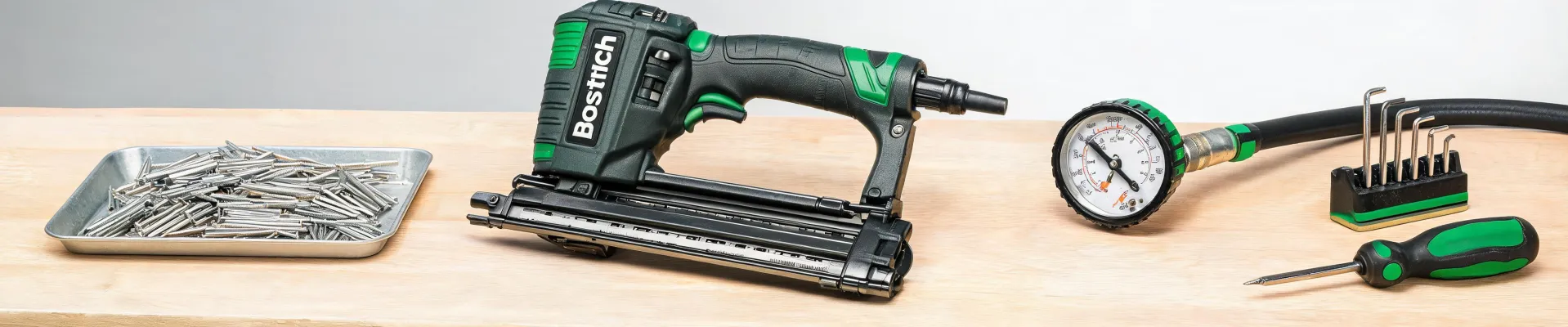
The question that cost me the most sleep: should you buy a complete Bostitch nail gun set or build your arsenal piece by piece? Most working contractors—and plenty of serious DIYers—eventually stand in front of this decision. Do you get the matched kit—compressor, nailers, hose, fittings—all designed as one system? Or do you buy tools as projects demand them, mixing brands and chasing used deals? I've done both, and the receipts are painful.
Here's the framework I'll use to compare them: upfront cost versus total cost of ownership, system compatibility, and the accessories question nobody warns you about. Each dimension gave me a different answer, which is exactly why this decision deserves a closer look.
Dimension 1: Upfront cost vs. total cost of ownership
When I first started contracting, I assumed the cheapest path was obvious: buy what I need when I need it, and scoop up used tools wherever I could. I typed "used chainsaws for sale near me" into my phone more times than I'd like to admit, convinced I was beating the system.
My initial approach was completely wrong. Here's the math that changed my mind.
I priced out a Bostitch nail gun set—compressor, a pair of nailers, hose, and the standard connections—next to the cost of buying each component separately and matching the specs as closely as possible. The set was cheaper. Not "about the same." Actually cheaper by a meaningful margin, with one warranty and one support line instead of four. That's the counterintuitive part: we assume bundles are a marketing trick, but in this case, the package was the better deal.
Then there's the used-tool trap. In the spring of 2021, I bought a used chainsaw that looked great in the listing photos. "Runs like new," the seller claimed. Three weeks later, it needed a carburetor and a new chain. That's $180 in parts and a weekend I'll never get back. I ended up with a tool I didn't trust and eventually replaced. The seller shipped it via USPS Priority Mail with tracking—the only part of that transaction that worked as expected.
Every cost analysis I did pointed to another bargain of the same kind: a used air compressor at roughly a third of the retail price. But my gut said something was off. The seller wouldn't let me test it under load and was vague about its service history. The numbers said buy. My gut said walk. I bought it anyway, and "needs a little work" turned out to mean oil in the airline. Another $90 in parts, and I still wouldn't trust it on a paying job.
What I mean is that the cheapest sticker price is rarely the cheapest total cost. You've got to factor in your own time spent diagnosing problems, the risk of a tool failing mid-job, and the cost of redoing work that a reliable tool would've gotten right the first time. A used tool you can't depend on costs more than a new tool that works every time.
Dimension 2: System compatibility—my September 2022 disaster
The second dimension is compatibility, and this is where I carry the scar tissue. In September 2022, I showed up to a trim package with a Bostitch nailer and a compressor from another brand. The fittings didn't match. The pressure settings fought each other. The hose connectors leaked no matter how much tape I wrapped around them. I spent 45 minutes on hold with two support lines, then another hour at a hardware store buying adapters that only introduced more leaks.
The job started two hours late. The customer noticed, and honestly? They should have.
A Bostitch nail gun set eliminates this specific failure mode, because the compressor, the nailers, and the connections are designed as one system. That's not marketing language; it's engineering. When you're figuring out how to use a Bostitch air compressor properly, the settings assume you're feeding compatible tools. The PSI ranges, the CFM ratings, the quick-connect sizes—they're all matched. Most of the air tool failures I've documented trace back to mixing brands and then blaming the equipment for what was actually a setup problem.
That said, I need to draw a boundary here so you don't take this too far. The matched-system logic doesn't transfer to every category of equipment. Take a close coupled centrifugal pump, for instance—a completely different animal. The motor and impeller are aligned and matched at the factory; you don't assemble a system around it the way you do with air tools. Different category, different rules. The lesson is to understand the tool class before you apply a buying rule. What works for pneumatic nailers won't automatically apply to pumps, chainsaws, or impact wrenches.
The verdict on dimension two: for air tools, a matched system wins. But that's a verdict about air tools, not a universal law of purchasing.
Dimension 3: Accessories—the hidden cost of "I'll get it later"
This is the dimension where I made my most embarrassing mistake, and it's also the one I get asked about the most. Do you need impact sockets for an impact wrench? Yes. Short answer: yes.
I bought my first impact wrench in 2023 and figured I'd pick up sockets as I needed them. A year later, I had a bag of chrome sockets, one rounded-off lug bolt, and a bruised hand. Here's the thing: chrome sockets aren't rated for the torque and shock of an impact wrench. The steel is too hard and too brittle. Impact-rated sockets are heat-treated differently and built with thicker walls, so they absorb the hammering instead of cracking or shattering. I got lucky—the bolt rounded off before the socket exploded.
That incident in Q1 2024—the wasted afternoon, the customer waiting, the embarrassment of explaining why my truck was down—is what pushed me to create my pre-purchase checklist. Every tool gets three questions now: What accessories does this tool actually require? Is that cost included in the bundle I'm considering? And is there an option that's both cheaper and genuinely rated for the job?
That checklist has caught 47 potential mistakes in the past 18 months. Some were minor. A few would've been expensive. When I applied those same questions to a Bostitch nail gun set, the answer was refreshing: the kit included what I actually needed. No surprise trips to the hardware store. No "oh, you also need a regulator and a moisture filter" moment after you've already committed on the job site. That's the real verdict on dimension three: a set is only a deal if the accessories are ones you'd buy anyway. For me, they were.
Per FTC guidelines (ftc.gov), marketing claims have to be truthful and substantiated with evidence. I've started applying the same standard to tools. If a manufacturer won't list the CFM rating, the PSI range, or the warranty terms in writing, I don't buy it. "Contractor grade" is a label. The numbers behind it are what actually matter.
So which one should you buy?
Here's the honest limitation instead of a sales pitch. I recommend the Bostitch nail gun set for working contractors, serious remodelers, and anyone entering the trades. The matched system, the warranty coverage, and the packaging all work in your favor. My mistakes taught me that the hard way, and I'd rather you learn it from my receipts than your own.
But if you already own a reliable compressor with compatible fittings, or if your work is limited to occasional weekend projects, the set might be more than you need. In that case, buy the individual nailer that matches your existing setup. That's not a compromise—it's applying the exact same cost logic in reverse.
One more caveat: this guidance comes from my context, which is residential remodeling with predictable framing and trim work. If your world is industrial—close coupled centrifugal pumps, large stationary compressors, that kind of thing—my perspective probably doesn't transfer. And if you're just starting out, buy the set, document your own mistakes, and build your checklist as you go.
The bottom line? Buying the right tool was never about finding the lowest number on the price tag. It's about knowing what you're actually paying for, what you'll actually use, and what kind of failure you can afford. I paid $3,200 to learn that distinction. Hopefully this helps you skip a few of those lessons.

Leave a Reply