Your tools are visible in your work — even when you think they aren't. That's the hill I'll die on as someone who reviews finished projects for a living. For five years, I've inspected roughly 300 jobs annually for a regional building company, covering everything from structural framing to finish carpentry. In 2025, I rejected about 9% of first-time submissions for rework. The leading defect category, by a wide margin, was fastening inconsistency.
Nobody sets out to produce messy fastening. But it happens when equipment won't behave. And that, more than raw skill, is what separates work that reads as "solid" from work that reads as "slightly off." I don't say this to push anyone toward a specific brand. I say it because I've documented the pattern for years, job after job.
Consistency Is the Detail Nobody Sees But Everyone Detects
Clients can't tell you whether a fastener is seated to the correct depth. But they can tell you whether a wall "feels straight" or a job "looks a little rough." That perception is largely driven by uniformity. When every fastener sits at the same depth, trim lays clean, framing reads square, and the project just looks like it was done by someone who knew what they were doing.
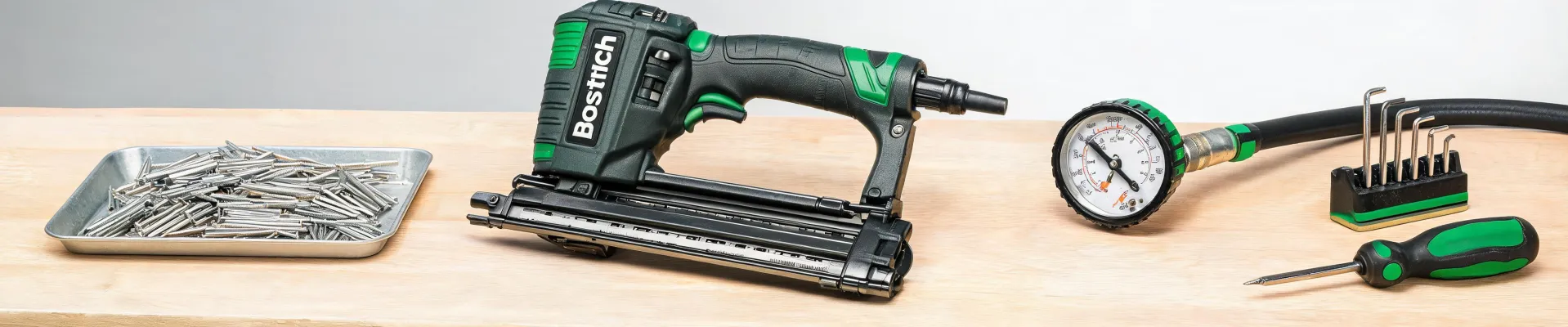
This is where a quality nailer earns its keep. A Bostitch pneumatic framing nailer, run at the right pressure and maintained properly, drives the same fastener to the same depth all day. Internal tolerances are tight enough that the firing sequence doesn't drift. More budget-friendly options can do the same — on a good day, with the right air supply, if everything lines up. The issue isn't whether they can do it once. It's whether they can do it on the 200th trigger pull.
Here's a mistake I made so you can learn it without paying for it. I knew I should verify the compressor pressure on a crew's framing nailer before they started a two-day deck build. But I thought, "What are the odds it's off? It's the same setup as last week." The odds caught up with me. Roughly 14% of the fasteners came out under-driven — I want to say 14%, don't quote me on the exact figure, but it was well into double digits. We had to partially lift and refasten the deck, which cost two days and a noticeable slice of margin.
That crew wasn't running a Bostitch nailer, by the way. But I've seen the same failure with every brand when the tool or the air supply is out of spec. The difference is that professional-grade equipment gives you a predictable window to work within. Cheap tools widen that window until "close enough" becomes the standard.
The Nailer Is Only Half the System
The other half is the compressor. And I'm continually surprised how few crews think about the relationship between the two. A pneumatic tool is only as good as the pressure feeding it. Set the regulator too low, and the nailer short-strokes. Set it too high, and you're overdriving fasteners below the surface.
It's the same principle as a globe valve in a plumbing system. If you've ever looked at a piping setup and asked "how does globe valve work," the short answer is that it throttles flow to control what comes out the other side. A compressor regulator does the same job for your nailer: it's a flow control device that keeps pressure predictable. When you understand that one concept, you stop blaming the tool for a setup problem.
That's why I've specified Bostitch pneumatic framing nailer and compressor packages for more than one crew. Not because I'm loyal to the logo, but because the system approach removes variables. The nailer's pressure needs are designed to match the compressor's output curve. You set the regulator to what the tool label says, and it behaves. That sounds basic, but you'd be surprised how many "tool failures" I've traced to an undersized compressor or a regulator that was never set in the first place.
The Counterintuitive Signal: Hand Tools Tell the Real Story
Here's the part that catches people off guard. When I walk a job site, I'm not only looking at the big-ticket items. I'm looking at the hand tools. A clean pair of electronic pliers with properly adjusted cutting edges tells me someone treats their equipment like a system. A 28 piece wrench set that's still complete — no missing sizes, no rounded-off jaws — tells me the same thing. These are small signals, but they're remarkably consistent.
A tradesperson who maintains a basic 28 piece wrench set is a tradesperson who checks the depth setting on their nailer before a long run. Someone who leaves electronic pliers in a damp toolbox is someone who "usually" gets around to cleaning up. And "usually" is how callbacks happen.
What I'm saying is this: professional perception doesn't start and end with the expensive nail gun. It starts with the small tools you don't think anyone notices. But the work always tells the truth about how you treat them.
The Budget Argument Falls Apart Under Inspection
I hear the same pushback every year: "I can't afford premium tools. I use what I have, and my work is fine." Fine. Usually. But let's be honest about the math.
I remember a job where we had two hours to pick a cordless framing solution. The site had no generator power, the schedule couldn't move, and I had to commit to a platform without my usual side-by-side testing. I ended up choosing a Bostitch cordless framing nail gun based on published specs and one phone call with a supplier I trust. I confirmed the order and immediately wondered if I'd made a mistake. The price was higher than the alternatives. What if the run time was overrated? What if it didn't hold up on day three?
The cordless gun was fine. It didn't do anything magical. It fired fasteners consistently at the right depth for a full day without battery fade. That's it. That's the whole trick — being reliable in a completely unglamorous way. And reliability is exactly what the budget argument underestimates.
Put another way: you aren't paying extra for a brand name. You're paying for predictability — for a tool that does what it's supposed to, with documented specs and replacement parts available when something finally wears out. Any brand can claim durability, of course. Per FTC guidelines (ftc.gov), advertising claims have to be truthful and substantiated with evidence. But the evidence that matters to me is whether a tool still finishes the day strong after three years of real use.
I've rejected work that was produced with premium tools and sloppy technique. I've approved work produced with modest tools and careful hands. A good tool doesn't make a careless worker careful. But it does keep a careful worker consistent, and consistency is what prevents rework, callbacks, and the quiet damage that happens when a client can't articulate why something feels off.
Your Tools Are Your Handshake
Here's the thing I want you to remember: your finished work is the only ad most clients will ever see. The fastener pattern, the trim seating, the small details that say "this was done deliberately" — all of it is a message about who you are and how you do business.
In five years of inspections, I've seen good tradespeople produce bad work because their equipment let them down. I've never seen a bad tradesperson become good because someone handed them a premium tool. But I've watched plenty of solid contractors quietly improve their reputation when they stopped fighting their equipment and started working with a system that behaves.
You don't need the most expensive tool on the market. You need the one that does the same thing every single time. Because the difference between "solid" and "slightly off" isn't a difference in talent. It's a difference in the 200th trigger pull.
That 200th trigger pull is your handshake with the client. Make sure it's saying the right thing.

Leave a Reply