There Isn't One Right Answer. There Are Three.
I'm a procurement manager at a 14-person facilities maintenance company. I've managed our tool and supply budget for six years, which works out to roughly $180,000 in tracked spending. Along the way, I've negotiated with more than 30 vendors, audited every invoice, and built more than one cost-tracking spreadsheet. So when I say the next sentence, I mean it: there's no single 'best' Bostitch tool decision. The right move depends on your situation.
Here's how I think about it. There are three scenarios. Different answer for each.
Scenario 1: You're Building a Tool System From Scratch
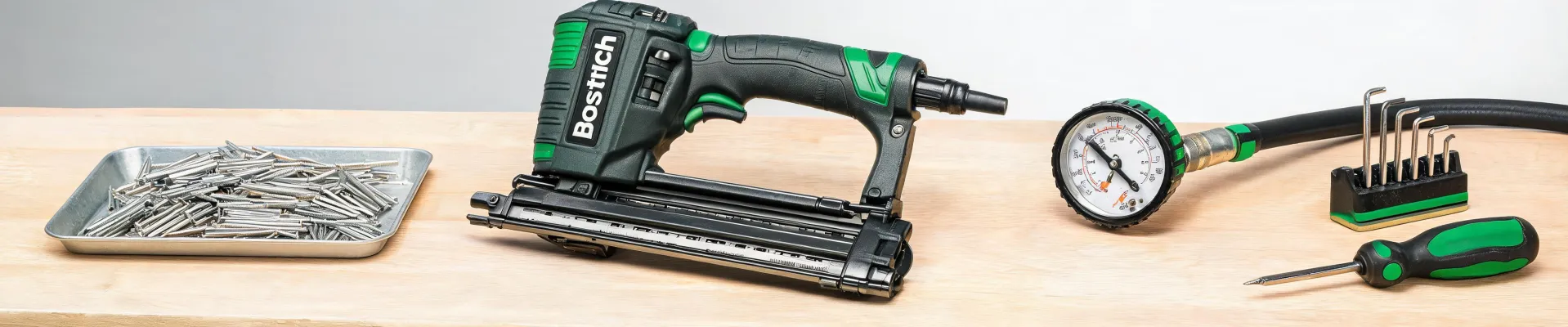
If you're starting a kit, a Bostitch pancake air compressor paired with a Bostitch F28WW nail gun is worth considering. Not because Bostitch is the flashiest brand, but because the system components are designed to work together. When I compared our first combo purchase against the 'buy separate' route, the combo cost about 12 percent more upfront. But it included the correct fittings, a matched hose, and a bag. No surprises at the job site.
Here's the counterintuitive part: you don't need the biggest compressor. A Bostitch pancake air compressor with enough SCFM to run a single framing nailer is enough for most crews. The larger tank feels nice, but it's heavier and louder. We eventually bought a second small pancake compressor for a second crew instead of one huge unit. Same total CFM, twice the flexibility.
If you're a one-person crew, the pancake is the kind of unit you can carry in one hand while holding a tool bag in the other. If your work happens at a fixed bench, a larger vertical compressor might make more sense. The pancake is not a universal answer; it's a system answer.
On the F28WW: it's a framing nailer, not a finish nailer. The F28WW drives 28-degree paper tape collated framing nails (per Bostitch's product page; verify current specs). If your work is all frames, this is the gun. If your work is trim and cabinets, keep looking. Buying a framing nailer because it was on sale is how I ended up with one we didn't use for nine months. Idle tool cost is money sitting on a shelf.
As of early 2026, Bostitch F28WW nail guns were commonly listed between $240 and $300 at major online retailers, with Bostitch pancake air compressor models in the $150 to $250 range depending on tank size and airflow (based on publicly listed prices; verify current rates). The exact numbers will change, but the principle won't: compare total system cost, not just the sticker price.
Scenario 2: You Already Own It. Fix or Replace?
I have mixed feelings about repair vs. replace. On one hand, a new tool gives you a warranty. On the other hand, I've seen a $45 repair extend a tool's life by 18 months. Most people skip the repair because they're afraid of downtime. That's a mistake.
In Q2 2024, our crew had a Bostitch F28WW nail gun that stopped driving nails. A new gun was around $260. A rebuild kit was $45. Our tech replaced the driver and o-rings in about 20 minutes. That gun ran until early 2026. If I had ordered a replacement immediately, I'd have spent $215 more for the same result.
The rule I use: if the repair cost is under half the replacement cost and the tool has no safety issue, repair it. If the repair is over half, replace it unless the tool has a long remaining life. This rule works for nailers, compressors, and even chainsaws.
But not every repair is worth it. A Bostitch pancake air compressor that won't build pressure might just need a $15 check valve. I've fixed those. But if the tank is rusted or leaking, stop. Don't weld it. That's a safety issue. Replace the unit. There's no price tag for a tank failure.
The same logic applies to any repair, even outside the Bostitch lineup. Say you're looking at a 42cc chainsaw fuel line diagram. The diagram is free. The fuel line costs around $7. If the saw has compression and still fires, replace the line. If the piston is scored or the saw sat with bad gas for years, the diagram won't save you. The repair cost becomes the decision.
According to Bostitch's manual (bostitch.com), always disconnect the air supply before clearing a jam on a pneumatic nailer. It's the kind of step people skip, and then they wonder why they spent $80 at the repair shop for a nail they could have removed in 10 seconds.
Scenario 3: You Have One Specific Project
This is where people get into trouble. They turn a one-day project into an excuse to buy a tool system.
Take a mortise pocket door lock. If you're installing one, you need a router, a mortising jig, and chisels. A framing nailer like the F28WW won't help you cut the pocket. It won't help you align the lock. It might help you nail the casing afterward, but that's it. If you don't already own a router, that's what you buy for this project. Not another nail gun.
For the casing around a pocket door, a Bostitch finish nailer is a better fit than the F28WW. But the mortise pocket door lock itself needs router work. Buy the tool that matches the task, not the one that happens to be on special.
And when changing a circular saw blade remember to unplug the saw (or remove the battery) before you touch the blade. Then press the spindle lock and rotate the blade until it clicks into place. Also check that the blade's arbor size matches the saw. I know this sounds basic. But I've replaced two saw arbors because someone skipped the spindle lock and stripped the threads. A $70 repair that started with a 30-second mistake. Don't be that story. 'I'll remember to' is not a safety plan.
Even when a job is small, the right information matters. If you're replacing a fuel line on that 42cc chainsaw, use the manufacturer's diagram. Reversing the supply and return lines can flood the carburetor. The diagram is not a suggestion. It's a map.
How to Tell Which Scenario You're In
The test is simple. Ask yourself: Am I building a system, fixing a tool I rely on, or solving one job?
- Building a system? Buy a matched Bostitch compressor plus nailer combination. Use the money saved on the right size, not the biggest size.
- Fixing a tool? Calculate the total cost of ownership. Include the repair kit, labor, downtime, and remaining life. Twenty minutes of labor often beats $260 for a new nailer.
- Solving one project? Buy the minimum tool that does the job. Rent it if you can. And read the manual.
When I audit our orders, the worst costs are never the most expensive genuine tools. They're the 'budget' replacements that didn't fit, the wrong compressor that couldn't keep up, the skipped safety step that caused a $120 arbor repair. Total cost always tells the truth.
I only believed that lesson after ignoring it once. I approved a low-cost regulator because it matched the thread size. It failed on-site two weeks later, and the wasted labor cost us $180. The $40 savings turned into a $220 problem. That's when I stopped buying on price and started buying on total cost.

Leave a Reply