-
Is the Bostitch F21PL Framing Nail Gun Still Worth Buying?
-
What Staple Size Does the Bostitch Hammer Tacker Use?
-
Click Torque vs. Set Torque Wrench: What's the Difference?
-
What Do Shackle Sizes Actually Mean?
-
What Bits Should You Use With an Impact Driver?
-
Bostitch Repair or Replace: When Does the Math Work?
I've spent six years as a procurement manager for a 40-person general contracting company. That means managing about $160,000 a year in tools and equipment, negotiating with 40+ vendors, and logging every order in our cost tracking system. If I didn't keep records, I'd have no idea what we actually spend on fastening tools — and neither would the owners.
These are the Bostitch questions I get asked most, by our crews and by other buyers. My experience is based on mid-size contracting crews, so if you're a solo carpenter or a huge industrial shop, some of the math will look different for you. Prices were accurate as of early 2025 — verify current rates before you budget.
- Is the Bostitch F21PL framing nail gun still worth buying?
- What staple size does the Bostitch hammer tacker use?
- Click torque vs. set torque wrench: what's the difference?
- What do shackle sizes actually mean?
- What bits should you use with an impact driver?
- Bostitch repair or replace: when does the math work?
Is the Bostitch F21PL Framing Nail Gun Still Worth Buying?
Short answer: yes, for most crews. Longer answer: it depends on what you're framing and how much weight tolerance your crew has.
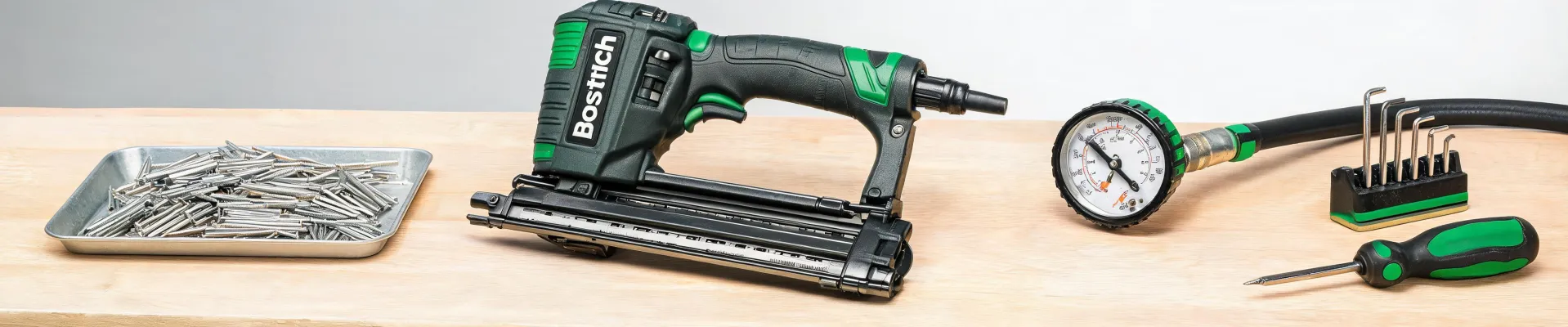
The F21PL is a 21-degree plastic-collated framing nailer that drives full round-head nails from 2" to 3-1/2", which covers just about everything we do on residential and light commercial frames. We bought our first one back in 2019 and added a second in 2021. Both are still running, though one needed a rebuild kit around the four-year mark.
From a cost view, here's why I keep buying it:
- Parts availability. Rebuild kits are easy to find and ship fast. That's a certainty you don't get with a newer, niche model.
- Systems compatibility. Our crew already runs Bostitch compressors, so oil, fittings, and repair procedures are standardized across the trailer.
- Resale value. Used F21PLs hold value better than most nailers in our experience.
Price reference: The F21PL typically lists between $250 and $330 at major online tool retailers as of Q1 2025. Prices fluctuate; verify current listings before you budget.
The main complaint I hear is weight — around 8 pounds, and overhead work gets tiring. For wall and roof framing, the crew still reaches for it because it doesn't bog down on long nails. If you're mostly doing trim, get a finish nailer instead. Trade-offs depend on your crew, but the F21PL has earned its spot in our rotation.
What Staple Size Does the Bostitch Hammer Tacker Use?
The Bostitch hammer tacker (current model is the HTP15, but older ones are all over job sites) uses 1/4-inch crown staples. Bostitch's own staples fit, and Arrow T50-style staples work too — convenient when the nearest store only carries one brand.
Lengths range from 1/4" up to about 1/2" for most hammer tackers, with 1/2" being the most useful for house wrap and roofing felt. I want to say the tool ships with a starter box of 1/2" staples, but don't quote me on that — it's been a few years since I've opened a new one.
Cost tip most people overlook: buy staples by the 5,000-count box, not the small refills. On one of our 2023 orders, the per-staple difference was roughly 40%. It's not a huge line item — maybe $60 a year for our crew — but it's exactly the kind of thing that shows up when you run the numbers.
Click Torque vs. Set Torque Wrench: What's the Difference?
This one confuses everyone, and the search phrase doesn't help. A “click” torque wrench is the type you set to a target value — turn the handle so the scale lines up, lock it in, and it clicks when you reach the value. A “set torque wrench” usually means one that's preset at the factory for a specific application. In practice, most people are really asking: should I buy a click-type torque wrench, or a set of them?
I'd say buy the set. A 3-piece click torque wrench set with 1/4", 3/8", and 1/2" drives covers everything from small fasteners to lug nuts. A decent one runs roughly $80 to $180 as of early 2025. Individual budget torque wrenches are cheaper, but less consistent when you're torquing the same value repeatedly.
One important habit: after using a click torque wrench, turn the dial back to zero before storing it. That keeps the spring relaxed and extends calibration life. And if you're torquing something safety-critical, budget $40 to $60 a year for recalibration. A click wrench that stops clicking at the right number is just an expensive lever.
What Do Shackle Sizes Actually Mean?
Shackle sizes are given by pin diameter, not the overall bow length. A “3/8-inch shackle” means the pin is 3/8" thick. Common sizes run from 1/4" up to 3/4" and beyond, and pin diameter drives the working load limit (WLL) — the number that matters for safety.
Roughly speaking, and this varies by grade and manufacturer, a 3/8" screw-pin shackle is rated around 2,000 pounds WLL, and a 1/2" around 4,000. Verify on the actual product, though. If the WLL isn't stamped on the shackle, don't use it for lifting. That's non-negotiable.
From a budget perspective, the mistake I see is over-buying. A 5/8" shackle costs roughly double a 3/8" one. If your rigging load is 1,500 pounds, a 3/8" shackle with a safety margin is the right call. We stock 3/8" and 1/2" and that covers 95% of our work.
What Bits Should You Use With an Impact Driver?
Impact-rated bits. That's the whole answer, really — or rather, that's the first part. A regular hex bit can survive a few screws, then shear off at the worst possible moment. Impact-rated bits use tougher steel and a collar that absorbs some of the shock, so they last much longer.
For our framing and decking crews, the stock list is short:
- #2 Phillips — universal, for almost everything
- #2 and #3 square (Robertson) — deck screws
- T20 and T25 Torx — structural screws and ledger boards
- 1/4" hex-shank drill bits — for drilling and driving without swapping tools
We tried the 100-piece sets early on; most bits sat untouched for two years. Now each crew gets a 20-piece impact-rated kit. Cost reference: a good kit runs $15 to $35, while single bits at the big-box store cost $6 to $10 each. The kit is better value even when you lose a few.
And don't buy non-impact bits to save $8. I did that once in 2022 during a supply shortage. The failure rate was, well, embarrassing. When you add up the stripped screws and lost crew time, the “cheap” option was the most expensive one that quarter.
Bostitch Repair or Replace: When Does the Math Work?
This is the question I get most from our own guys. A nailer dies on site, the natural instinct is to price a new one. But the total-cost math usually says repair.
Rebuild kits for the F21PL — O-rings, driver blade, bumpers, the parts that wear out — cost around $30 to $60 depending on what's needed. A new F21PL is $250-plus, and a “budget” alternative at $180 adds a new parts line to your inventory. If the tool body is still solid, a rebuild is almost always the lower total cost.
But here's the part that matters more than parts prices: time. In March 2024, we had two nailers down at the start of a framing week. The repair kit and overnight shipping ran about $90. The alternative — waiting days for a new tool, or driving to three stores hoping one has it in stock — would have cost far more in idle crew time. We paid for certainty, and it was worth every dollar.
I'm not against aftermarket parts or independent repair shops; I've seen good work from both. But for tools that are literally holding a roof together, we stick with Bostitch OEM parts. That's a risk decision, not a blanket judgment. Check the model number on your tool before ordering parts — Bostitch refreshes its lineup faster than my budget spreadsheet gets updated.

Leave a Reply